Yea, such comparisons should be done in units like “% of average worker salery”.
Not saying that their argument is wrong and things are way better now, I just don’t like absolute value comparisons over such distances.
While the numbers show that $5000 inflation-adjusted is more achievable now than in the past, I suspect most of that progress was made in the 25 years immediately following then. Also, the numbers are per household, and a lot more households have multiple wage earners now.

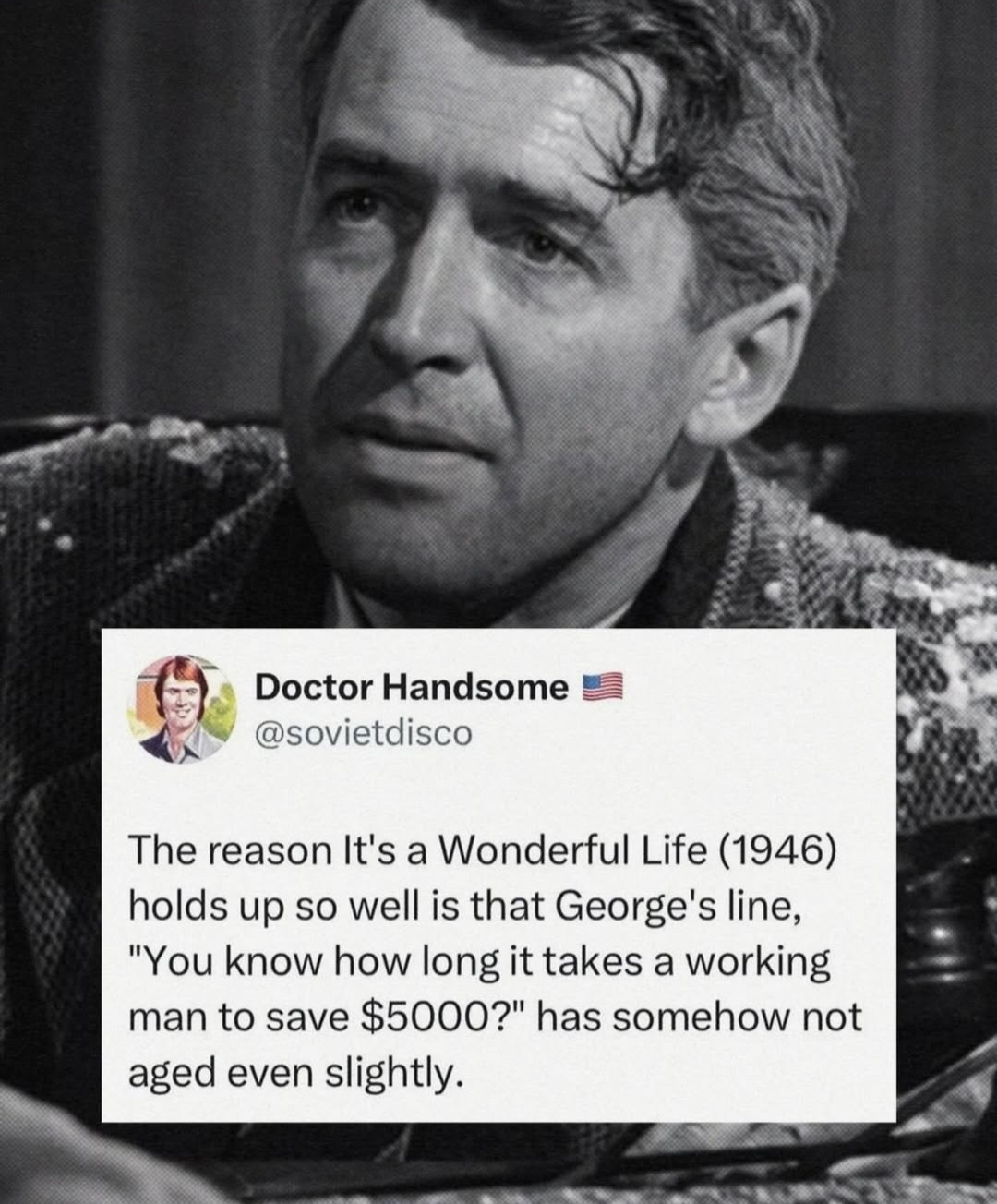
Yea, such comparisons should be done in units like “% of average worker salery”. Not saying that their argument is wrong and things are way better now, I just don’t like absolute value comparisons over such distances.
Median average salary in 1947 was $36,000 [1]A value of $5,000 then would represent 13.8% of that median salary.$86,000 today (the inflation adjusted amount of $5,000) represents 102.7% of the current median salary of $83,730 [2]
Edit: I can’t read, see below for the correct maths
Or put another way:
1.5 months of work vs 1 year of work.
The first link says the median salary was $3000 not $36000. So $5000 would represent 166.7% of that salary.
You are in fact correct, I put my misreading down to too much Christmas spirit.
While the numbers show that $5000 inflation-adjusted is more achievable now than in the past, I suspect most of that progress was made in the 25 years immediately following then. Also, the numbers are per household, and a lot more households have multiple wage earners now.
Where did you get that? That’s not what your link says at all. $36k was the median salary around 20 years ago, not 80 years ago.
You are in fact correct, I put my misreading down to too much Christmas spirit.
Average means nothing, the rich shift the average.
At least use the median or even better the minimum wage as standard.
Thats why I wrote “average worker”, which excludes the rich. But median is also good.