You must log in or register to comment.
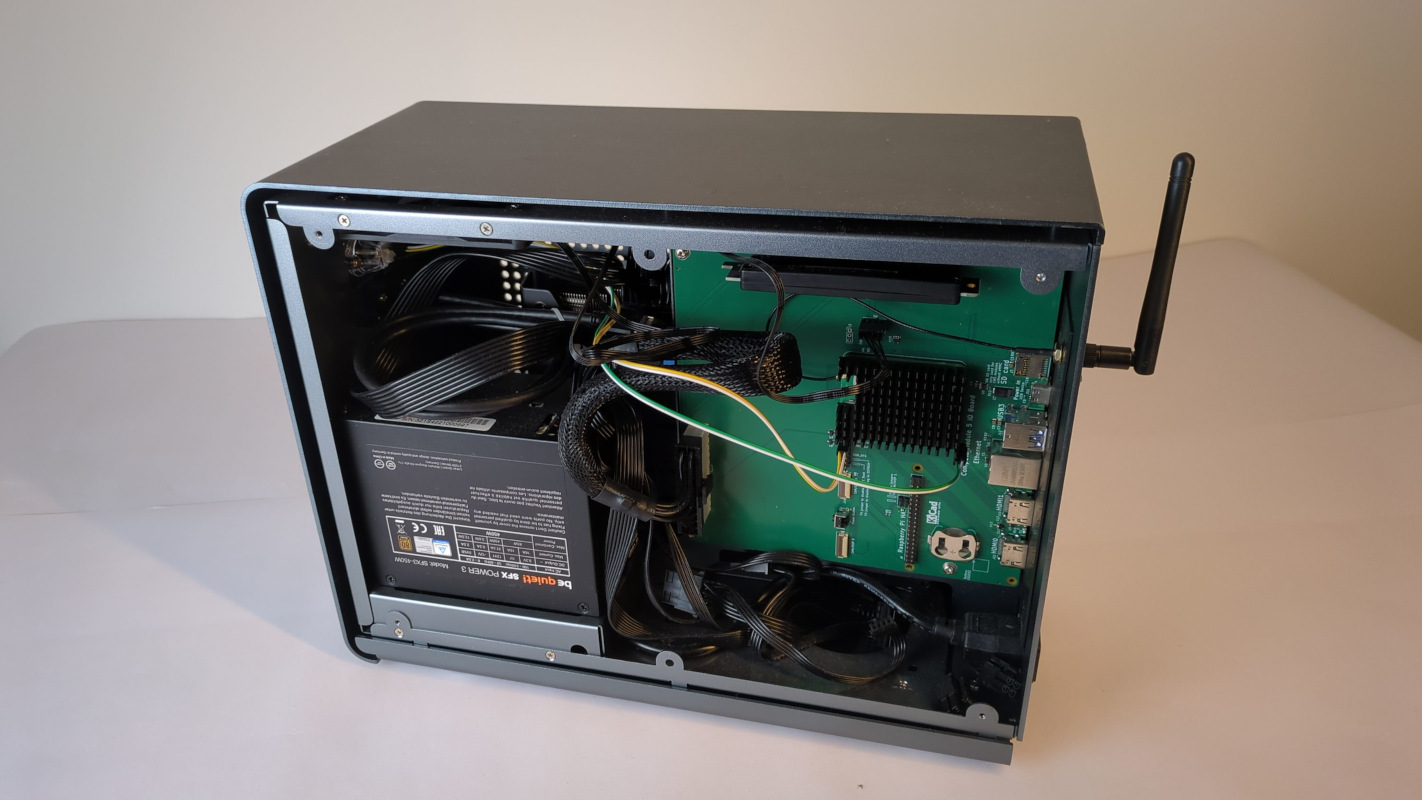
Awful title from Hackaday, makes it sound like the Raspberry Pi itself is growing in size. It’s actually just an oversized accessory you can attach a Pi 5 to. The article body itself doesn’t do a whole lot to make that clear, either, until you click through the links and see better pictures of the product.
Seems like the use-case would be if you wanted to add a GPU to the Pi, which seems to be becoming more popular to use for a NAS, transcoding, and local LLMs.
No
This…seems completely insane. Like buying a pickup truck to drive a motorcycle around because you don’t want to bother getting your M-class license.
That PSU is insane for a board that can run off 5V.
…a microwave?
I thought one of the selling points of Raspberry Pi was its small form factor…?
- This isn’t actually a Pi, it’s an accessory for a Pi 5
- Potentially this enables non-electrically-savvy folks to use external GPUs with the Pi following some build guide
Whether or not it’s worth it remains to be seen, but that’s the main use-case I can see that this board adds that appeals to more than just tinkerers.
But why? Especially looking at the power supply.
I guess you might want to link the psu to a bunch of relays that controlled by the gpio, and use it to deliver medium amounts of power to various peripherals. i guess lots of motors or maybe fairly powerful led lighting arrays, or weak heaters , comes to mind.
So what seemed most daft to me is exposing the 3v and 5v lines on that breadboard like thing, but not using the psu’s +/-12v lines - that could let you run 12 and 24V stuff. plenty of space to allow for a bunch of relays and some connectors.
But even so its a strange form factor for that.
Neat! I hate it
Edit: It has come to my attention that it isn’t actually the people behind the Pi doing this. I really should read more rather than jumping to conclusions. There’s a few obvious rewrites I could make, but I think the prediction at the end is still valid even if the route I took wasn’t the right one.
This would appear to indicate that someone in charge of product design at Pi HQ is a Gen X-er or Boomer desperate to relive computing history through their own products.
Computer on a board. Bigger computer on a board. Computer entirely within a keyboard.
And now a computer in a PC-like case.
Prediction: The next step will be some kind of ARM-based cloud service.
deleted by creator
AIO PCs were and remain a terrible idea…the keyboard PC is a cool novelty reminiscent of the Commodore 64/128 era but kinda stupid nowadays. Would be cool in a C64 shell as a dedicated emulation device tho.
This doesn’t appear to be made by the people from either the Raspberry Pi Foundation or Raspberry Pi Holdings.
You’re better off with a Beaglebone if you want GPIO. The Raspberry Pi doesn’t have any analog pins, for one thing.