

cross-posted from: https://lemmy.sdf.org/post/49968113
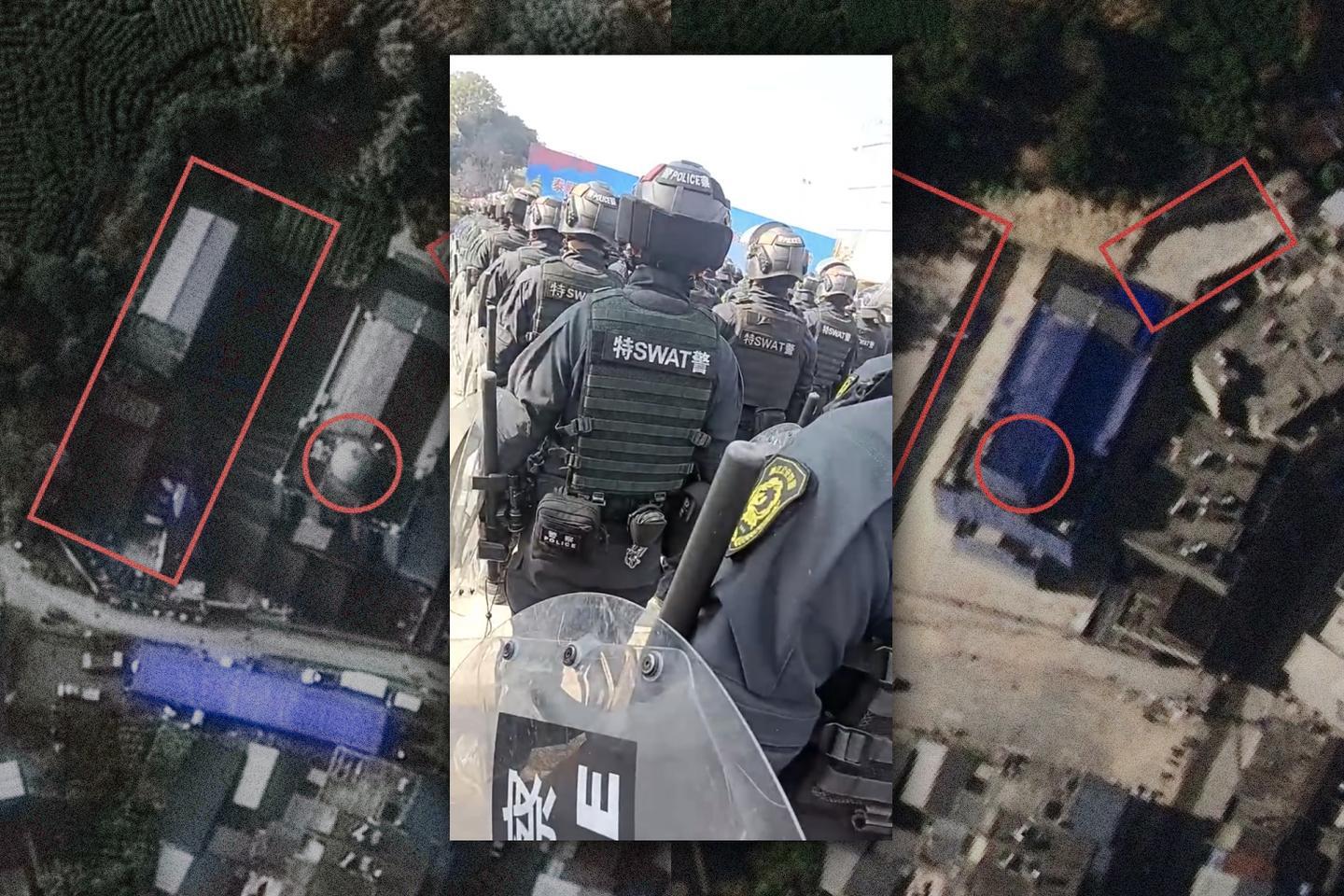
The residents of this rural Chinese town had never witnessed anything like it. Around 10 pm on Sunday, December 14, law enforcement descended by the hundreds on the streets of Yayang. Videos posted on Chinese social media and geolocated by Le Monde showed officers moving into the town, wearing helmets and armed with batons and riot shields.
The day before, dozens of wanted notices had been plastered on the walls of this town of several thousand people. Underneath two portraits of men staring out at passersby, the notices read: “Please report any unlawful acts committed by Lin Enzhao, Lin Enci and their criminal gang (…), accused of provoking quarrels and disturbing public order.” This particularly vague offense has become the Chinese Communist Party’s tool of choice to stifle dissent. According to testimonies collected by Le Monde, the two brothers led services at the Yayang protestant church, which was built nearly 30 years ago.
…
Three weeks after the Yayang operation, police targeted another house church in Chengdu. Six of its leaders were imprisoned and charged with similar offenses as those cited in Yayang. In October, one of China’s main house churches, present in some 40 cities, was targeted. Its founder and 20 other church leaders remain imprisoned.
…
According to a local Christian interviewed by Le Monde, it has become impossible for believers to worship freely in the district: “Services are now monitored by government agents in the churches. Many are preparing to stop gathering there and return entirely to the model of house churches.”
These “house churches” began to develop at the end of the Cultural Revolution (1966-1976), thanks to a period of relative tolerance by the government. Initially limited to the private sphere, they gradually grew into public places of worship, and today are believed to include tens of millions of believers across China. They differ from the official Christian faith (44 million followers in 2018, according to Beijing), which is practiced under the supervision of the Communist Party through a tightly controlled national patriotic association.
But Xi Jinping’s rise to power changed the situation. “Since he took office, the relatively controlled freedoms religions enjoyed since the 1980s have been sharply curtailed,” explained Julie Remoiville, a specialist in Chinese religions. “Ideological control has greatly intensified, and Xi Jinping has had many places of worship, including churches, destroyed.”
…
So, I did a little digging on this group - the Yayang Church Network - because I was curious to know the details.
Turns out, there’s a prohibition in China against church attendance for minors. China does not allow anyone under 18 years old to attend religious services or receive religious education under a set of policies rooted in the Regulations on Religious Affairs (revised in 2018) and in the government’s broader mandate to “separate religion and education.”
The Yayang Network operates in open defiance of this rule. It’s leadership - specifically a pair of evangelical pastors named Lin Enci and Lin Enzhao - have made it a practice to openly and publicly denounce the law in services where parents are encouraged to bring young children. And this police action is in response to these organized religious protests.
Now, I’ve been in the Reddit/Lemmy community for a while. And… historically… these sites have been pretty nakedly against religious indoctrination of young people. There’s also a strong anti-natalist sentiment which might run afoul of church’s progenitor - Watchman Nee or Nee T’o-sheng - whose evangelical traditional outlook encouraged large families in strict defiance to the Chinese One Child Policy.
So I do have to wonder if people on this site are going to be outraged at China for religious persecution generally speaking. Or if they’re actually sympathetic to the Yayang Network’s evangelical traditions and founding beliefs.
I can easily dislike both.
Sure. But you still need to square the circle on public policy.
Are you in favor of minors being forced to attend religious services by their parents or not? Should this forced attendance be a prosecutable offense or not? Should repeat offenders be arrested and charged or allowed to operate in defiance of these rules indefinitely?
As we saw under Biden, liberals love to say they have strong moral convictions. But they hate the idea of actually enforcing any of them.
So, assuming you’re fine with the Yayang Network continuing to operate, you also have to ask yourself… are you going to be happen when these people are running your town? Your state? Your country?
To pull your card from a previous comment: this attitude is legalism.
Even if we assume the law is written as a good faith civic regulation and not a tool to discourage religious support networks and competing power structures to the ccp, what can it possibly achieve?
If the whole neighborhood wants to go to a service and there’s no adults left to babysit the kids, what else are they supposed to do besides take them? A child isn’t a pet that you can leave with a bone and a bowl of water.
And is not going to a community gathering going to “stop indoctrination”? These kids still live with their very religious parents and there are probably bibles, religious paraphernalia and religious friends all over their daily lives. Conversely, millions of kids are dragged to church services all over the world and manage to grow into productive, secular citizens or choose to discard their indoctrination naturally later in life.
That raises the question: do these people have the right to organize and operate their communities in a way that suites them or not? Was there any evidence of seditious organizing against the state? Were they in a cultist commune refusing to pay taxes and killing police? Or does the mere act of civil disobedience make them deplorable criminals that deserve any punishment the state decrees?
And further, does that punishment look to fit the crime? A civil offense (at best) causing no bodily harm to any other person results in police in military gear goose stepping down your streets and demolishing your church. Seems pretty goddamn similar to ICE kicking in civilian doors because their immigration status lapsed.
Why do you have a such a visceral reaction to one but a cool, impartial analysis of the other?.. 🤔
If you’re suspicious or hostile to Evangelical Christianity, there’s no reason to believe this can’t be both.
Christianity as an entry point for KMT nationalism has been a problem in China since the Revolution.
Are you a sovereign citizen? No, organizations don’t just get to write their own laws because they call themselves a church.
Ask the Branch Davidians. In this case, Yayang Network repeatedly and notoriously violated these laws, escalated rhetoric when they were delicensed, and are now actively agitating for a full church lead revolt.
After the riots in Hong Kong - heavily influenced by Trump aligned evangelicals - and the violent insurgencies in the United States lead by like minded Evangelical conservatives, I’m not sure how trying to serve a couple of guys with an arrest warrant is an overreaction.
I’d call it a logical reaction.
I’d also be curious to know what you’d have them do differently.
So far, the liberal response is “do nothing and hope they stop”. And we all know how that worked out for the Americans.
Let’s start here:
Evangelical Christianity is a boogeyman, even in America. It’s true that there are some really, repressive, shitty congregations. These factions fabricate persecution, which is amplified by the conservative media empire into a general attack on all Christians in America. They then use this framing to hammer all sorts of wedge issues for partisan gains.
You can just look at public opinion polling on any topic: America has been trending more and more progressive on every issue right alongside the Christofascist capture of the USA. Participation in any organized religion is currently at an all time low in the USA (47%) and trending down. The Christian window dressing on the Orange Reich is not for popular appeal, it’s a dog whistle.
China is not the USA. There are a million reasons organized religion wouldn’t work as a political vector there.
For one, the CCP has a tight grip on the media in a one-party state. Just leave any enclaves of whiny Evangelicals alone and let them shout fabricated persecutions into the void. Let them have any quaint rituals or prayer groups or churches they want. Even if they want to wander from town to town handing out pamphlets, it would be an uphill battle because…
Two, China has never historically had organized religion or been very receptive to the concept. They don’t even have a native word for “religion”, and when one was invented it’s meaning quickly devolved into slang for “suspicious cult”.
If you care to look it up, you might notice that Christianity never got much of a foothold outside of colonial footprints. Even then, thousands of Christian missionaries and converts were being spontaneously massacred decades before the CCP even existed.
Since taking over, the CCP went from a very hard enforced state atheism to a focus on purging only foreign religions to a much more lax stance after the change to their constitution in 1978. Religious groups in China have always been a tiny minority and generally ostracized; the lifeline of an enshrined right to religion was a major progressive step:
The general CCP idea of the time being that religion is vestigial and will wither away on its own; violent suppression is counterproductive.
Then there was a big change with Xi taking the reigns in 2012. Let’s review the official CCP stance on religion for party members from that time:
To put it another way, the only allowable religion in the CCP (and thereby the future of China) is Marxism. The constitutional right to religion has been officially overruled, as any theism will be incompatible with the explicit end goal. This particular dogmatic view is in line with Xi-ism, and that dogma has been opaquely decided within the party. No transparency or public input, no vote, nothing…
This is what people mean when they say “red fascism”. All rights exist at the whim of the state and can be unilaterally revoked. One day you can practice your religion as agreed, the next day your “license” (a concept not hinted at in the constitution) is revoked and attending a service makes you a terrorist.
If the government can unilaterally cancel a citizen’s core rights, that citizen has the same power to divest the authority they grant to that government. Does that mean I agree with whatever “revolt” they’re calling for or whatever their religion professes? No. But it’s a pretty basic axiom of most political theory.
Right. Sure. Did you watch the videos? They were serving a couple of arrest warrants the same way that ICE shows up to a neighborhood with a couple deportation papers…
Ah yes. Because not raising the national flag, displaying a cross, refusing to install security cameras, and having children at your services is the same as… checks notes …Shooting 20 cops over a 50 day siege.
https://en.wikipedia.org/wiki/Taiping_Rebellion
…
Interesting to make the parallel of the inept, corrupt and teetering late-Qing dynasty to the modern CCP… Losing their grip on power via economic mismanagement and triggering a bloody civil war by lashing out at the people that fill the vacuum. Very bold stance for a tankie.
So looking a fraction of an inch beneath the surface we find it’s like every other rebellion in history: a charismatic leader pitches a grass roots solution to the material problems of a neglected population, the population rallies and the state retaliates. This leader just happened to have a Christ-themed psychotic break.
If you read up more you’d find out how that Christian messaging was counter productive, generating resistance from both the traditional rural/Confucian population and the more modern/liberal upper classes.
I know you’re trying to win an argument here and not engage with the history at all.
But surely you can see the difference between a government that crumbles in the face of a reactionary Christian cult and one that gets our way ahead of the problem.
My moral convictions are more of the situational kind… In this case, I don’t know enough about the particular events to actually have a qualified opinion, and it’s not important enough to me to do the research. I’m content to dislike the ccp for being an oppressive near-dictatorship under Xi, and this random church I’ve never heard of for indoctrinating children (which all churches do, or they’d soon go extinct). On the balance, I probably dislike the heavyhandedness of the reaction more than the religious practice in this instance, but not with any strong conviction.
Consistently enforced, trying to shield kids from indoctrination is a noble goal. But I don’t think they apply this to state propaganda