This is basically urban legend at this point; “buy borrow die” is a tiny piece of the ultra-wealthy’s financial strategy, at least when it comes to the “borrow” part, which is what everyone’s focused on:
In reality, the ultra wealthy do not borrow against a large fraction of their unsold gains. On average from
2004 to 2022, the top 1% of wealth-holders only borrowed 1-2% of their annual economic income.
Borrowing while holding unrealized gains is, in fact, more of a middle-class activity than an ultra-wealthy one: Americans in the 50-90th percentiles borrowed 42% of their unrealized gains in 2022, compared to just 4% for the top 1% of wealth-holders.
The primary tax avoidance strategy for the top 1% is not to borrow, but simply not to sell appreciated assets.
On average from 2004 to 2022, the top 1% of wealth-holders only borrowed 1-2% of their annual economic income
What’s confusing to me is that there must be a reason they’re borrowing. When you borrow, you have to pay interest. If you’re someone who has a lot of money, why would you pay someone to lend you money? I guess the only thing that makes sense is that they think that whatever makes them rich, say Amazon shares or something, will go up at a rate that beats the interest rate they have to pay for the loan. OTOH, I guess they’re not so sure of that that they borrow in order to buy even more Amazon shares.
The primary tax avoidance strategy for the top 1% is not to borrow, but simply not to sell appreciated assets
I assume this means “not to sell all of their appreciated assets”, because they do spend a lot of money and it has to come from somewhere.
The reason the rich borrow money is to take advantage of tax loopholes. It’s not about being reasonable or what ought to make sense. They are gaming the system, that’s it. So, how does it work?
If they have investments in the stock market, then they get taxed when they sell those. So even though the investments are usually going up in value, they don’t want to sell too often. But they still need to buy things.
So, where do they get money for living, houses, cars, travel, etc? If they get paid for working a job, their income is taxed a lot, meh. If they sell their stocks, they get taxed a little, meh. But if they get a low-interest loan, that money is not taxed.
And you might say hey, money’s gotta be paid back some day. But remember, the goal is to find the loopholes, the places and times where either you don’t pay tax or you pay much less tax. And those loopholes are all over the place. In the end, the details are just boring. Most financial scams have just enough moving parts to look amazing, but if you take an hour to figure them out, it’s nothing exciting.
I cant blame them, honestly. And I think 99.99% of poor people would use the same strategies if they could. This is not about being morally superior, its about finding ways to keep your money. And this is something everyone is interested in.
Unfortunately only the rich can use this strategy in practice, but we all would if we could.
Businesses. I’ve seen ‘the back end’ of an upper middle class family with a business, and the ways the mother (the tax genius of the scheme) moved money around and labeled various things as expenses for businesses was wild. None of it was illegal, it just was clearly not the intended purpose of the tax laws. One example I clearly remember was sticking five cattle on each of the properties they purchased, and all taxes just disappeared (went from thousands of dollars to just… dollars) due to agricultural exemptions. All of the cattle and their care suddenly became expenses, because the labor they hired to care for them was somehow completely deductible or expensable or however the law looked at it, which allowed them to shuffle money from another business to make it look negative…
and so on and so forth. I think they had more than four businesses that were legally separate (and incorporated, with the board being family members [and those family members are part of a trust that let even more shenanigans happen]) but supported the way money was shuffled. This was for a family that, at most, made ~ $500,000. Super high, above that 1% mark, but not even close to the insanity that the truly wealthy can pull off. Anything business related opens up an exponential number of ways to move money, even while using it, compared to the options a casual income-only tax-payer has.
As much as we can point at ‘Trump, dumb’ and tell ourselves that the rich are stupid but lucky, the majority are not at his level. They hire (multiple) people making six figures to manage their money because that investment pays off.
A basic one is negative gearing + trusts + cheap loans.
Negative gearing allows you to deduct/combine different income streams together to reduce your taxable income, and hence tax liability.
Traditionally used by middle/upper middle class to deduct mortgage interest payments and reduce their taxable income.
Rich(er) people combine this with trusts to distribute income/expenses among trust beneficiaries for something more tax advantageous. Usually this is someone like a spouse, child, or extended family member.
Add on the fact that rich people get cheaper loans, which often makes it cheaper to finance day to day life with loans, and only draw down (ie realise capital gains) after shuffling around incomes/expenses for a year.
Tax loopholes are basically legal ways to shift the timing and benefiary of income/expenses. There’s a bunch of other ones, like
choice of depreciation calculation
purchasing things on behalf of a “trust” or “company”
getting paid in low tax jurisdictions
moving money into tax advantageous retirement accounts
None of that explains anything for wealth levels we’re talking about. Negative gearing implies a loss elsewhere, trusts max out at the same rate as all other inheritance they just avoid probate, retirement maxes out way earlier than what they have.
Nope, they definitely do. The specific assets and schemes differ across wealth levels and also across time as laws change, but the general principles of finding and exploiting loopholes remain the same.
The middle class negatively gears property despite the property gaining in capital terms. The ultra wealthy negatively gears sports teams despite the team gaining in capital terms.
The middle class deducts fancy electronics and cars as “hobbies”. The ultra wealthy deducts entire luxury hotels and horse racing clubs as “hobbies”.
The middle class stuffs income into retirement accounts. The ultra wealthy stuffs assets, which are way more fungible in value, into retirement accounts.
Neat doc, thanks for linking. I find this part very sensible in light of what you brought up
In most cases, the ultra wealthy don’t need to borrow, because their liquid, taxable income—salaries,
business income, and capital gains—is significantly higher than their annual consumption.
That makes sense… I mean once you’re somehow generating millions or more every year in income, no need to borrow at all really. It’s making it to that upper tier of income vs. expenses that few reach.

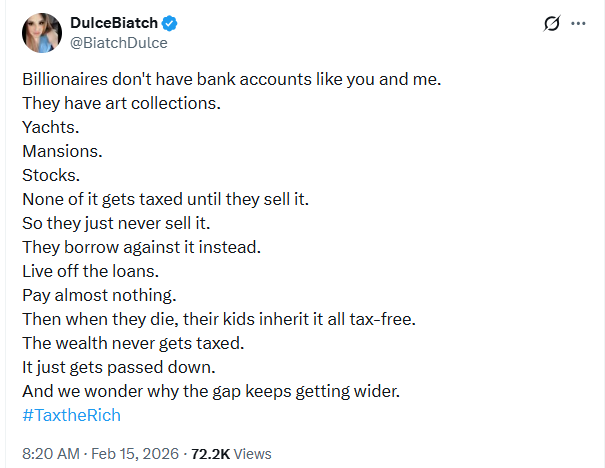
Yup, search for “Buy borrow die” and there are various articles about the technique.
This is basically urban legend at this point; “buy borrow die” is a tiny piece of the ultra-wealthy’s financial strategy, at least when it comes to the “borrow” part, which is what everyone’s focused on:
What’s confusing to me is that there must be a reason they’re borrowing. When you borrow, you have to pay interest. If you’re someone who has a lot of money, why would you pay someone to lend you money? I guess the only thing that makes sense is that they think that whatever makes them rich, say Amazon shares or something, will go up at a rate that beats the interest rate they have to pay for the loan. OTOH, I guess they’re not so sure of that that they borrow in order to buy even more Amazon shares.
I assume this means “not to sell all of their appreciated assets”, because they do spend a lot of money and it has to come from somewhere.
The reason the rich borrow money is to take advantage of tax loopholes. It’s not about being reasonable or what ought to make sense. They are gaming the system, that’s it. So, how does it work?
If they have investments in the stock market, then they get taxed when they sell those. So even though the investments are usually going up in value, they don’t want to sell too often. But they still need to buy things.
So, where do they get money for living, houses, cars, travel, etc? If they get paid for working a job, their income is taxed a lot, meh. If they sell their stocks, they get taxed a little, meh. But if they get a low-interest loan, that money is not taxed.
And you might say hey, money’s gotta be paid back some day. But remember, the goal is to find the loopholes, the places and times where either you don’t pay tax or you pay much less tax. And those loopholes are all over the place. In the end, the details are just boring. Most financial scams have just enough moving parts to look amazing, but if you take an hour to figure them out, it’s nothing exciting.
I cant blame them, honestly. And I think 99.99% of poor people would use the same strategies if they could. This is not about being morally superior, its about finding ways to keep your money. And this is something everyone is interested in.
Unfortunately only the rich can use this strategy in practice, but we all would if we could.
Ok, what tax loopholes?
Businesses. I’ve seen ‘the back end’ of an upper middle class family with a business, and the ways the mother (the tax genius of the scheme) moved money around and labeled various things as expenses for businesses was wild. None of it was illegal, it just was clearly not the intended purpose of the tax laws. One example I clearly remember was sticking five cattle on each of the properties they purchased, and all taxes just disappeared (went from thousands of dollars to just… dollars) due to agricultural exemptions. All of the cattle and their care suddenly became expenses, because the labor they hired to care for them was somehow completely deductible or expensable or however the law looked at it, which allowed them to shuffle money from another business to make it look negative…
and so on and so forth. I think they had more than four businesses that were legally separate (and incorporated, with the board being family members [and those family members are part of a trust that let even more shenanigans happen]) but supported the way money was shuffled. This was for a family that, at most, made ~ $500,000. Super high, above that 1% mark, but not even close to the insanity that the truly wealthy can pull off. Anything business related opens up an exponential number of ways to move money, even while using it, compared to the options a casual income-only tax-payer has.
As much as we can point at ‘Trump, dumb’ and tell ourselves that the rich are stupid but lucky, the majority are not at his level. They hire (multiple) people making six figures to manage their money because that investment pays off.
A basic one is negative gearing + trusts + cheap loans.
Negative gearing allows you to deduct/combine different income streams together to reduce your taxable income, and hence tax liability.
Traditionally used by middle/upper middle class to deduct mortgage interest payments and reduce their taxable income.
Rich(er) people combine this with trusts to distribute income/expenses among trust beneficiaries for something more tax advantageous. Usually this is someone like a spouse, child, or extended family member.
Add on the fact that rich people get cheaper loans, which often makes it cheaper to finance day to day life with loans, and only draw down (ie realise capital gains) after shuffling around incomes/expenses for a year.
Tax loopholes are basically legal ways to shift the timing and benefiary of income/expenses. There’s a bunch of other ones, like
None of that explains anything for wealth levels we’re talking about. Negative gearing implies a loss elsewhere, trusts max out at the same rate as all other inheritance they just avoid probate, retirement maxes out way earlier than what they have.
Nope, they definitely do. The specific assets and schemes differ across wealth levels and also across time as laws change, but the general principles of finding and exploiting loopholes remain the same.
The middle class negatively gears property despite the property gaining in capital terms. The ultra wealthy negatively gears sports teams despite the team gaining in capital terms.
The middle class deducts fancy electronics and cars as “hobbies”. The ultra wealthy deducts entire luxury hotels and horse racing clubs as “hobbies”.
The middle class stuffs income into retirement accounts. The ultra wealthy stuffs assets, which are way more fungible in value, into retirement accounts.
The Secret IRS Files Archives — ProPublica - https://www.propublica.org/series/the-secret-irs-files
Ten Ways Billionaires Avoid Taxes on an Epic Scale — ProPublica - https://www.propublica.org/article/billionaires-tax-avoidance-techniques-irs-files
More Than Half of America’s 100 Richest People Exploit Special Trusts to Avoid Estate Taxes — ProPublica - https://www.propublica.org/article/more-than-half-of-americas-100-richest-people-exploit-special-trusts-to-avoid-estate-taxes
Neat doc, thanks for linking. I find this part very sensible in light of what you brought up
That makes sense… I mean once you’re somehow generating millions or more every year in income, no need to borrow at all really. It’s making it to that upper tier of income vs. expenses that few reach.
That’s the key thing.