I’m not even close to the type of person where this strategy is an option, but the magic is in the stepped-up basis from what I understand.
Let’s say an asset is purchased for $1 million, held until it’s worth $10 million, and used to secure a $5 million loan. If you sell the asset, you owe taxes on the $9 million capital gain. If you die, the asset’s value “steps up” to the new baseline of $10 million. Your heir could then sell it with no capital gains tax, and pay off the loan and pocket the rest. If they hold onto the asset, and it appreciates to $11 million, they would only owe taxes on the gain of $1 million, not $10 million.
The whole scheme makes sense when it’s applied to a random farmer inheriting land from his parents: you dont want to force him to sell the land to pay capital gains. It makes a lot less sense when it’s someone inheriting stocks worth the GDP of a country.


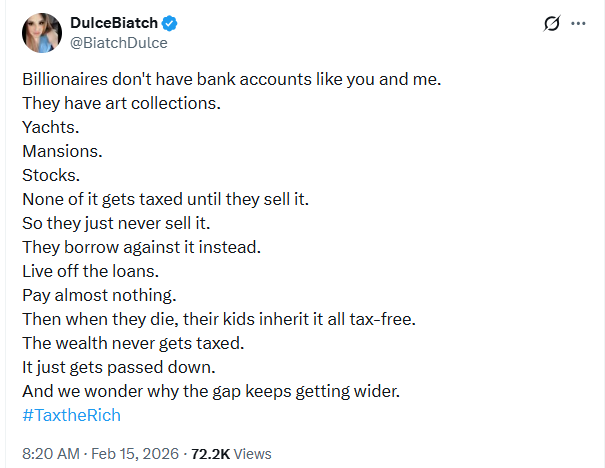
I’m not even close to the type of person where this strategy is an option, but the magic is in the stepped-up basis from what I understand.
Let’s say an asset is purchased for $1 million, held until it’s worth $10 million, and used to secure a $5 million loan. If you sell the asset, you owe taxes on the $9 million capital gain. If you die, the asset’s value “steps up” to the new baseline of $10 million. Your heir could then sell it with no capital gains tax, and pay off the loan and pocket the rest. If they hold onto the asset, and it appreciates to $11 million, they would only owe taxes on the gain of $1 million, not $10 million.
The whole scheme makes sense when it’s applied to a random farmer inheriting land from his parents: you dont want to force him to sell the land to pay capital gains. It makes a lot less sense when it’s someone inheriting stocks worth the GDP of a country.