Why’s that? You stated your opinion knowing that many people are ignorant of it, but failed to back it up. Why should we research your idea when we have ideas of our own? Don’t suggest we’re ignorant if you’re not willing to take the first step in educating us. Your contempt feels good but doesn’t solve any problems. Ciao
They think the LVT will solve all social problems ever. That’s the premise of the book he wrote about it.
He’s basically like Marx, but instead of communal ownership of production he thinks taxing land value will solve all society’s problems. Like communists, Georgists think if you just read this book and BELIEVE poverty will disappear.
The LVT has a lot of merits, but it has lots of drawbacks. It’s difficult to value land as district from property, for one. It would also be highly inaccurate in the case of mineral rights and other factors.
I feel you and I’m glad you asked.
The goal of my comment is to invoke interest so one can go down the rabbithole on ones own terms. This has a much more sustainable effect than just serving information on a boilerplate nobody asked for. Much like a catchy title/thumbnail on a yt video generates clicks, but the actual information does not.
My Standpoint:
Our present tax system is bad (almost worldwide): Tax based on value generated (like income, sales and import taxes) costs society a lot (real costs but also opportunity costs) while simultaniously not solving a lot of todays issues (f.e. tax evasion, old money, zone planning / car centric design, pollution, etc.).
Land Value Tax (or more precicely: Resource Tax) solves this by getting rid of the penalty for being productive or creating value while simultaniously taxing those being exponantionally wasteful with resources and/or pollute.
With LVT, there is now a penalty free incentive to increase profits and/or efficiency. On the other hand, if you consume and/or occupy resources like land, oil or air pollution, you’ll have to pay tax for that derived from the resources scarcity. The sum of the tax would be similar or higher than todays sum and would finance all government spending including a citizens dividend which could be interpreted today as unconditional basic income which would provide for basic human needs.
Georgism is PRO Economy and PRO Humanity. Win Win. Regardless of your political flavor, you should be in favor 😏
Winners: Society, everyone from poor to rich, resourceful entrepreneurs
Losers: old money, polluters, unrighteous beneficiaries of today’s flawed legal situation
In real life it’s far more complex to administer than a straight property tax, that’s why it will never be popular. It also creates bizarre outcomes where where it rewards some land uses and punishes others and creates weird incentives about land topology and parcelization.
Who is going to assess the value of the land as distinct from improvements? Geologists? Environmentalists? Different parents will presume different values and push those values. Property taxes are assumed basically based on other similar properties on the market, in terms of size, age, and space. But 2 parcels of 2 acre right next to each other could be radically different values depending in there topology and environments. I lived on a 2 acre parcel once, and our neighbors had 1/4 acre plots, but our 2 acres was mostly swampy low lying land that was not adjacent to the part the land our house was on that was regular. It was also weirdly shaped and the ‘access’ to it was a narrow 10ft corridor. It was essentially… useless land attached to our parcel, we couldn’t even develop it because in order to clear it you’d have to get permission form your neighbor to drive construction equipment across their driveway/lawn and destroy it. The extra ‘land’ in our case added 0 value to our property and in fact removed value, as houses around us were often selling for more due to the extra liability our extra land came with.
It introduces just as many problems as it those it claims to solve. It makes sense in some limited contexts, like say, urban land use across small and regular parcels, but not all land is urban land.
You forget that George was writing when society 70% agricultural and rural and working off a model of undeveloped land.
in 2026 only 17% of the USA population lives outside of cities.

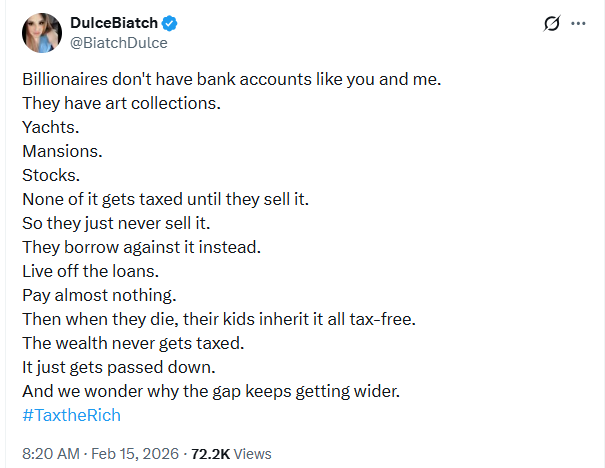
One word: Land value tax.
Every time I see a post like this I am disappointed that NO ONE mentions Henry George.
People, please, go educate yourself. Taxes were solved before ww1.
Why’s that? You stated your opinion knowing that many people are ignorant of it, but failed to back it up. Why should we research your idea when we have ideas of our own? Don’t suggest we’re ignorant if you’re not willing to take the first step in educating us. Your contempt feels good but doesn’t solve any problems. Ciao
Georgism is an ideology.
They think the LVT will solve all social problems ever. That’s the premise of the book he wrote about it.
He’s basically like Marx, but instead of communal ownership of production he thinks taxing land value will solve all society’s problems. Like communists, Georgists think if you just read this book and BELIEVE poverty will disappear.
The LVT has a lot of merits, but it has lots of drawbacks. It’s difficult to value land as district from property, for one. It would also be highly inaccurate in the case of mineral rights and other factors.
I feel you and I’m glad you asked. The goal of my comment is to invoke interest so one can go down the rabbithole on ones own terms. This has a much more sustainable effect than just serving information on a boilerplate nobody asked for. Much like a catchy title/thumbnail on a yt video generates clicks, but the actual information does not.
There are a lot of resources about LVT out there including some educational videos in an entertainning way. Pick your own poison: https://www.youtube.com/results?search_query=georgism
My Standpoint: Our present tax system is bad (almost worldwide): Tax based on value generated (like income, sales and import taxes) costs society a lot (real costs but also opportunity costs) while simultaniously not solving a lot of todays issues (f.e. tax evasion, old money, zone planning / car centric design, pollution, etc.). Land Value Tax (or more precicely: Resource Tax) solves this by getting rid of the penalty for being productive or creating value while simultaniously taxing those being exponantionally wasteful with resources and/or pollute.
With LVT, there is now a penalty free incentive to increase profits and/or efficiency. On the other hand, if you consume and/or occupy resources like land, oil or air pollution, you’ll have to pay tax for that derived from the resources scarcity. The sum of the tax would be similar or higher than todays sum and would finance all government spending including a citizens dividend which could be interpreted today as unconditional basic income which would provide for basic human needs.
Georgism is PRO Economy and PRO Humanity. Win Win. Regardless of your political flavor, you should be in favor 😏
Winners: Society, everyone from poor to rich, resourceful entrepreneurs
Losers: old money, polluters, unrighteous beneficiaries of today’s flawed legal situation
I worked for 5 years to promote LVT.
In real life it’s far more complex to administer than a straight property tax, that’s why it will never be popular. It also creates bizarre outcomes where where it rewards some land uses and punishes others and creates weird incentives about land topology and parcelization.
Who is going to assess the value of the land as distinct from improvements? Geologists? Environmentalists? Different parents will presume different values and push those values. Property taxes are assumed basically based on other similar properties on the market, in terms of size, age, and space. But 2 parcels of 2 acre right next to each other could be radically different values depending in there topology and environments. I lived on a 2 acre parcel once, and our neighbors had 1/4 acre plots, but our 2 acres was mostly swampy low lying land that was not adjacent to the part the land our house was on that was regular. It was also weirdly shaped and the ‘access’ to it was a narrow 10ft corridor. It was essentially… useless land attached to our parcel, we couldn’t even develop it because in order to clear it you’d have to get permission form your neighbor to drive construction equipment across their driveway/lawn and destroy it. The extra ‘land’ in our case added 0 value to our property and in fact removed value, as houses around us were often selling for more due to the extra liability our extra land came with.
It introduces just as many problems as it those it claims to solve. It makes sense in some limited contexts, like say, urban land use across small and regular parcels, but not all land is urban land.
You forget that George was writing when society 70% agricultural and rural and working off a model of undeveloped land. in 2026 only 17% of the USA population lives outside of cities.
Technically three words.
I’m german speaking. So for me, this is one word ;)
We Swedes can get in on the verylongcompoundword fun too
Fun fact, in German the entire Bible is just one word!
deleted by creator