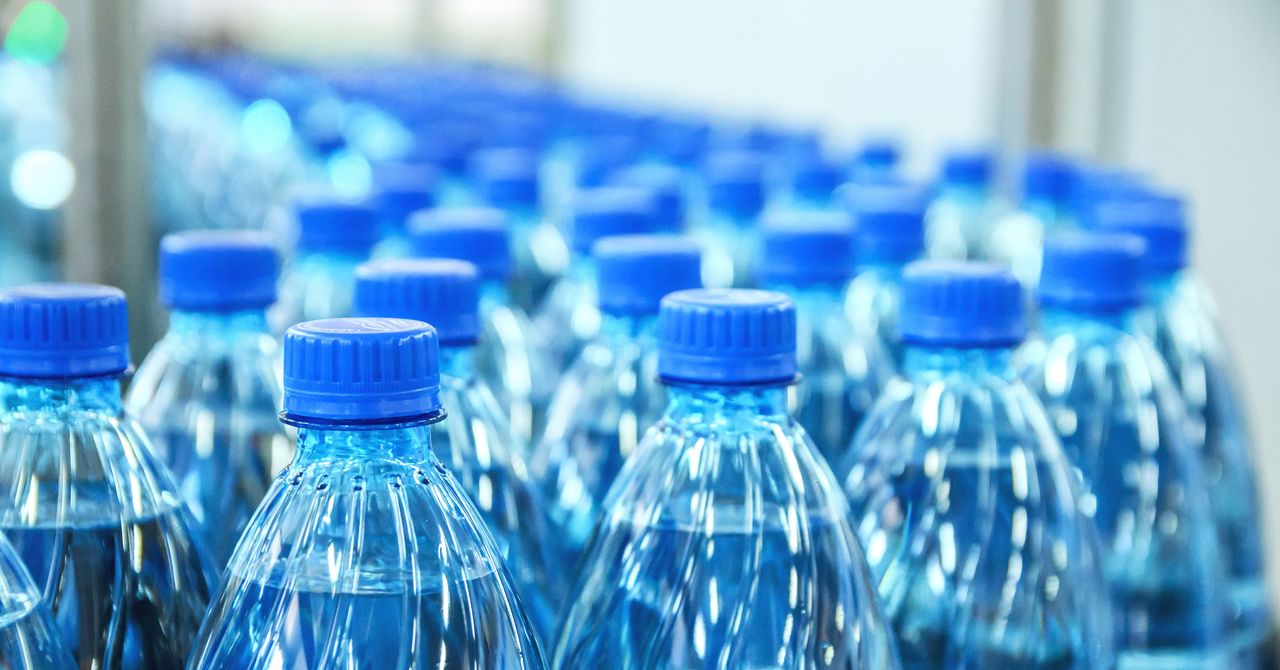
Drinking water in plastic bottles contains countless particles too small to see. New research finds that people who drink water from them on a daily basis ingest far more microplastics than those who don’t.
“Particles” is almost useless as a measure. They’re not movie tickets, I’m not interested in their discreet number. Give me a defined quantity. Is 10,000 particles 1 gram, half a gram, a tenth of a gram, what?
“You’re eating far too many particles of salt, we’re going to need to to cut back by at least 2,000 particles every lunar cycle.”
It’s also meaningless without the context of how many particles other people consume.
She found that people ingest an average of 39,000 to 52,000 microplastic particles per year from food and drinking water, and those who use bottled water on a daily basis ingest nearly 90,000 more microplastic particles into their bodies.
Aha! So, now a more informative headline could be something like, “People Who Drink Bottled Water on a Daily Basis Ingest 3 Times as Many Microplastic Particles Each Year.”
Which I would argue is also far scarier than just some out of context bigish number.
But, I’m with you on ditching “particles” altogether and providing it in a standard measurement.
I looked up what constitutes a unit of microplastics and the definition I found in this article was “any synthetic solid particle or polymeric matrix, with regular or irregular shape and with size ranging from 1 μm to 5 mm, of either primary or secondary manufacturing origin, which are insoluble in water”.
Because “microplastics” is a broad term that covers particles of varying size, structure, and weight, researchers refer to them in terms of number of particles per unit or total mass of microplastics per sample.
Great, how convenient that the latter option is based on mass, just as the OP requested. The researchers should clarify the number based on total mass.
Good point. But particle size is also important. Swallow a small sphere of 10g of plastic and it passes through you largely without consequence. 10g of nanoparticles and its in every one of your organs doing god knows what.
Which is kind of what I’m getting at. I’ve read that we have the equivalent to as much as a crayons worth of micro plastics in our brain. A crayon, while not particularly scientific, puts a pretty fine point on the issue in an intuitive sense, and also addresses the cumulative nature of the pollution. By the head line it seems like they are only talking about a certain sized micro plastic, and without further context they might as well just say “a lot”.


“Particles” is almost useless as a measure. They’re not movie tickets, I’m not interested in their discreet number. Give me a defined quantity. Is 10,000 particles 1 gram, half a gram, a tenth of a gram, what?
“You’re eating far too many particles of salt, we’re going to need to to cut back by at least 2,000 particles every lunar cycle.”
Yeah, I’m waiting for the comments in the style of “an average person ingests 3*10^12 plastic particles each year.” I have no reference to the number.
It’s also meaningless without the context of how many particles other people consume.
Aha! So, now a more informative headline could be something like, “People Who Drink Bottled Water on a Daily Basis Ingest 3 Times as Many Microplastic Particles Each Year.”
Which I would argue is also far scarier than just some out of context bigish number.
But, I’m with you on ditching “particles” altogether and providing it in a standard measurement.
I looked up what constitutes a unit of microplastics and the definition I found in this article was “any synthetic solid particle or polymeric matrix, with regular or irregular shape and with size ranging from 1 μm to 5 mm, of either primary or secondary manufacturing origin, which are insoluble in water”.
Because “microplastics” is a broad term that covers particles of varying size, structure, and weight, researchers refer to them in terms of number of particles per unit or total mass of microplastics per sample.
Great, how convenient that the latter option is based on mass, just as the OP requested. The researchers should clarify the number based on total mass.
Good point. But particle size is also important. Swallow a small sphere of 10g of plastic and it passes through you largely without consequence. 10g of nanoparticles and its in every one of your organs doing god knows what.
Which is kind of what I’m getting at. I’ve read that we have the equivalent to as much as a crayons worth of micro plastics in our brain. A crayon, while not particularly scientific, puts a pretty fine point on the issue in an intuitive sense, and also addresses the cumulative nature of the pollution. By the head line it seems like they are only talking about a certain sized micro plastic, and without further context they might as well just say “a lot”.