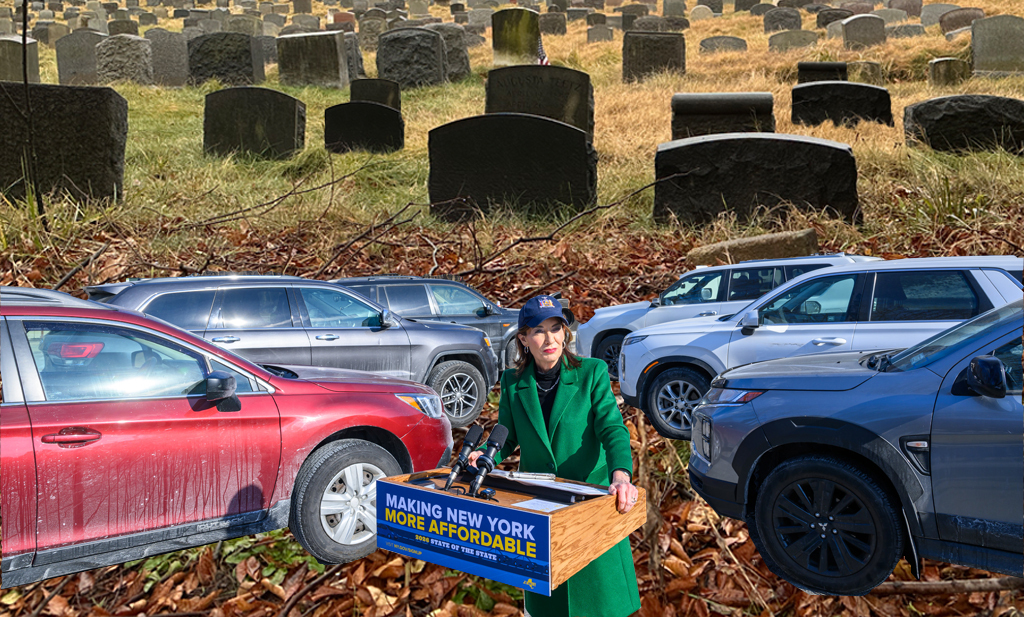
Drivers: Don’t allow insurance companies to use speed camera data. We don’t want bad drivers to pay more.
Also drivers: Insurance premiums are too expenvie. Do something.
Governor: 🙆
Can New York get just one governor who isn’t a fucking enemy of the people?
Why is it that something required by the government (car insurance) is not provided BY the government?
PPP
Because it’s not required by the government. I don’t have any, for example, because I don’t own a car.
We already spend too many trillions of dollars subsidizing private cars. No more please.
$$$$$$$$$$$$$
The same governor that gave a billion dollars of taxpayer money to billionaires to build a head injury stadium. Not surprising.
I never understood different rates for different insurance risk profiles.
The whole point of insurance is agrigate risk. Risk based rates work against that idea, defeating the purpose of insurance.
That’s because you misunderstand the purpose of insurance.
The purpose of insurance is to provide stability.
That is, instead of paying a lot of money with a low frequency, you pay a small amount of money with high frequency.
Of course, as the provider of that “stability service”, you pay the insurance company.
Note that at no point in this definition is more than one customer necessary.
Each customer has a different definition for “a lot of money” (X), “small amount of money” (Y), “high frequency” (Z). “Low frequency” is usually a month or a year though.
Customers “control” variables X and Z. Insurance companies control Y. For simplicity let’s say A = X*Z.
In an ideal market, each customer would accept the policy where Y is highest.
In your view, insurance policies should have constant Y.
If you make an insurance company based on that, you have 2 options:
- Set a low Y, you’ll go bankrupt.
- Set a high Y, you’ll go bankrupt.
In scenario 1. You’ll go bankrupt because your customers will be the ones with the highest A in the market. Since low A customers will go to another company that sets Y as a function of A.
In scenario 2. You’ll go bankrupt because you’ll have no customers. Setting a Y high enough so scenario 1. Doesn’t happen means that not even the highest A will be willing to pay your high Y.
If you see it from the PoV of the customer:
Why would I pay the same as my neighbour that drives drunk every day when I only use my car once a years on a small trip while following every traffic law and regulation? I’ll just go to that other insurance company that costs only a small fraction of my neighbour’s.
All of that is about a company selling a product in a market.
But insurance doesn’t need to be that. It’s purpose is unrelated to any of that.
Insurance, no matter where it comes from, is about pooling money from a large group to cover the losses of a small group. It exists because nobody knows which group they’ll be in.
EDIT:
Ideally insurance would be a state regulated monopoly, in order to have the largest possible pool. That would be the most effective and efficient way of doing it.In fact trying to categorize people into lower and higher risk pools, just makes smaller pools. Which hurts the overall efficiency of insurance for the purpose of creating more attractive products to sell in a profit driven market. It’s an example of how commerce itself can actually hurt some markets.
What you describe as an individual spreading out small payments instead of having one large payment, is actually just a loan. You can open a line of credit at a bank for emergencies. That does the same thing. It isn’t insurance.
The aggregated risk is “if the person gets into a collision and how much it’s likely to cost” not “how much it will cost when the person gets into a collision”
I don’t think an aggregate risk model makes sense for something like car insurance where personal behavior has such a huge impact on payouts.
Health insurance where insurance is a necessity and choices do not necessarily impact risk is where aggregate works better.
Healthe insurance (as done in the US) isn’t realy insurance, but that’s whole other issue.
Personal choice absolutely has a large effect on health risks. What foods you chose to eat? Where you chose live? How often you exercise? Those and hundreds more choices all effect health risk. Literally every choice you make has a positive or negative effect on your health risk. But most of them are ignored in health insurance prices.
Personal choice is a lot easier when you have money, leisure time, or both. Late-state capitalism means that many people don’t have those resources.
This is an example of why is a Capitalist Governor, an example of why she is a member of a 90+% Capitalist political party.
Just keep blaming your voters from not voting for your members & deny the obvious Capitalist actions those politicians you want your voters to voter for, & history will eventually blow you away. The question is will The Living Planet & All Living Being, including Us (even those of Us, who are no longer apart of either Capitalist Parties) go extinct with you?
What an asshole.