It’s already shredding naturally. At least this process contains it for longer than it otherwise would, potentially reduces more shedding from tires, and gives it some purposeful existence while we come up with better ideas.
Better than just letting it rot somewhere, right? At least, that’s my take. Maybe it’s wrong, but it’s not the worst idea I’ve ever heard.
Mixing it with a binder, effectively embedding it into a semi buried rock a seems like a slightly safer option than letting it sit out in the sun to be broken down by UV.
Who is leaving it in the sun? It’s supposed to be capped off at a landfill. Where it is sequestered to some degree. Any other use liberates the thousands of virtually unregulated additives, and the microplastics themselves.
You realize the microplastics are still released from a capped landfill, right?…
I’m not necessarily saying this is a better option, but you’re talking like a capped landfill is the best solution out there, and hand waving any argument against it.
There’s also the problem of landfills taking decades to fill, with UV breaking down the topmost layer, heat breaking down internal layers, and water flowing through (and needing to be treated in the best case scenario).
It’s not great no, the best thing would be to make less of this plastic, and to use less dangerous additives in it. To maybe use the same additives, and study the ones we use. Because it is worse recycling it than dumping it. Yeah the top layer, the capped landfills will eventually leak, they have fires at these landfills, (I heard there was a landfill in like the SW, a huge one, where they’ve had this fire going for like decades under the trash mountain, and there is nuclear waste lost in there from like the 50s or something they lost.) And the water flowing through, I think at least for some stuff like cement kiln dust they put down layers of plastic, several feet of material, then another layer of plastic, to prevent the water leaching right through, I had hoped they do something to prevent the rain but I guess they probably don’t.
There supposedly is exponentially more plastic being produced now than before. Ten years ago they were saying, 90% of all plastic ever produced had been in the last ten years or something. As incredible as that sounds, they had new plastic productions come online since then. I don’t know what all new they are using this plastic for. But it doesn’t matter how much we recycle it, if we even find a use that is not worse for the environment, the air, the water, the land, plant and animal life, than landfilling it.
This is only one waste problem too. Pfas is ubiquitous, fracking has sullied entire watersheds with every known contaminant, as they use toxic wastes as fracking fluids to get rid of it as much as for it’s properties, thanks to exemptions written in Bush’s Energy Bills by Dick Cheney. Their deep injection wells to handle the flowback from those fracking operations that have a 15 % failure rate, and allow class 1 waste to be disposed of in class 2 wells because of another exemption in the same bills. Herbicides and other pesticides are overused, especially on crops genetically engineered to take more of those pesticides, fertilizer run off, sewage as fertilizer, but it often has industrial inputs to the sewage, that then gets spread on farm fields, introducing contaminants directly, and furthering run off problems. That is just scratching the surface.
Our national discourse, and laws, on pollutants is dishonest to say the least. Regulators captured, lawmakers are first tier leased to these corporations’ trade groups, and a constellation of science and media and lobbyists crafts the alternate reality that furthers their business interests. We are literally poisoning millions of people in some cases so a company can save a modest amount of money on waste disposal. No one would stand for it, if they knew reality. But they trust authority, which has left me convinced that some of these pollutants are making us docile, and trusting of authority, more than before.
and what are the odds that whatever company that is contracted to do the work does not use recycled plastic and instead shreds new plastic, because it is cheaper.
I guess that’s up to whatever process is used by municipalities to decide between vendors, and would encourage you to persuade your local government not to do this should they consider this strategy.
I dunno man. There are no perfect solutions for dealing with plastic waste at the moment. Until we have one, there are worse ways to go about handling it.

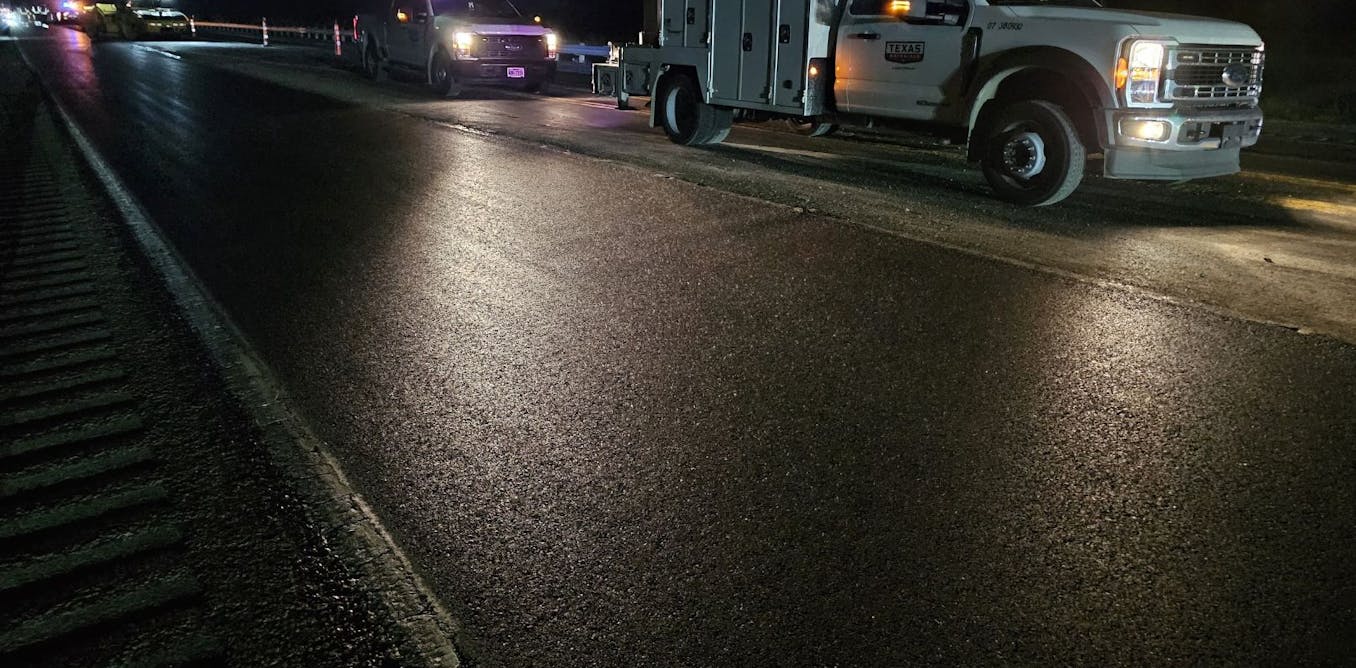
So we shred it to tiny particles and that’s that? Hmm
It’s already shredding naturally. At least this process contains it for longer than it otherwise would, potentially reduces more shedding from tires, and gives it some purposeful existence while we come up with better ideas.
Better than just letting it rot somewhere, right? At least, that’s my take. Maybe it’s wrong, but it’s not the worst idea I’ve ever heard.
Mixing it with a binder, effectively embedding it into a semi buried rock a seems like a slightly safer option than letting it sit out in the sun to be broken down by UV.
Who is leaving it in the sun? It’s supposed to be capped off at a landfill. Where it is sequestered to some degree. Any other use liberates the thousands of virtually unregulated additives, and the microplastics themselves.
You realize the microplastics are still released from a capped landfill, right?…
I’m not necessarily saying this is a better option, but you’re talking like a capped landfill is the best solution out there, and hand waving any argument against it.
There’s also the problem of landfills taking decades to fill, with UV breaking down the topmost layer, heat breaking down internal layers, and water flowing through (and needing to be treated in the best case scenario).
It’s not great no, the best thing would be to make less of this plastic, and to use less dangerous additives in it. To maybe use the same additives, and study the ones we use. Because it is worse recycling it than dumping it. Yeah the top layer, the capped landfills will eventually leak, they have fires at these landfills, (I heard there was a landfill in like the SW, a huge one, where they’ve had this fire going for like decades under the trash mountain, and there is nuclear waste lost in there from like the 50s or something they lost.) And the water flowing through, I think at least for some stuff like cement kiln dust they put down layers of plastic, several feet of material, then another layer of plastic, to prevent the water leaching right through, I had hoped they do something to prevent the rain but I guess they probably don’t.
There supposedly is exponentially more plastic being produced now than before. Ten years ago they were saying, 90% of all plastic ever produced had been in the last ten years or something. As incredible as that sounds, they had new plastic productions come online since then. I don’t know what all new they are using this plastic for. But it doesn’t matter how much we recycle it, if we even find a use that is not worse for the environment, the air, the water, the land, plant and animal life, than landfilling it.
This is only one waste problem too. Pfas is ubiquitous, fracking has sullied entire watersheds with every known contaminant, as they use toxic wastes as fracking fluids to get rid of it as much as for it’s properties, thanks to exemptions written in Bush’s Energy Bills by Dick Cheney. Their deep injection wells to handle the flowback from those fracking operations that have a 15 % failure rate, and allow class 1 waste to be disposed of in class 2 wells because of another exemption in the same bills. Herbicides and other pesticides are overused, especially on crops genetically engineered to take more of those pesticides, fertilizer run off, sewage as fertilizer, but it often has industrial inputs to the sewage, that then gets spread on farm fields, introducing contaminants directly, and furthering run off problems. That is just scratching the surface.
Our national discourse, and laws, on pollutants is dishonest to say the least. Regulators captured, lawmakers are first tier leased to these corporations’ trade groups, and a constellation of science and media and lobbyists crafts the alternate reality that furthers their business interests. We are literally poisoning millions of people in some cases so a company can save a modest amount of money on waste disposal. No one would stand for it, if they knew reality. But they trust authority, which has left me convinced that some of these pollutants are making us docile, and trusting of authority, more than before.
Not sure there are any “safe” options tbh but I’d rather it serve some purpose if it’s just going to break down either way, for sure.
and what are the odds that whatever company that is contracted to do the work does not use recycled plastic and instead shreds new plastic, because it is cheaper.
I guess that’s up to whatever process is used by municipalities to decide between vendors, and would encourage you to persuade your local government not to do this should they consider this strategy.
I dunno man. There are no perfect solutions for dealing with plastic waste at the moment. Until we have one, there are worse ways to go about handling it.
you’re right. i was just letting my doomerism run rampant on lemmy for a minute.
No worries I get it, that’s all too easy to do nowadays lol
🦵 🥫 🛣️