

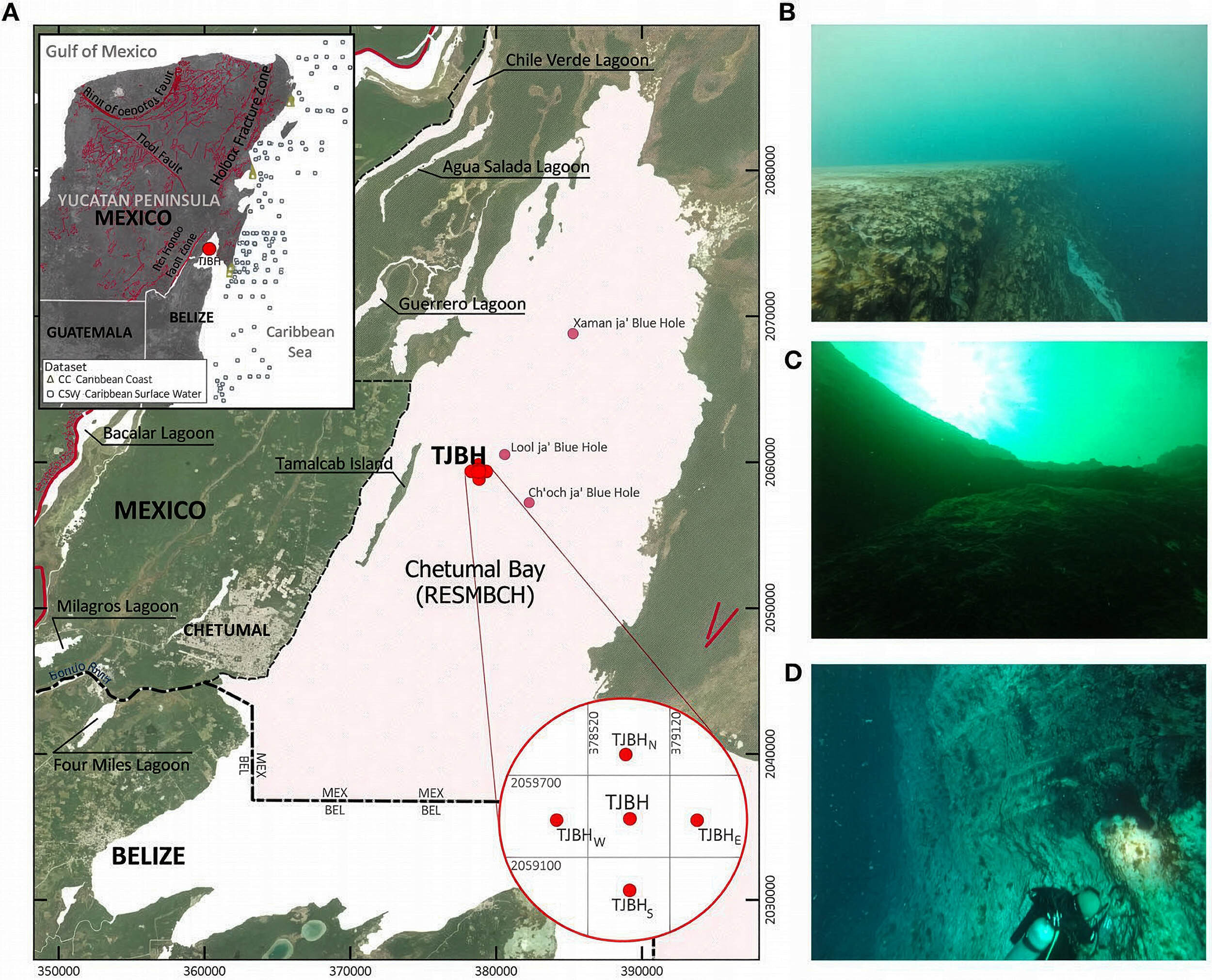
From the surface, Chetumal Bay looks almost placid – just a wide sheet of water with no hint of drama underneath. But below that calm is Taam ja’, a massive underwater sinkhole, or “blue hole,” that’s turned into an unexpected mystery for scientists.
At first, the plan seemed straightforward: map it with sonar, get a depth, move on. Instead, the early readings created a bigger problem – what if Taam ja’ isn’t anywhere near as shallow as those first numbers suggested?
The most recent measurements point to a hole that drops far deeper than expected, and the true bottom may still be out of reach…
They only got to 1300 feet which is well above crushing depth for remotely operated vehicles and cameras. Challenger deep is 35,000 feet and 27 people have been down there.
I would assume the bigger problems will be visibility (cave systems tend to have murky water and it sounds like the bay also has murky water) and being able to maneuver an rov or submersible in the passages. Some caves are so narrow that cave divers have to take off their gear and squeeze themselves through a passage so getting an rov in would be impossible.
Not to immediately gainsay what you’re talking about but I think visible light isn’t necessary for “vision”. Think radar, etc
Caves, especially sink holes and cenotes in mexico actually tend to have pretty clear water. The murkyness in water comes either from organic matter or silt. If there’s no light there is no algae to limit visibility. If the cave has flow the silt is often carried away quickly. If there is no flow the silt will sink to the bottom, clearing up the visibility. Once the silt is disturbed (e.g. by a diver kicking their fin in the wrong direction) it can take a long time to settle again.
Right, I just mean the pole would be able to poke the bottom of whatever hole. As far as exploring, yeah, I mean of course a cave system beats a straight pole lowered from the surface.
I’m thinking some kind of automated submersible, like a drone but in the water.
The murky water is something I don’t have an answer for. Then you’re just falling back on sonar.
I don’t think they’ll find Godzilla down there, or any kind of “monster” or anything that would wow the average doom scroller. But we might find new life down there, something that is suited to the higher pressure. And that could be interesting. Though, just like we’d die down there, it would likely die “up here”.