It’s 1970. You inherit $10M from your rich dad who worked hard.
Buy $10M index fund stock.
Borrow $10M against stock.
Live tax free off that $10M loan for 30 years (you can do that because you started in 1970 when it was cheap to buy a house).
Your stock is now worth $58M (avg 6% per year for 30 years)
Your kids inherit the stock at its current value and immediately sell $10M worth to pay off original loan. They pay no capital gains tax because the stock barely moved in the time between when they took ownership and selling it. All of the value growth since original purchase in 1970 is now tax free. The kids now start with $48M.
Repeat
Obviously, there is more to it than this. For example, this does not account for interest in the loan, or diversification of investments, or ability to hire accountants to maximize on the process.
Your kids inherit the stock at its current value and immediately sell $10M worth to pay off original loan
And the bank says “um, what about the rest?” In the 1970s and early 80s the inflation rate was, at times, above 10%, so your loan’s interest rate would have been above that. But say on average the loan’s interest rate was 5% per year over 30 years… the bank isn’t going to be content for just the original $10M.
That’s what success looks like. But, you don’t know if you’re going to be successful when you take out the loan. If there’s a market downturn you’re on the hook for the loan and your portfolio has crashed. If you sold a few stocks instead of taking out a loan, you’re insulated from that possibility.
You think they’re giving out low rate 30-50 year rolling personal loans in the tens or hundreds of millions of dollars range? This I find hard to believe. The premise makes sense, but I don’t think these loans usually exist.
You might find it hard to believe, but nevertheless it is true. These are considered to be extremely safe loans, so they give out sweetheart rates to get them.
Since taxes are paid when an asset is sold, not when it goes up in value, your net worth goes up with no tax liability change. When you die, the purchase price for tax purposes resets. Now the inheritor sells the assets. Since the sale price is essentially the same as the taxation price, there’s no taxes.
You’re borrowing today’s money against tomorrow’s value and taking the difference out of your death messing with taxes to free up the value.
From a financial perspective the time horizon for return doesn’t matter, only that the return is balanced against the time. From that perspective, the people giving the loan have no reason to really care since it makes them look good and they’ll at least not be working there when and if it goes wrong.
For the individual wealthy, they aren’t. Some loans might get paid off by taking another loan, but the goal is to take the loan to the grave. The loan would get paid after death because then the estate can sell the stocks without paying any capital gains tax.
Let’s say you buy 1 million worth of stocks. The day before you die that stock is worth 51 million. If you cash out that stock you’re paying capital gains tax on 50 million. Let’s say the capital gains tax is 20% which means you’d pay 10 mil in taxes. So you get 41 million from the sale. Let’s say the loan is exactly 41 million so to pay off the loan you get nothing.
But if you die and that stock goes to the estate they haven’t gained any capital from the stock so when they sell it they pay no tax on it. The estate then sells the stock tax free to pay off whatever debt there was (the estate sells only 41 million worth of stocks keeping the 10 million on stocks). That 10 million is effectively free money that goes to the inheritor.
Basically it’s all just tax evasion for the ultrawealthy. Except it’s legal so technically it’s not tax evasion. And realistically the numbers are even more astronomical than what I used as an example.
They get a painting worth 10K, get a loan for that, then get it appraised for 30K, get a loan on that from somewhere else and pay off the other one. That’s one idea.
The second is they like assets that provide passive income and appreciate. You’ll find a lot get into land as well and rental units.
Since the 1970s governments have been continually printing more money. This means that if you can get a low enough interest loan (i.e. by having a ton of money already so that you’re low risk), the money you owe will devalue faster than interest accrues. You just keep doing that, and/or use it to invest.

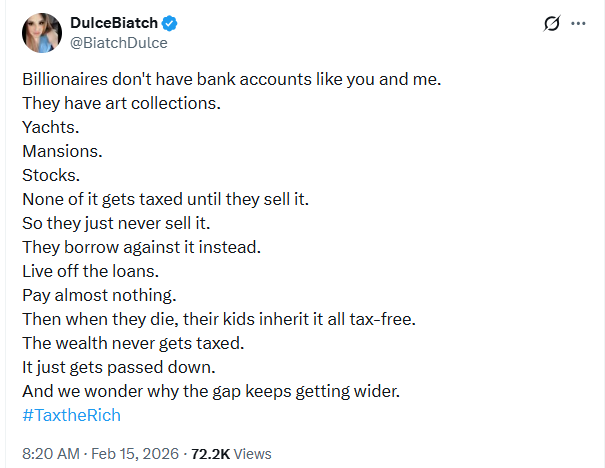
This doesn’t make any sense. How are the loans getting paid back?
This is the process, extremely simplified:
Obviously, there is more to it than this. For example, this does not account for interest in the loan, or diversification of investments, or ability to hire accountants to maximize on the process.
And the bank says “um, what about the rest?” In the 1970s and early 80s the inflation rate was, at times, above 10%, so your loan’s interest rate would have been above that. But say on average the loan’s interest rate was 5% per year over 30 years… the bank isn’t going to be content for just the original $10M.
All that matters is that your portfolio grows faster than the interest rate.
That’s what success looks like. But, you don’t know if you’re going to be successful when you take out the loan. If there’s a market downturn you’re on the hook for the loan and your portfolio has crashed. If you sold a few stocks instead of taking out a loan, you’re insulated from that possibility.
You think they’re giving out low rate 30-50 year rolling personal loans in the tens or hundreds of millions of dollars range? This I find hard to believe. The premise makes sense, but I don’t think these loans usually exist.
You might find it hard to believe, but nevertheless it is true. These are considered to be extremely safe loans, so they give out sweetheart rates to get them.
https://budgetlab.yale.edu/research/buy-borrow-die-options-reforming-tax-treatment-borrowing-against-appreciated-assets
It’s actually a real thing.
Since taxes are paid when an asset is sold, not when it goes up in value, your net worth goes up with no tax liability change. When you die, the purchase price for tax purposes resets. Now the inheritor sells the assets. Since the sale price is essentially the same as the taxation price, there’s no taxes.
You’re borrowing today’s money against tomorrow’s value and taking the difference out of your death messing with taxes to free up the value.
From a financial perspective the time horizon for return doesn’t matter, only that the return is balanced against the time. From that perspective, the people giving the loan have no reason to really care since it makes them look good and they’ll at least not be working there when and if it goes wrong.
For the individual wealthy, they aren’t. Some loans might get paid off by taking another loan, but the goal is to take the loan to the grave. The loan would get paid after death because then the estate can sell the stocks without paying any capital gains tax.
Let’s say you buy 1 million worth of stocks. The day before you die that stock is worth 51 million. If you cash out that stock you’re paying capital gains tax on 50 million. Let’s say the capital gains tax is 20% which means you’d pay 10 mil in taxes. So you get 41 million from the sale. Let’s say the loan is exactly 41 million so to pay off the loan you get nothing.
But if you die and that stock goes to the estate they haven’t gained any capital from the stock so when they sell it they pay no tax on it. The estate then sells the stock tax free to pay off whatever debt there was (the estate sells only 41 million worth of stocks keeping the 10 million on stocks). That 10 million is effectively free money that goes to the inheritor.
Basically it’s all just tax evasion for the ultrawealthy. Except it’s legal so technically it’s not tax evasion. And realistically the numbers are even more astronomical than what I used as an example.
They get a painting worth 10K, get a loan for that, then get it appraised for 30K, get a loan on that from somewhere else and pay off the other one. That’s one idea.
The second is they like assets that provide passive income and appreciate. You’ll find a lot get into land as well and rental units.
Look, the rich people wrote the laws. You think they didn’t leave loopholes for themselves? … Tax law doesn’t have to make sense.
Since the 1970s governments have been continually printing more money. This means that if you can get a low enough interest loan (i.e. by having a ton of money already so that you’re low risk), the money you owe will devalue faster than interest accrues. You just keep doing that, and/or use it to invest.
the stocks pay dividends,