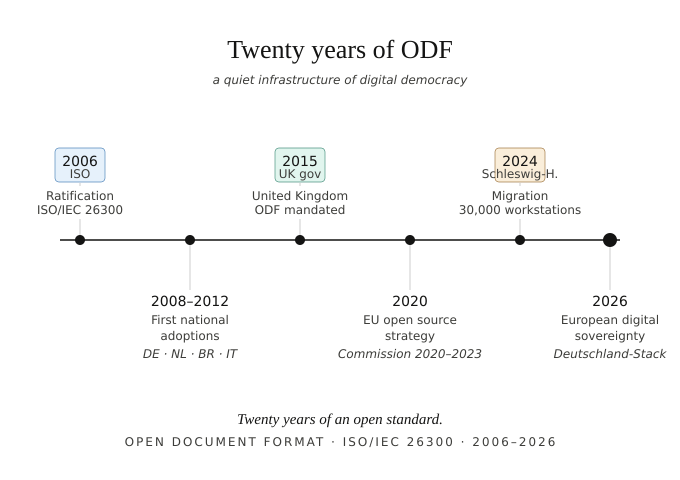
Dear office suite users, In recent days you will have read various articles announcing the arrival of Euro-Office, which is being “marketed” as the first open-source office suite developed in Europe. We feel compelled — reluctantly, since open source should rest on transparency, not deception — to correct this claim. The first open-source office suite developed in Europe was OpenOffice.org in 2001, based on StarOffice’s source code, followed by LibreOffice from 2010. These are two genuine open-source office suites, built from source code that originated in Europe. They are not a freeware clone of MS Office whose code provenance is undisclosed, nor a product that has rebranded itself out of pure opportunism to ride today’s wave of Digital Sovereignty. It is worth remembering that many of those who champion Digital Sovereignty today were silent back in 2006, when the open ISO/IEC ODF standard — the pillar of Digital Sovereignty — was announced: not only did they not listen to us during all these years, but in some cases they greeted us with a condescending smile. If we can speak of Digital Sovereignty in Europe today, it is thanks to The Document Foundation and LibreOffice community members at large, who kept
I really don’t get this latest series if tantrums from LibreOffice/The Document Foundation. They are attacking every other up-and-coming open source document project.
They are not. They are pointing out how innefectual the Euro-Office setup is in the context of EU Digital Sovereignty. If the EU wants to free its document stack from dependencies it makes no sense that they’d pick a product that only supports OOXML, which is fully controlled by Microsoft. (And riddled with Russian spyware, but that’s the icing on the cake.)
And speaking of OOXML, let’s get some things straight:
It is an open standard since 2006.
It has never been truly open. It was demonstrated back in 2006 and time and time again that Microsoft doesn’t publish the full spec and that they obfuscate what they do publish. It is impossible to fully support what comes out of the latest MS Office in an open manner.
It is a recognized ISO standard, just like ODF. (ISO/IEC 29500)
Yes, because back in 2006 Microsoft asked their vendors in all ISO-voting countries to join the ISO committees and vote in favor of OOXML. A practice which the ISO was completely unprepared for, but also did absolutely nothing to correct.
ISO/IEC 29500 is a joke and choosing to enforce as an EU-wide standard is a joke.
Thing is, this is supposed to replace MS365 not Libreoffice.
And the collaborative work environment will receive docs from workplaces that maybe use MS365.
If those don’t render correctly, the user will complain about jumbled docs that make no sense because the one image moved the whole document by 10 pages
I thought Onlyoffice supported both formats, but apparently you’re right; OOXML gets native support and ODF is treated by the developers as an import/export process (based on the comments there).
To the end user, that makes it look like OOXML is the default and ODF is an inconvenient second option you have to manually choose, but the issues probably run much deeper than that.
The format is standardised. It might not be a standard you like, but it’s a standard that the US can’t “take away” from the EU. Microsoft, especially in cloud form, can remove access to Office tomorrow if they’re pressured to by the US government.
We might have a desire for better file formats. The EU doesn’t give a monkey about our crusade, it purely cares about not having US leverage hanging over them like a sword. And the underlying file formats, exactly because it’s a ISO standard (however poor it may be) is fine for this purpose.
It’s not a fine standard. Microsoft filed it with the express goal of preventing ODF from becoming the prevailing document standard, not with the goal of documenting OOXML. It’s intentionally obfuscated and kept different from MS Office. It’s not a standard it’s a red herring.
And Adobe PDFs are not the same as PDF/As and yet somehow the world still turns and PDF readers of all sorts find their way around.
I’m not saying OOXML is a great standard. I’m saying it’s a fine standard for the specific purpose of having a format that Microsoft can no longer claim IP rights over, so that should Microsoft suddenly feel pressurised to remove Office functionality from Europe, Europe still has a workable solution that’s compatible and interchangeable with the 99.9% of all editable document files sent around.
Euro-Office and OnlyOffice don’t “only support” OOXML. Where did you get that idea?
And not every software developed in Russia is “riddled with Russian spyware.” The code is open so where do you suppose all this supposed spyware is hiding? Or is that just fear-mongering?
I’d love for LibreOffice to do a serious modernization to be a viable alternative. But for most users, it feels like a downgrade whether or not it is technically better under the hood. I use OnlyOffice these days even though it has a lot more bugs because the UX is just that much better in spite of it.
Whereas StarOffice/OpenOffice/LibreOffice is a product officially developed by Sun, then donated to the Apache Foundation, then forked as LibreOffice governed by The Document Foundation.


They are not. They are pointing out how innefectual the Euro-Office setup is in the context of EU Digital Sovereignty. If the EU wants to free its document stack from dependencies it makes no sense that they’d pick a product that only supports OOXML, which is fully controlled by Microsoft. (And riddled with Russian spyware, but that’s the icing on the cake.)
And speaking of OOXML, let’s get some things straight:
It has never been truly open. It was demonstrated back in 2006 and time and time again that Microsoft doesn’t publish the full spec and that they obfuscate what they do publish. It is impossible to fully support what comes out of the latest MS Office in an open manner.
Yes, because back in 2006 Microsoft asked their vendors in all ISO-voting countries to join the ISO committees and vote in favor of OOXML. A practice which the ISO was completely unprepared for, but also did absolutely nothing to correct.
ISO/IEC 29500 is a joke and choosing to enforce as an EU-wide standard is a joke.
https://en.wikipedia.org/wiki/Standardization_of_Office_Open_XML#Complaints_about_the_national_bodies_process
Which is why LibreOffice, or a similar product that supports both OOXML and ODF should have been chosen.
That has to be taken into account for migration but it doesn’t mean we have to keep being tied to Microsoft.
Thing is, this is supposed to replace MS365 not Libreoffice.
And the collaborative work environment will receive docs from workplaces that maybe use MS365.
If those don’t render correctly, the user will complain about jumbled docs that make no sense because the one image moved the whole document by 10 pages
I thought Onlyoffice supported both formats, but apparently you’re right; OOXML gets native support and ODF is treated by the developers as an import/export process (based on the comments there).
To the end user, that makes it look like OOXML is the default and ODF is an inconvenient second option you have to manually choose, but the issues probably run much deeper than that.
The EU wants to not depend on US software.
The format is standardised. It might not be a standard you like, but it’s a standard that the US can’t “take away” from the EU. Microsoft, especially in cloud form, can remove access to Office tomorrow if they’re pressured to by the US government.
We might have a desire for better file formats. The EU doesn’t give a monkey about our crusade, it purely cares about not having US leverage hanging over them like a sword. And the underlying file formats, exactly because it’s a ISO standard (however poor it may be) is fine for this purpose.
It’s not a fine standard. Microsoft filed it with the express goal of preventing ODF from becoming the prevailing document standard, not with the goal of documenting OOXML. It’s intentionally obfuscated and kept different from MS Office. It’s not a standard it’s a red herring.
And Adobe PDFs are not the same as PDF/As and yet somehow the world still turns and PDF readers of all sorts find their way around.
I’m not saying OOXML is a great standard. I’m saying it’s a fine standard for the specific purpose of having a format that Microsoft can no longer claim IP rights over, so that should Microsoft suddenly feel pressurised to remove Office functionality from Europe, Europe still has a workable solution that’s compatible and interchangeable with the 99.9% of all editable document files sent around.
Euro-Office and OnlyOffice don’t “only support” OOXML. Where did you get that idea?
And not every software developed in Russia is “riddled with Russian spyware.” The code is open so where do you suppose all this supposed spyware is hiding? Or is that just fear-mongering?
I’d love for LibreOffice to do a serious modernization to be a viable alternative. But for most users, it feels like a downgrade whether or not it is technically better under the hood. I use OnlyOffice these days even though it has a lot more bugs because the UX is just that much better in spite of it.
From the fact ODF “support” is an awkward import/export function. It’s not a first class format.
On their live service. They don’t publish the spyware with the code they choose to open, obviously. 😃
Russian ownership of OPENOFFICE is why this Euro fork exists.
edit: meant ONLYOFFICE. too many Os out there
OnlyOffice is not related to OpenOffice. OnlyOffice is developed by Ascensio System which has labored to obscure their Russian backing.
Whereas StarOffice/OpenOffice/LibreOffice is a product officially developed by Sun, then donated to the Apache Foundation, then forked as LibreOffice governed by The Document Foundation.
https://en.wikipedia.org/wiki/OpenOffice.org#Forks_and_derivative_software
sorry too many O office apps, I meant onlyoffice, which is the base of the EuroOffice app