

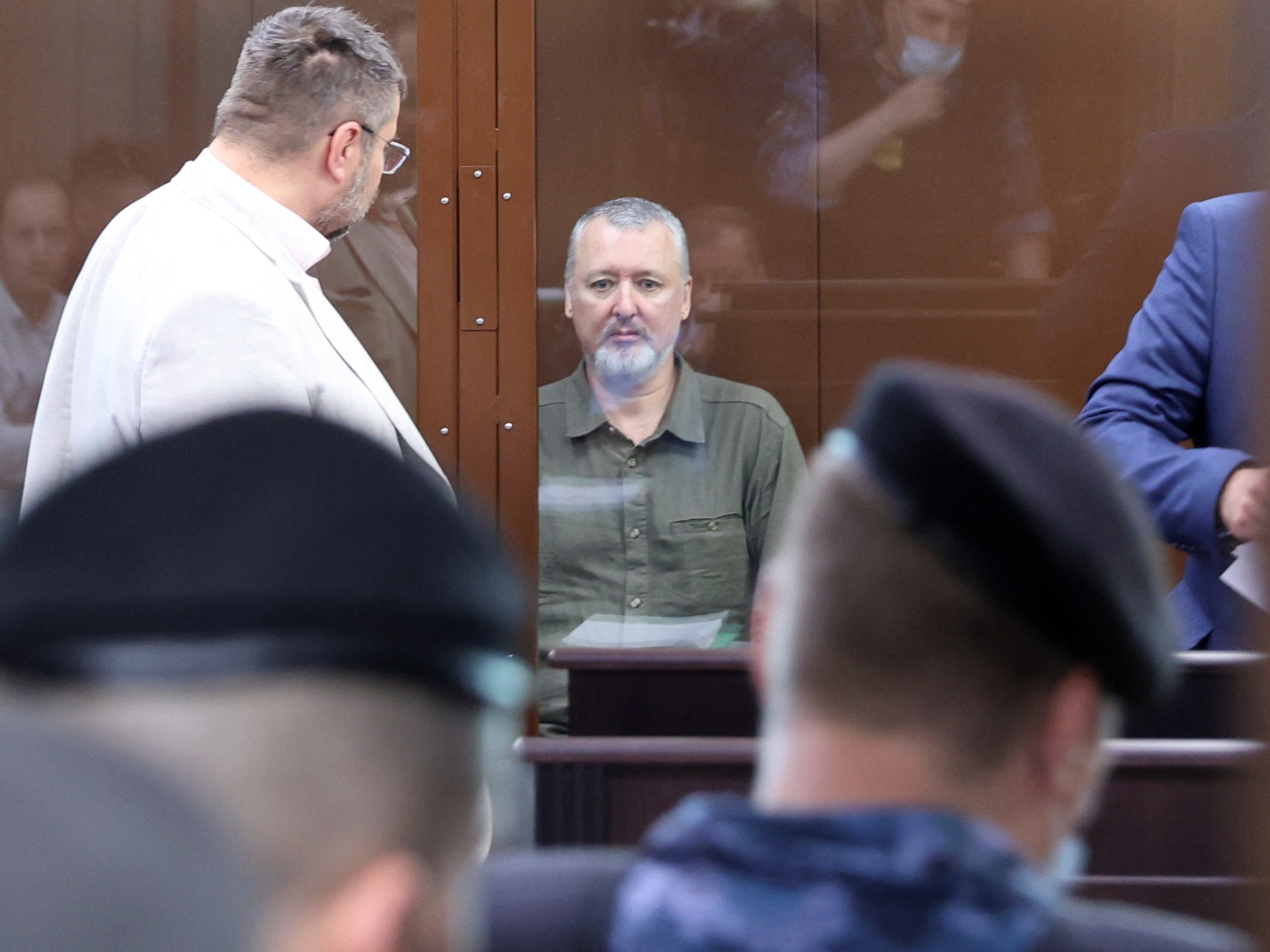
Kyiv, Ukraine – Igor Strelkov, a former Russian intelligence officer whose speeches were filled with historic references, rose to fame as one of the poster boys of the “Russian Spring”.
The term mirrored the “Arab Spring” uprisings of the early 2010s and was coined by Russia to describe Crimea’s annexation and Moscow-backed revolts in southeastern Ukraine in 2014
To the Kremlin’s backers, pencil-moustached Strelkov, now 52, was the perfect antidote for phantom pains about Russia’s long-gone imperial might, a reincarnated czarist-era officer whose “patriotism” justified anything he did.
“I pulled the war’s trigger,” he told the nationalist Zavtra newspaper while describing how he led four dozen armed “volunteers” who crossed into Ukraine’s Donetsk region in April 2014.
Strelkov boasted of ordering the torture and execution of pro-Ukrainian officials, police officers and war prisoners in Donetsk – and carried out at least one of the executions.
To his supporters, his actions meant the dawn of a new page in Russia’s history.
“We all remember these events, this feeling of overwhelming joy and pride for Russia,” a group that calls itself A Russian Movement to Defend Igor Strelkov said on Telegram on August 3.
Nine years later, Strelkov is behind bars.
But he is not imprisoned in Ukraine, where he is wanted for war crimes – nor in the Netherlands, where a court sentenced him to life in jail in 2002 for his alleged role in the downing of the Malaysian MH17 plane that killed 298 people.
Strelkov, whose nom de guerre means “Shooter” and whose real last name is Girkin, was arrested in Moscow on July 23 and faces up to five years in jail for “extremism”.
For thousands of Russians, similar charges translated into real prison sentences, and few doubt that Strelkov will be acquitted
Strelkov was apprehended three days after publishing an angry Telegram post in which he regretted that Russian President Vladimir Putin was a man.
“I am forced to express pity that Putin is not a woman. A weak and not-so-bright woman could have talented favourites,” Strelkov wrote, referring to Russian czarinas who made their favourites key ministers or generals.
Catherine the Great’s favourite Grigory Potemkin conquered Crimea in 1783 – and had fake “Potemkin villages” built in what is now southern Ukraine ahead of his crowned lover’s visit.
Strelkov compared the achievements of Putin’s rule to these villages.
“For 23 years, at the helm of Russia was a nobody who could fool most of Russians,” he wrote.
Strelkov, however, had written similarly critical posts many times before, and analysts agree that his arrest was likely triggered by the May 26 riot of the Wagner Group private army.
Going after Wagner chief Yevgeny Prigozhin, who still has thousands of battle-tested soldiers at hand, is problematic to the Kremlin – at least for now. Meanwhile, Strelkov’s supporters will hardly take up arms to break their idol out of jail.
“He was arrested because it’s easy, doesn’t cost [the Kremlin] anything. He is simply a spent force,” fugitive opposition activist Sergey Bizyukin told Al Jazeera. “He’s got no resources, no people behind him.”
The arrest is also an attempt to tighten control over warmongers.
Putin has for decades tolerated overtly zealous supporters whose radical statements made him look moderate and calm. Some proposed a war on the United States; others touted concentration camps for LGBT Russians.
Strelkov was part of a “hidden radical opposition that is controlled by authorities and comes up with even more monstrous scripts for the war”, Kyiv-based analyst Aleksey Kushch told Al Jazeera.
But Strelkov crossed a line or two and will get away with a relatively small jail term, he said.
Opposition leader Alexey Navalny also stood trial on “extremism” charges – but was sentenced to 19 years in jail earlier this month
Other observers warn of a new wave of purges in Russia.
Since the conflict in Ukraine began in February 2022, the Kremlin has focused on persecuting anti-war activists.
These days, the Kremlin is ready to squash the “right opposition” personified by Wagner’s Prigozhin, a fraction within Russia’s top brass and over-patriotic Russians who demand the war’s escalation, said Nikolay Mitrokhin of Germany’s University of Bremen.
They bristle at the Kremlin and its generals for poor decision-making that led to catastrophic losses of manpower and retreats from several Ukrainian regions last year.
“Girkin was one of the brightest speakers to voice such a position, plus he had a certain authority among the troops and law enforcement officers,” Mitrokhin told Al Jazeera
The Kremlin has already warned the staunchest stalwarts of a wider “total war” to curb their criticism.
“The ‘total war’ supporters won’t go anywhere, but since around February their ‘systemic’ party has visibly and sharply reduced the amount of criticism of top brass,” Mitrokhin said.
The irony is that Strelkov was Prigozhin’s sworn enemy.
Both showered each other with obscenities after Strelkov refused to join Wagner in January.
His arrest followed a complaint written by a former Wagner employee, the RBC Daily, a Russian publication, reported
Strelkov’s arrest and a campaign to silence the warmongers do not mean, however, that the Kremlin is attempting to freeze the war and negotiate a truce with Kyiv.
In mid-July, Moscow suspended a “grain deal” with Kyiv that allowed Ukraine to ship wheat and other foodstuffs across the Black Sea.
Russian cruise missile and drone attacks began to target Ukrainian seaports and terminals, while the Kremlin pushed for legislation toughening punishment for draft dodging.
These steps manifest Putin’s determination to continue the war, and Strelkov’s arrest will prevent him from “corrupting the army with his pessimism”, Mitrokhin said.
The arrest “frightened” Russian military officers, civilian officials, and turncoat Ukrainians serving the Kremlin in occupied Ukrainian territories, a Ukrainian group said.
They began “taking ‘vacations’ to sit out the new ‘purges of cadres’ at home,” the National Resistance Center of Ukraine said days after Strelkov’s arrest. “Most of the Kremlin ‘curators’ [Moscow-appointed officials in occupied Ukraine] left for their homes” in Russia, it said.
From reenactments to war crimes, Strelkov’s road to Donetsk began with a hobby.
A historian by education and monarchist by conviction, he dabbled in reenactments of World War I battles.
In the early 1990s, he joined separatists in ex-Soviet Moldova and Bosnia.
He then enlisted in the Russian military, fought against separatists in Chechnya, and became an officer with the FSB, the main KGB successor once headed by Putin.
Once in Ukraine, he “pioneered” the replication of war crimes committed in Chechnya.
“The orders by Girkin to execute POWs in 2014 were in line with informal Russian rules of engagement in Chechnya,” Ivar Dale, a senior policy adviser with the Norwegian Helsinki Committee, a rights watchdog, told Al Jazeera.
“Girkin is merely the expression of a partly formalised code of Russian armed forces that violate humanitarian law,” he said.
After falling out with a Kremlin-appointed official of Donetsk in late 2014, Strelkov returned to Russia.
Initially supportive of Putin, he eventually switched to lambasting the Kremlin for handling the political fate of separatist “People’s Republics” of Donetsk and neighbouring Luhansk.
The Kremlin and Kyiv negotiated a ceasefire and a batch of accords known as Minsk 1, 2 and 3 that envisaged the “federalisation” of Ukraine and the reintegration of separatist statelets.
But Strelkov criticised the deals and predicted a full-scale war.
“They will have to go to war no matter what,” he wrote in 2015 about Vladislav Surkov, the Kremlin’s chief ideologue at the time. “The war will get them out of their cozy coffins, like vampires, into God’s light.”
Once the war began, he lambasted the Kremlin for not doing enough to win it.
According to Dale, Strelkov should be held responsible for alleged war crimes along with Russia’s top brass and Prigozhin.
“They are all responsible for terrible suffering,” he said. “They all belong in court.”