

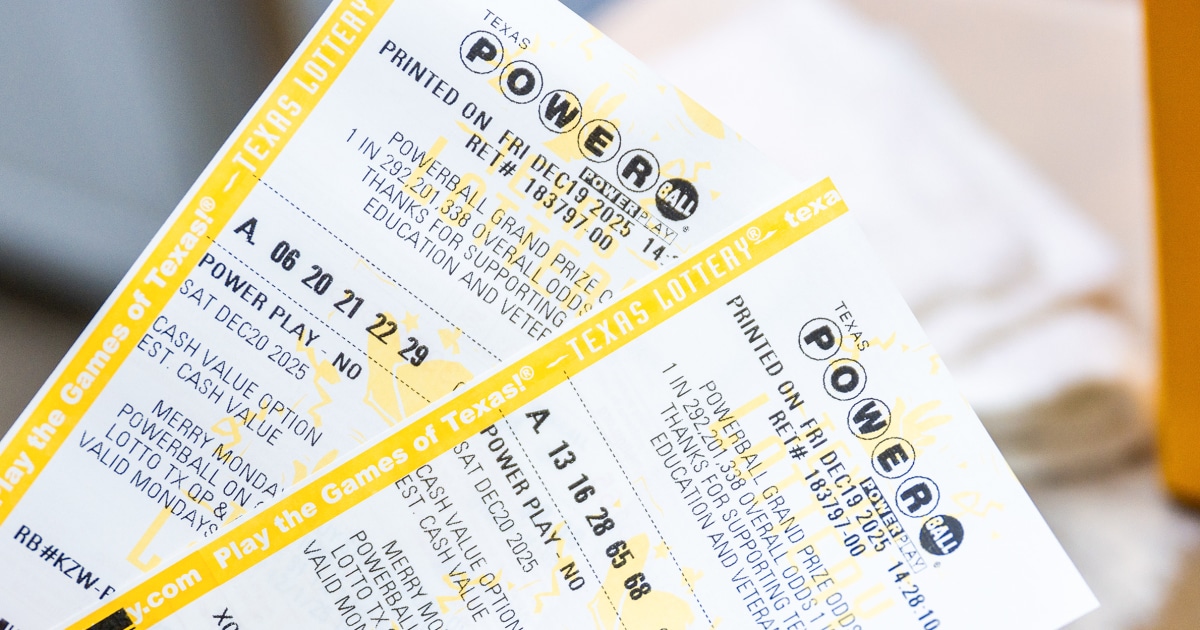
A lucky person who bought a ticket in Arkansas will take home a whopping $1.817 billion Powerball jackpot, which has a cash option of $834.9 million.
The Christmas Eve prize is the second-largest U.S. lottery jackpot ever won and the largest Powerball prize this year, according to a news release from the Multi-State Lottery Association.
I don’t play the lottery so I never understood lottery math. You only get a little more than half of the prize in cash? The rest is taken as taxes? Why don’t they do this to actual billionaires?
A few of topics to cover here to explain it all: 1. Lottery Annuities, 2. Taxation 3. Wealth based Tax Avoidance.
For a lottery grand prize, the actual payout of the total is done via a multiple (30 in this case) payment yearly annuity, usually one that increases in size by a fixed amount (5% for this), where the total face value of the payments equals the winnings. If the winner took the annuity payout, they’d get like $25M today and more every year for 29 more years until they got about $100M, which would equal the jackpot. Alternatively, the lottery offers a “lump sum” payment, based on the value of the annuity (basically what it would cost today for someone to buy that stream of payments), which will be like half of the jackpot face value due to how compound interest works.
For taxes, any lottery payment is income and will be taxed accordingly by relevant entities, this will further reduce the take home amount by another 40%-60%.
For billionaires, they have wealth in the form of investment in the billions, not typically income. There are lots of loopholes here due to tax code complexity, but the 2 common examples are: long term investment tax and loans. If you’ve held any stock for at least a year, you only need to pay a reduced tax amount (this exists to incentivize stable participation in the stock market). Money you received from a loan is not income and is not taxed, lenders will allow you to secure your loan with investment holdings. There might be some additional trickery related to the cost basis used for payments of stock as compensation, I’m not looking into it. Basically, you can combine these into a process where you make large purchases or even day to day based on money from loans, and only pay those off using long-term investments, paying less income tax on your profit from them, which effectively reduces your tax burden. With massive holdings, you can turbo charge this, into what is essentially a ponzi scheme of loans, assuming interest on your investments is better than your loans (which will be lower because of your low risk to default).
Say you have $1B in mixed assets ($700M in long-term assets, $150M in each of short-term assets and cash), you want to buy a $100M house. You basically have 4 choices. Choice 1, pay with cash, you already paid taxes on it at whatever rate you did, but now it can’t earn you money by being invested. Choice 2, sell short-term holdings, you’ll pay taxes on your profits for this year as ordinary income, it also cannot earn more interest. Choice 3, sell long-term holdings, you pay reduced taxes on your profits for this year, it cannot earn more interest. Choice 4, purchase using a loan secured by your stock, you pay no taxes, you can continue to invest all your money which will earn more than the interest payments will cost on the loan. 4b, you take out loans to pay for your other loans, it’s basically always more profitable to keep your money invested and you never pay full tax on investment income if you need to use it.
Say you earn 7% interest in the stock market and loans charge 3.5% interest, a loan to buy the house, you take out 2 lines of credit (loans), you use the lines of credit to pay for the mortgage payments and each line of credit to make minimum payments on the other, and your investments appreciate. Averaged out, you “earn” 7M from your investments you didn’t sell, and accrue only about 3.5M or so additional debt, and pay no taxes on any of it. Each year, this repeats with larger numbers and profit growing faster than debt, you bought a house, you actually paid nothing, people will keep giving you loans so long as you keep having much more holdings than debt, ad infinum. This works until the stock market cracks in half and you earn less interest than debt accrued, but even then you just need to sell enough stock to max minimum payments, and only pay lower taxes on the profits until the market turns around. That’s more or less the extreme example.
There’s another aspect to this, that eventually the loans have to be repaid. That may involve selling assets, which would expose the seller to capital gains.
However, if the loan is held until the owner of the loan dies, then the estate gets stuck with that bill. But the estate inherits all the assets at a stepped-up cost basis. The assets are still sold to pay off the loan, but very little will be owed in capital gains taxes.
It’s so common that it’s referred to as the Buy, Borrow, Die strategy that the wealthy use to avoid taxes.
Because income is taxed not assets.
Old money vs new money. You can read about that more in books like The Great Gatsby.
High net worth individuals don’t have the same income on paper (because that would be taxable at a very high rate), so most of their wealth is tied in assets and investments that can be pulled from and taxed at a much lower rate (or even tax free in certain cases). An ordinary person with a sudden windfall doesn’t have the same treatment, and get the full amount taxed.
Also, the lottery is a tax on those who don’t understand (or are willing to learn) about statistics. Never play.
Also, the lottery is a tax on those who don’t understand (or are willing to learn) about statistics. Never play.
I bought a ticket this time around, and I understand statistics. I understand that my odds of winning are infinitely better with one ticket than no tickets. But the difference between one ticket and more than one ticket is inconsequential. So one ticket it is.
I also understand the odds of winning Powerball are about 1 in 300 million. So once the jackpot gets over 600m or so, the expected value is high enough to justify buying that one ticket.
So, when I see the jackpot get big, I buy a ticket, and dont get my hopes up.
You’d be better off contributing that ticket’s cost as a contribution towards an index or money market fund. Reliable returns compared to that ticket lol
There’s also the entertainment value of the ticket.
No no, I understand the improbability and don’t play, which means I’m better than everyone who does. Quit having fun. Right? Right?
Not only do you recognize the improbability but also the carelessness of throwing that $2 away instead of buying $2 worth of stock which would allow you to retire 3 minutes earlier 35 years from now.
Nah, there’s nothing wrong with having fun. It’s just that you’ll likely never experience the win in your lifetime, so I’d rather use that collective money over time to buy a couple steam games or something, ya know?
The odds of $5 into an index fund turning into $700 million are in fact lower than the odds of winning the Powerball. An occasional gamble in the Powerball is not going to end my retirement plans any more than the occasional latte or avocado toast.
It depends on how the states distribute the income from the lotto. Sometimes a neighbor and I buy a ticket and view it as a donation to the generations behind us.
Billionaires don’t have that much in cash, it’s (mostly and usually) unrealized gains from ownership of stock, which they use as collateral for loans. If you wanted to tax the “assets” of billionaires, you would have to tax unrealized gains on stocks, which would absolutely fuck every person with an investment account, IRA, 401k, 403b, etc. Or you would have to tax loans, which would fuck anyone with a mortgage, or a car, or … you get the point.
It’s not as easy as “tax the billionaires”
Edit to add: as far as the lotto goes, if you take the cash option you only get half the jackpot. And then 35-ish percent goes to the IRS under the “gift” tax (iirc). If you take the “equal payments over 20 years” option, you get the full jackpot split over 20 years but pay the 35% each year and also lose out on 20 years of investment growth. So even though you only end up getting like 40% of the jackpot with the cash option, you come out ahead over the long run
You can get the full amount but it’s split into payments for like 20 years or something. The idea being that is half now is more valuable than double later.
I understand the instant payout’s attraction. In this case, it makes you nearly a billionaire. It solves every financial problem a normal person has immediately. Take the payout, buy a “modest” $1 million home, live lavishly by spending $1,000 every day for 90 years straight, and still have $800 million left - still nearly a billionaire
Realistically you’d probably be taking home $400-500M after taxes but thats still enough to never need to work again and pretty much buy whatever you want.
If you invested $450M and it only earned a low 5% APR, you’d make $22M after just a year and $124M after 5 years which would be enough to live on without ever even touching the principle.
$1 million is just a normal home in most of the populated parts of the US. Literally 3 bedroom, 2.5 bath, 2000 sq ft.
Real estate prices are out of control.
No it’s not. It is that way in some parts, but no where near most.
And it is if you invest it reasonably.
“Buyer”. Sucks for you that you shouldn’t exist now. Luigi comin?
Yeah why be happy for someone having luck and being able to break out of the hamster wheel.
Lotto winners rarely stay out of the hamster wheel.
By definition, people who play the lottery are bad at managing money.
Then everyone they’ve ever known comes out of the woodwork looking for money.
They end up blowing through it in a handful of years and end up poorer than when they started.
My plan for if I ever win the lottery…first thing, before telling anyone (except maybe my wife but she can’t keep a secret for shit), is to find a good lawyer. Not brag to family or friends. Not cash it in. Lawyer.
Then find a real good financial advisor. This amount of money could provide generational wealth. 800m in S&P would earn 40-80 million per year. That’s way more than enough for me and my immediate family to never work again, for several generations.
Of course that’ll never happen, because you can’t win if you don’t play.