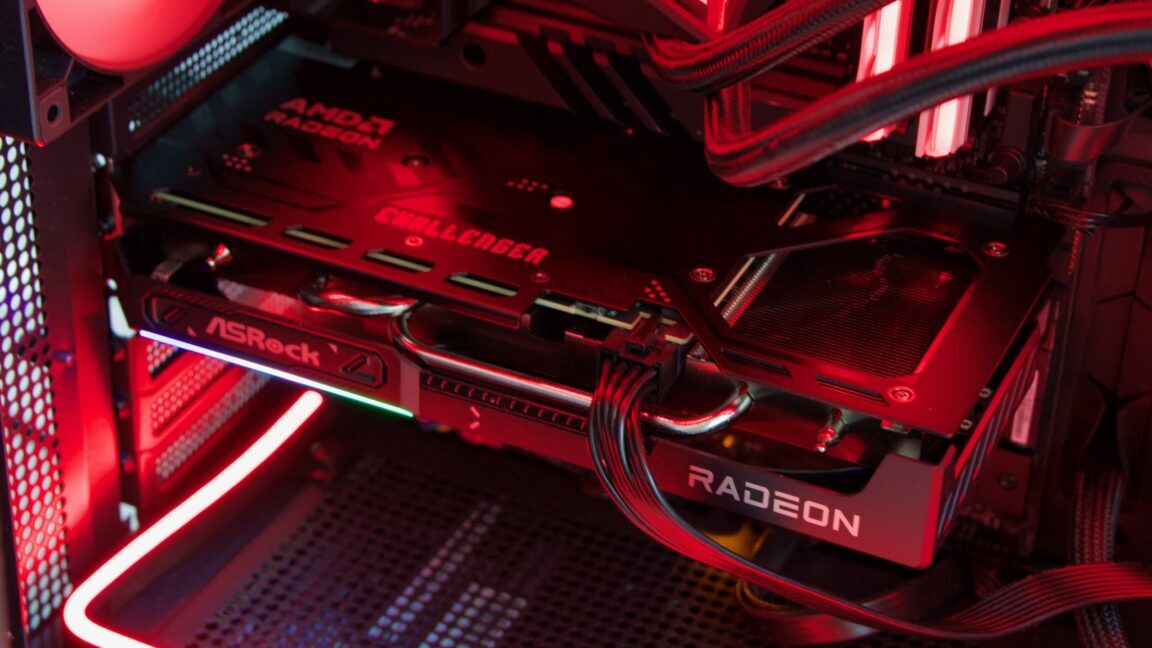
I went to a pc building shop and the price of 64 RAM DDR5 was over $1000. I could have built an entire PC with that price a year ago.
Clearly the best advice is “Build your PC a year ago”
Not even. More like 3 months ago.
The pair of 2x16 DDR5 6000 TEAMGROUP I bought back in April was $90 from Amazon. According to pcpartpicker, pricing started trending upwards late September, which Newegg still had it at $89 (9/30/25; B&H @ $109). The same pair at B&H is currently $439 (12/21/25) and MemoryC is asking $596. It’s insane.
I guess my ageing i5-8400, 16GB, GTX 1060 rig can keep hobbling along a while yet.
Although I was amused to see my Legion Go S actually has a more powerful CPU now.
I guess my 96GB of RAM from 3 years ago will still hold up for another decade.
Get Into books.
or play some (a)vn’s.
So do we expect the cost of gpu’s to also rise due to this? Some money is opening up and next year I wanted to upgrade anyway. Might just need to buy it earlier
One of the commenters said:
“avoid building a PC right now” is advice I’ve been following since 2017
And honestly yeah. I guess at this point if you can afford it, just pull the plug whenever, it’s always some bullshit going on the PC Market anyway.
I built my PC in 2019 right at the end of the year and I thank the gods everyday. I’ve only done one CPU upgrade since and it’s still great for 1440p gaming. The whole tower minus monitor and what not was probably like $900 at the time
Same timing for me also. Still plays new games relatively well. Especially considering I have an ultra wide monitor
how do you think market socialism would solve this problem?
Market is isane that what comlnisme do to a country /s
Don’t consume any AI products. Don’t consume any products made or marketed with AI products. Don’t support any companies than invest in AI or are invested in because of AI. Lets kill this nonsense in 2026 and bring computing, jobs and wealth back into the hands of ordinary people. And a prememptive - NO BAILOUT for the tech bros when this shit crashes.
AI is mainly being aimed at B2B
And isn’t delivering there either
IMO, the pricing is an extortion scam rather than a real shortage. People are falling for it because of AI hype narrative. Best to wait it out.

64GB of DDR3 RAM in a system of that era is straight nuts!
I got a good deal where it was cheaper than the 32gb I intended to have :D It’s DDR4 btw. So it might be worth the whole system soon (1000k for the whole computer in 2017)
Ah, completely forgot that Intel 6th gen introduced DDR4 - I would’ve sworn it was much more recent than that!
You’ve certainly gotten your money’s worth out of your system - that’s for sure!
I went from a 3570K, 16GB, GTX 670 -> GTX 1080 (later SLI’d), to my current rig:
5950X, 32GB, RTX 3090 -> RX 7900 XTX
Just before the Ethereum mining rush took off, and with the current pricing due to AI fuckery - I don’t think I’ll be switching up anytime soon.
Gratz! That seems like you got really good timing to upgrade and then hold on for a bit :)
Yeah, in hindsight it really landed at an opportune time.
It’s a crying shame how greedy companies like Nvidia & Micron have gotten from back-to-back runs on their products - it feel like it will take a generational downturn for them to pull their heads in, and return to the more modest profit margins of the past (which even then was around 30%, IIRC).
That’s actually pretty solid hardware lol get a grip
It still works fine most of the time with a 1080p Monitor :)
I play with less on 2k 120fps
DDR4 is serviceable to me.
Here’s some actual advice for PC builders - what do you actually want from your system? Nothing you say can be vague, you have to set up goals. That’s the entire important note of PC building is what you’re building it for and how long you want it to last for as in, how long until you’re wanting to build another?
Instructions unclear. Purchased a 5090, 9800X3D and 64gb DDR5 RAM for playing Terraria. Also, it has shiny lights.
I want:
- Multitasking speed
- Fast SSD storage for dev tasks, builds…etc
- Large SSD storage for games
- Memory to run multiple development environments, lots of research tabs, and not have to turn them off to go play a game for a couple hours
- A GPU capable of playing most games on decent settings on a 4k monitor (upscaling allowed)
So generally this means:
- mid-high end CPU
- mid GPU
- 64+ GB RAM
- 1x High Performance 1TB m.2 SSD as primary drive
- 1x w/e 2TB m.2 SSD for secondary
RAM prices makes this… Absurd. My current PC is actually getting a bit slow for me now, it’s about 5 years old now, and it’s time for an upgrade. Which is going to cost me 2-3x what it should, simply from RAM…
I commented elsewhere in the thread that one option that can mitigate limited RAM for some users is to get a fast, dedicated NVMe swap device, stick a large pagefile/paging partition on it, and let the OS page out stuff that isn’t actively being used. Flash memory prices are up too, but are vastly cheaper than RAM.
My guess is that this generally isn’t the ideal solution for situations where one RAM-hungry game is what’s eating up all the memory, but for some things you mention (like wanting to leave a bunch of browser tabs open while going to play a game), I’d expect it to be pretty effective.
dev tasks, builds…etc
I don’t know how applicable it is to your use case, but there’s ccache to cache compiled binaries and distcc to do distributed C/C++ builds across multiple machines, if you can coral up some older machines.
It looks like Mozilla’s sccache does both caching and distributed builds, and supports Rust as well. I haven’t used it myself.
My predicament, personally, is that my computer is starting to feel slow to me but I’m on AM4 and ddr4. The good jumps in performance are to be had in moving to the newer generations, which means that buying ram cannot be avoided. The suboptimal move is to stay on this legacy platform and be satisfied with marginal gains while investing further into hardware that will become obsolete sooner
Or use zram/zswap on Linux with ZSTD compression, which dedicates part of physical RAM to compressed swap.
Yeah. I’m on a relatively old build with DDR4, but still a decent processor and GPU. So far gaming have not been an issue with whatever I’m throwing at it. Not much in the way of loading times, and no real problem with the size of it. Some less game-y stuff, like video transcoding and 3D renders, also fine. And while I can see those improving somewhat with DDR5, I’m not sure it’s the actual bottleneck. And gaming won’t be much better with it… I mean seriously, moving loading times from 3 seconds to 2? I don’t really care.
The real issue will be when things starts to break down, as hardware do over time. It’s not that I want to replace the hardware if there’s no pressure from the software side, but I will have to if RAM goes bad, or motherboard decide to not power up.
DDR4 does not fit in my DDR5 slots.
Don’t buy a DDR 5 mobo?
One thing I’ve run into is not performance with old hardware but missing features from the CPU/GPU. Think of tpm 2.0 requirements for Windows 11. There’s other obscure instruction sets that newer games and programs require such as resizeable bar if you want to run a local llm.
I want to be able to run VRChat at high FPS even in the fanciest of settings with a lot of high quality avatars.
I haven’t used it, but my understanding is that it’s vaguely like Second Life, popular with folks creating adult-content-oriented-worlds.
From a technical standpoint, that might actually be a pretty good example of a game that would benefit from cloud gaming, since I assume that it’s not all that latency-critical, not the way an FPS would be.
I guess that there would potentially be privacy issues with adult content stuff that would argue against cloud hosting, but in the case of VRChat, the service itself is already living in the cloud, so…shrugs
VR doesn’t work with cloud gaming, the latency would make you throw up immediately.
That’s fair, but my understanding is that VRChat, despite the name, isn’t a VR-only thing.
My PC currently experiences a memory overload if I play ~150mods Skyrim for more than 2 hours straight. I currently have 16gb DDR4, Gtx1660 Nvidia. My thoughts are that the graphics card is the weak link but those are still too big a ticket.
Sadly it may actually be your ram. I had a 1660 until a couple months ago and the card kept up fine, at least for older games. With 16gb of memory though my system kept bottlenecking. Upgrading to 32 was like a breath of fresh air
That’s exactly what I’m thinking, newest game I play is 10 years old so I’m not expecting my cards to be out any time soon. I’m just miffed that I said I’d get more ram in December and then AI decided to eat all of it in November.
If it’s a leak in a mod and some pages just aren’t being accessed at all, then I’d think that the OS might be able to just page them out.
It might be possible to crank up the amount of swap you have and put that swap on a relatively-fast storage device. Preferably NVMe, or maybe SATA-attached SSD. I mean, yeah, SSD prices are up too, but you don’t need all that much space to just store swap, and it’s vastly cheaper than DRAM.
If you have a spare NVMe slot on your system or a free spot to mount a 2.5 inch SATA drive and SATA plug, should be good.
If you have a free PCIe slot, doing a quick Amazon search, looks like a PCIe card with a beefy heatsink to provide an M.2 slot to mount a single stick of NVMe can be had for $14:
https://www.amazon.com/Sabrent-NVMe-PCIe-Aluminum-EC-PCIE/dp/B084GDY2PW
And a 128GB M.2 stick of NVMe for $20:
https://www.amazon.com/GALIMU-128GB-XP2000-Gen4x4-XP2000F128GInternal/dp/B0FY4CQRYF
I have no idea the degree to which “lots of cheap, fast swap” helps. It will probably depend a lot on a particular use case. In some cases, probably about as good as having the memory. My guess is that in general, it’ll tend to be more helpful on systems running lots of programs than on systems running one large game (though a leak might change that up), but hard to say without actual testing.
If a flash storage device is really heavily used, I imagine that it’ll probably eat through its lifetime write cycles relatively quickly, but if nothing else lives on the device, no biggie if it fails (well, not in terms of data loss for stored stuff), and I don’t expect it being 5 or 10 years until DRAM prices come back down, so it doesn’t need to last forever.
Probably be interesting to see some gaming sites benchmark some of these approaches.
Playing it on a lean linux distro (or simply neutering Windows heavily) helps a ton. There’s tons of Windows stuff that just sits in the background for no reason.
There are also texture optimizers for Skyrim, and some other performance mods.
Honestly, I kinda wish that Bethesda would do a new release of Skyrim that aims at playing well with massive mod sets. Like, slash load time for huge mod counts via defaulting to lazy-loading a lot more stuff. Help avoid or resolve mod conflicts. Let the game intelligently deal with texture resolutions; have mods just provide a single high-resolution image and let the game and scale down and apply GPU texture compression appropriate to a given system, rather than having the developers do tweaking at creation time. Improve multicore support (Starfield has already done that, so they’ve already done the technical work).
I think there are already community tools for texture management and decompression.
And… I don’t know. There’s such a critical mass of mods now that it doesn’t seem worth breaking compatibility with them all once again?
The Skyrim mod scene is actually extremely messy; if you look at other bigs ones (like, say, Stardew Valley), there’s a lot more cohesiveness and performance consciousness among modders. Or Mass Effect, which is more consolidated amongst a few big modsz
So I think the Skyrim community could do a better job of creating an easier to set up, more performant out-of-the-box experience for players, even as jank as the game is. But the game just has a different culture around it, I think.
Funny enough, I’m actually running bazzite. That’s why i know there’s a memory issue instead of windows dicking around lol
Well, just to rule it out, have you tried Windows? Like a neutered windows with defender disabled and such.
I’ve found that Linux can get rather fussy under high memory pressure. It works and doesn’t crash, but it also really bogs down anything high performance once the swapping begins.
It can also get fussy with Nvidia.
So I’m not saying Skyrim will run better on Windows, but it might be worth a shot.
I run CachyOS, yet I still keep Windows around for some other heavily modded games.
The best we can do is just wait when price will fall down after ai bubble will explode
The prices will never go down again. There is literally no reason for the companies to decrease the prices. There will be like a 50$ decrease and people would go “oh look it’s so cheap now!!1!!” and companies will keep making 3 times their profits.
Probably but with all the idiots fueled by sunken costs and desperate to prove they were right to invest, it could still last a long time.
I built a decent PC a couple years ago, and I don’t need to upgrade often since I don’t really care about cutting edge. So I kinda dodged a bullet, but, this sucks.
i built one literally in early November and prices were still normal, that was close haha
Honestly the incentive to “upgrade” a gaming PC the past decade is really weak. Aside from a few AAA titles almost all games run just fine on old hardware. Particularly if you ditch Windows.
So let’s just all refuse to buy this overpriced shit. The same price increases have already happened to GPUs and gamers felt like they “needed” to pay those prices still, nah fuck that, don’t give these greedy pigs a dime.

What I see inside the headset after setting the game to 25% Render scale FSR Ultra Performance Lossless Scaling 5x framegen:

Strangely enough even in 2017 the CPU was the Bottleneck for VR with strange micro stuttering in some games. But most played really well (Moss, Walking dead, Half Life Alyx, Holopoint, Beatsaber, Elite Dangerous etc.)
Honestly, a system with 64GB of memory is pretty well-provisioned compared to a typical prebuilt computer system from a major vendor.
I’ve felt that historically, PC vendors have always scrimped too far on RAM. In late 2025 with our RAM shortage, it’d be understandable, but in many prior years, it just looked like a false economy to me. Especially on systems with rotational drives — the OS is going to use any excess RAM for caching, and that’s usually a major performance gain if one has rotational drives sitting around.
EDIT: And battery. At least in 2025, a lot of people are using SSD storage, and caching that in RAM isn’t as huge a win as it is with rotational drives. But lithium batteries have gotten steadily cheaper over the years. The fact that smartphone, tablet, and laptop vendors aren’t jamming a ton of battery in their devices in 2025 is kinda crazy to me.
I intended 32 GB DDR4 2400 but got a Deal for 64 GB DDR 4 2100 for 10 Euro cheaper. The whole system was only 1k to built myself and the only Upgrades I got was a NVME and SSD over the years. I got really lucky to have a Mainboard from that era with an NVME and USBC slot.
But on the other Hand a AM4 Ryzen chipset would have been nice instead of the dark Age Intel Chipset without being able to Upgrade much…
I’m worried that they’re trying to price us into not owning our machines anymore. You will own nothing and rent from us strategy.
Well, good news!
Valve will bring GameBox upon us.
The big unknown that’s been a popular topic of discussion is whether Valve locked in a long-running contract for the hardware before the RAM price increases happened. If they did, then they can probably offer favorable prices, and they’re probably sitting pretty. If not, then they won’t.
My guess is that they didn’t, since:
-
They announced that they would hold off on announcing pricing due to still working on figuring out the hardware cost (which I suspect very likely includes the RAM situation).
-
I’d bet that they have a high degree of risk in the number of units that the Steam Machine 2.0 will sell. The Steam Deck was an unexpectedly large success. Steam Machine 1.0 kinda flopped. Steam Machine 2.0 could go down either route. They probably don’t want to contract to have a ton of units built and then have huge oversupply. Even major PC vendors like Dell and Lenovo got blindsided and were unprepared, and I suspect that they’re in a much less-risky position to commit to a given level of sales and doing long-running purchases than Valve is.
I’ve even seen some articles propose that the radical increase in RAM prices might cause Steam Machine 2.0’s release to be postponed, if Valve didn’t have long-running contracts in place and doesn’t think that it can succeed at a higher price point than they anticipated.
-
I hear you, you makes sense, but that way lies the death of personal general computing, which would be a crying shame. You’ll have nothing and (won’t) like it a few years later, SaaS taking over powered by all those ‘AI’ datacentres. Peak phone could even have happened if RAM becomes prohibitive, instead they’re just windows on an all centralized, subscription web services. I see it as a pretty existential threat for my preferred way of life.
Probably but with all the idiots fueled by sunken costs and desperate to prove they were right to invest, it could still last a long time.
not necessarily with hardware though. now they are flush with investments and have holes burning in their pockets. everyone is trying to get in on the first stage of AI datacenters.
they may artificially extend the bubble, but rapid hardware expansion/refreshing will be the first thing to slow down or stop when they see it’s not providing value.
Im going to get me a dual CPU thread riper server for $399 when the crash happens!
assuming they will come down, if they can even get people to buy at an inflated price they wont reduce it.
The ai bubble will never pop.
Safeguards have been removed from the market and too many rich people are balls deep. Markets will be manipulated and prices will continue to soar.
nah, it’s a casino. crash will come eventually, the complication is that both bulls and bears want the same thing in the end…higher those lines go up the more $ the people who know how much the underlying is actually worth can cash out.
a crash/correction is just someone cashing out and either not putting the $ back in or atleast actually putting thought behind how they put it back in. the real suckers are the ones buying into everything automatically no matter the price.
Thats how bubbles pop. Those safeguards dont prevent an infinite money glitch, they stop the entire system from crumbling in a mild headwind. People always think this time is different during the growth phase of the bubble.

Why do you need a computer? Here is the AI on your smartphone, enjoy!
“Do you guys not have phones?“
As (relatively) old as they are, midrange Core i5 chips from Intel’s 12th-, 13th-, and 14th-generation Core CPU lineups are still solid choices for budget-to-midrange PC builds.
I would be hesitant about obtaining secondhand 13th or 14th gen desktop Intel CPUs, since those are the ones that destroy themselves over time. There is no way to know whether they’ve been run on non-updated BIOSes and damaged themselves. I burned through an i9-13900 and an i9-14900 myself. Started with occasional errors and gradually got worse until they couldn’t even get through boot. I am sure that there are lots of people trying to unload damaged processors (knowingly or unknowingly) that have only seen the early stages of damage.
12th-gen CPUs are safe.
Consider pre-built systems. A quick glance at Dell’s Alienware lineup and Lenovo’s Legion lineup makes it clear that these towers still aren’t particularly price-competitive with similarly specced self-built PCs. This was true before there was a RAM shortage, and it’s true now. But for certain kinds of PCs, particularly budget PCs, it can still make more sense to buy than to build.
I just picked up two Alienware PCs for relatives to take advantage of this window, but it was only something like a two-week window, where Dell announced at the beginning of December that they were doing price increases to reflect the RAM shortage mid-December. I believe that that window is closed now (or, well, it might still be cheaper to get DIMMs with a PC than separate, but not to get memory that way at pre-memory-shortage prices any more).
EDIT: From memory, Lenovo announced that they were doing their RAM-induced price increases at the beginning of January, so for Lenovo, it might still work for another week-and-a-half or so.
EDIT2: 15th gen Intel CPUs are also safe WRT damage, but like AMD’s AM5-socket processors, they can’t use DDR4 memory, which is what the author is trying to find a route to do.