

cross-posted from: https://news.abolish.capital/post/15189
Top Democratic officials in Colorado are among those condemning President Donald Trump’s denial of two disaster relief requests from Gov. Jared Polis—his latest action in a state that critics say he is retaliating against for its prosecution of a former county clerk who was involved in election denial efforts in 2020.
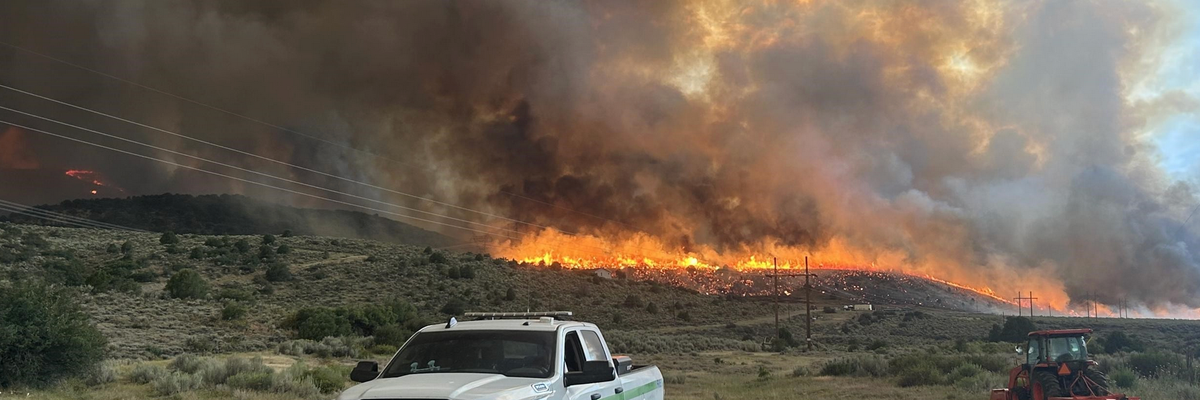
After the White House denied the requests for Trump to declare major disasters in parts of Colorado that experienced the Lee and Elf fires in August and flooding in October—a move that would unlock Federal Emergency Management Agency (FEMA) funding to help with recovery efforts—Polis joined other Democratic leaders in calling on Trump to reconsider and accusing him of playing “political games.”
“One of the most amazing things to witness as governor has been the resilience of Coloradans following a natural disaster,” said Polis. “Their courage, strength, and willingness to help one another is unmatched—values that President Trump seems to have forgotten. I call on the president’s better angels, and urge him to reconsider these requests. This is about the Coloradans who need this support, and we won’t stop fighting for them to get what they deserve. Colorado will be appealing this decision.”
The governor was joined by Democratic Sens. Michael Bennet and John Hickenlooper in speaking out against the denial.
— (@)
Polis made the requests in late September and last month, noting in his first request that Rio Blanco County, which both fires ripped through, has an economy driven “largely by energy production” at the Piceance Basin.
“This local industry is powered by two local utility providers who have sustained over $24 million in damages to their infrastructure,” his office said. “Without support to recover local utility infrastructure, stalled production risks the local economy, major rate increases on Coloradans, and local economic collapse.”
In November, Polis noted that FEMA had confirmed $13.8 million in damages to public infrastructure from flooding in several western counties, with roads and bridges particularly affected.
Communities also have ongoing debris removal needs, sewer system failures, and damages to essential drinking water and wastewater infrastructure.
The Stafford Act authorizes the president to declare a major disaster in order to unlock additional federal funding to respond to floods and other emergencies.
Trump has sought to reduce federal funding that goes to states for emergency management—denying at least 12 requests from states between January-October, with Democratic-led states facing many of the denials.
He has overtly politicized disaster relief, announcing in August that any state or city that boycotts Israeli products in protest of its attacks on and policies in Palestinian territories would not receive funding they requested.
Despite this, White House spokesperson Abigail Jackson told The Hill on Monday that “there is no politicization to the president’s decisions on disaster relief”—but Polis and other Democrats suggested the flooding and fire relief request denial was part of Trump’s larger efforts to retaliate against the state of Colorado.
Last week, the president’s top budget adviser, Office of Management and Budget Director Russell Vought, announced the administration was dismantling the National Center for Atmospheric Research (NCAR), a major climate research and meteorological facility in Boulder.
A number of critics said that move appeared to be in retaliation for the conviction in a state court of Tina Peters, a former county clerk who was found guilty of allowing someone access to secure voting system data as part of an effort to prove the baseless claim that the 2020 election was stolen from Trump.
Despite uncertainty about Trump’s authority to pardon Peters, the president claimed recently that he will do so. He has directly attacked Polis for Peters’ treatment by the state.
“When the people of Western Colorado need assistance the most—as recovery from the Elk and Lee fires continues—President Trump abandons them in a blatant act of retaliation against our state,” said Rep. Joe Neguse (D-Colo.) on Sunday night of Trump’s latest action toward Colorado. “Shameful.”
From Common Dreams via This RSS Feed.
Is there any sort of legal or social contract here that the state(s) could argue is being violated, as grounds to draw up a resolution of secession? Would such a threat do any good? Maybe this isn’t the ‘hill to die on’ but… what will be, if anything? Am I out of question marks? :p
I’m not American so I don’t know if this even makes sense, but at what point will states have to take things to another level in their relationship with the Federal government?
The realistic answer is lawsuits. They take a long time and don’t make headlines but there’s probably been more successes than most people realize.
There’s regional health cooperatives, for things like vaccine recommendations now that CDC is mostly conspiracy theory nonsense.
Trump may have withdrawn the us from the Paris Accords, but 24 US states and many cities committed to the climate initiatives. There’s less they can do as Trump rolls back efficiency standards and air pollution regulations but they do have control over local issues like energy portfolio standards, building requirements, insulation and appliance updates, incentives for businesses and homeowners, etc. my state still has some pretty compelling incentives for energy improvements
Varies from State to State. New Hampshire has one of the best IMO
https://www.nh.gov/glance/state-constitution/bill-rights
[Art.] 7. [State Sovereignty.]
back to top
The people of this State have the sole and exclusive right of governing themselves as a free, sovereign, and independent State; and do, and forever hereafter shall, exercise and enjoy every power, jurisdiction, and right, pertaining thereto, which is not, or may not hereafter be, by them expressly delegated to the United States of America in Congress assembled.