

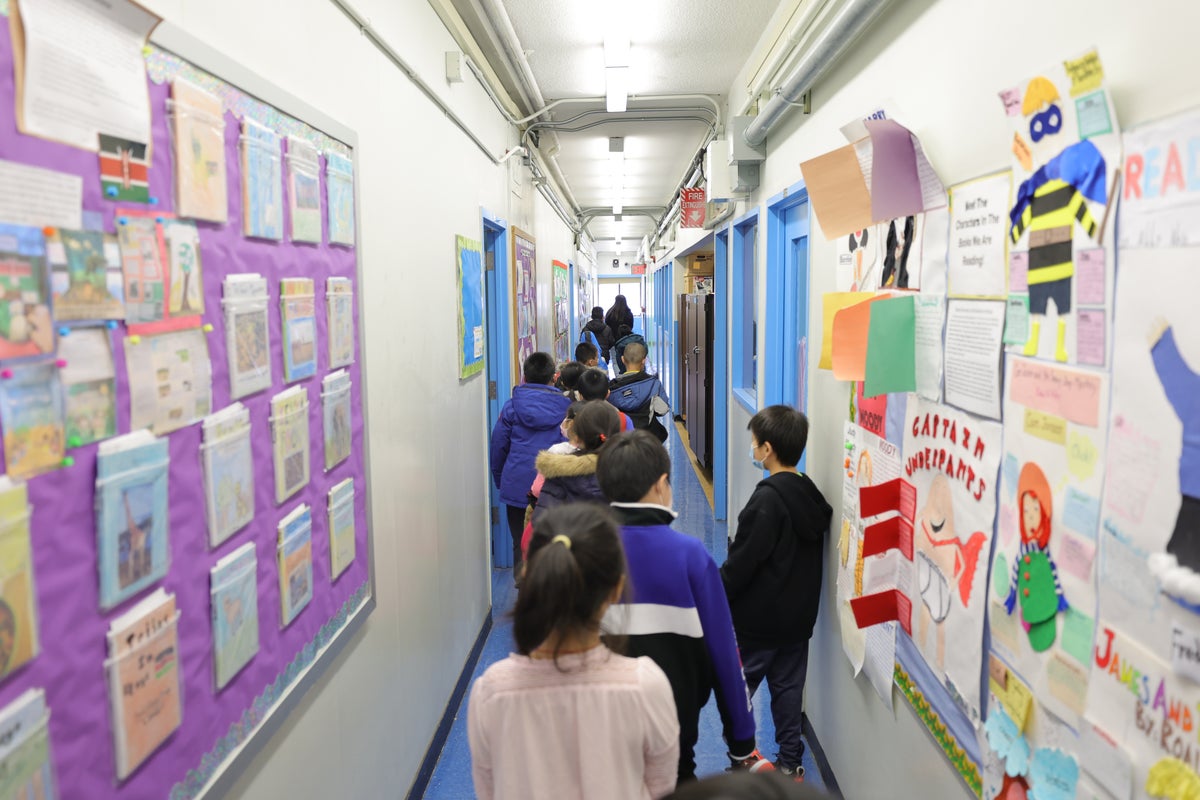
At least 31 states and the District of Columbia restrict cell phones in schools
New York City teachers say the state’s recently implemented cell phone ban in schools has showed that numerous students no longer know how to tell time on an old-fashioned clock.
“That’s a major skill that they’re not used to at all,” Tiana Millen, an assistant principal at Cardozo High School in Queens, told Gothamist of what she’s noticed after the ban, which went into effect in September.
Students in the city’s school system are meant to learn basic time-telling skills in the first and second grade, according to officials, though it appears children have fallen out of practice doing so in an increasingly digital world.
I’ve been hearing this since I was a kid, though back then they just blamed the use of digital clocks instead of phones.
“These newfangled analog clocks with hands are killing the ability of people to understand clock bells. Kids these days.”
https://en.wikipedia.org/wiki/Striking_clock
I just want to say, as someone who lives near such a bell, I’m grateful that they appear to observe “quiet hours” between 8pm and 8am. When I first moved in, I was worried it’d be dinging all night. Thank goodness that’s not the case.
I just have car alarms going off for no reason at 4am to worry about.
I thought these were still common? Any time I’m near a church they do their thing every 15 minutes, banging one bell 1-4 times and then if it’s 4 they bang another 1-12 times, signaling the time.
Well, not entirely, they’re usually quiet during the night, but you get my point.
Didn’t know people can’t understand those anymore.
The one near me plays the 4 bar “Westminster Quarters”. It plays one bar for each quarter hour. The full song on the hour, and bangs out the hour.
I used to live in a city with many striking clocks, which meant that no matter where you were in the city, you could probably hear a bell ring out on the hour.
I’m realising now how much I miss it. I remember times like drinking with friends into the wee hours of the morning, when we would hear a bell and then all fall silent as we counted how many chimes there were. If it was only 2, we would laugh and continue, but for four or more, we would wince and contemplate the future consequences of our choices.
Or while doing an all-nighter to get an assignment in before a morning deadline, how my handwriting speed would become a touch more frantic with each passing chime
I used to think it was a meme too and I still think it is to a point. But several of my recent jobs were at universities and I have met several people younger than me now who cannot read an analog clock, use a mouse, copy a file to a flash drive, or make change. To say nothing of their ability to find information that can’t be googled (like the location of a classroom). I have really begun to feel that the general population has absolutely failed GenZ and I really hope we can break the pattern before GenAlpha gets much older.
I met someone the other year who didn’t know the difference between cut and paste, and copy and paste
Edit: I agree with the last part of your comment especially. So often, I see people blaming GenZ for their lack of knowledge, but that feels unfair to me. From my perspective as a younger Millennial, it looked like society seemed to assume “oh, GenZ are digital natives, so they’re naturally a whizz at all this computer stuff” and often assumed that it wasn’t necessary to do much work to teach them how to use computers. Now that I’ve had more chance to meet GenZ folk in the workplace, I’ve heard this complaint from them a lot.
It’s made me grateful for growing up as a Millennial. I was too young to experience the early days of computing, but at least I got to experience computers and the internet before they became the closed, walled-off gardens that GenZ grew up with
Elder millennial here, I also struggle reading analogue clocks to this day. I can, but it just takes me a long time to do so. And I’ve been like this since I was a little kid.