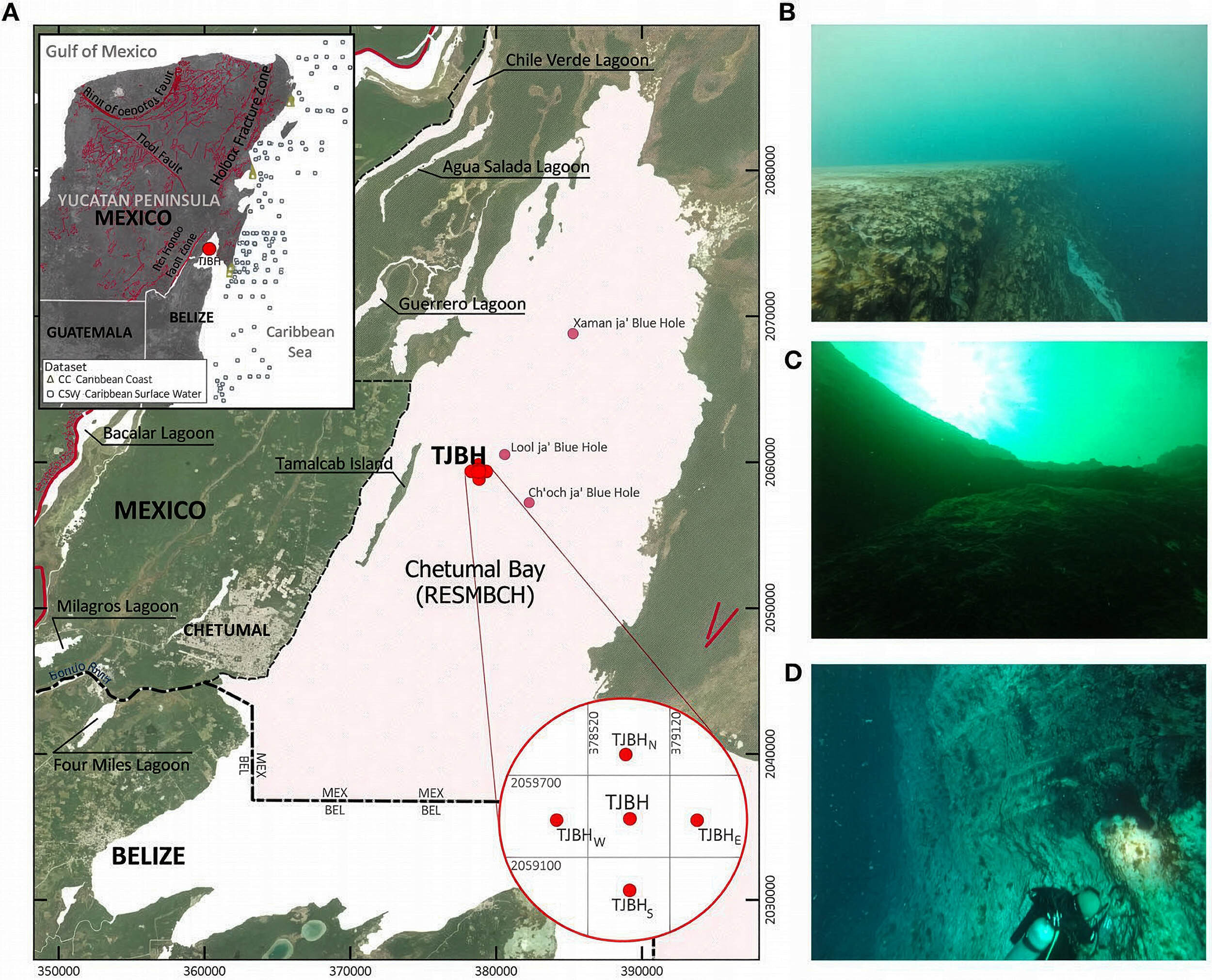
From the surface, Chetumal Bay looks almost placid – just a wide sheet of water with no hint of drama underneath. But below that calm is Taam ja’, a massive underwater sinkhole, or “blue hole,” that’s turned into an unexpected mystery for scientists.
At first, the plan seemed straightforward: map it with sonar, get a depth, move on. Instead, the early readings created a bigger problem – what if Taam ja’ isn’t anywhere near as shallow as those first numbers suggested?
The most recent measurements point to a hole that drops far deeper than expected, and the true bottom may still be out of reach…
Below about 1,300 feet (400 meters), the trend shifted. Temperature began to creep upward slightly while salinity climbed even higher. That combination suggests the deeper water has a different origin – its own distinct “signature.”
When the team compared the measurements to nearby regional waters, the upper layers lined up with the bay’s mixed, lower-salinity water. The deepest measured layers, though, moved toward values more typical of Caribbean marine water.
That doesn’t prove there’s one big open tunnel connecting Taam ja’ directly to the Caribbean, but it does support the idea that the deepest water isn’t coming only from the bay above.
Why do so many of the exact same posts, not cross-posts, show up twice on my feed?
Scientists discover OP’s mom.
I think they are wondering how deep it is not how thick
Yeah I reckon I could figure out how deep it is but I’m kind of busy right now with other stuff.
So the line they brought for the CTD was only 500m, and they only made it to 423 before the reading didn’t line up with the wire out.
So it’s deep, but sometimes you can’t bring the CTD & winch you want, you bring the one you can get.
They’ll figure it out sooner than later, but for anyone who works with these thing it’s clickbait title.
I wouldn’t be surprised if someone gets funding or a billionaire to want to film this hole so they’ll stick an ROV in it and make a documentary about it. That would probably be more reliable than a standalone CTD or rosette.
I assume a guy named Dave is running a sushi shop nearby with some pals?
And one of those pals is the coolest dude ever?
Send some billionaires in a fancy sub! They have a great track record in the deep.
Send them all, in one big one.
It’s still astounding that really happened and wasn’t just the plot of a “Down Periscope” type movie.
If only they’d have gotten advice from [REDACTED], the director of Titanic.
Haha.
If only they’d done a 30 second search on why this is a bad idea… Or the lack of testing.
The thing is they DID test it! And they even had a working failure detection mechanism with the microphones. They had seen the signs of failure from previous dives. And then just ignored all of that.
Wow.
Guess their definition of test and mine are different. I’d want a whole slew of testing regimen, including test to failure over a long time - essentially years of running it unmanned.
You can definitely thoroughly test something then ignore the results.
I don’t think it would’ve mattered because they had all the evidence they needed and just ignored it regardless.
Avatar Rule 34 be like.
Was gonna make a similar joke but with Smurfette.
That’s a search that seems like it could backfire horribly.
Accepted
Whatever might be down there isn’t expected to be valuable enough to risk limb and dollar to reach.
FTFY
Just a beer bottle probably.
It’d probably be less expensive than something stupid like sending a Tesla to orbit.
Didn’t they basically just use it as a payload for a test flight, though?
If you’re already launching garbage into orbit, you might as well use your specific garbage for marketing.
Relevant username.
The only thing we can know for sure about a hole that deep is that there are bodies at the bottom.
Sounds like they need to try harder.
Papa Smurf’s butthole?
We should know about how deep it is if we know the dimensions of the Earth’s core. There has to be a good amount of rock between that and the bottom of this trench.
We may not be able to send a human (or other biological being) down there, but we can certainly run a pipe down there. The question is, can we get lights and a camera that can withstand the pressure and show us what’s down there? I wanna say yes, we have solid state lighting that would not be subject to pressure, same for recording materials, but I’m not 100% sure. I would say for a camera you need space between the lens and the glass, and the lens and the image sensor, but I’m not sure you can’t just use glass instead of air, if it’s clear enough.
I am almost certain it can be reached, but I’m almost certain a human can’t go there.
We have submersibles that can explore and even carry a human to the bottom of the Mariana Trench, which is over 10km deep, far deeper than this hole could possibly be. But they are very expensive and I’d guess it’s not worth the cost to map out an obscure feature of a bay.
We should assemble a team of billionaires and send them down there in a plastic submarine. For…science.
If they get the writer of this article to help write their grant proposal, they may just get the money.
They only got to 1300 feet which is well above crushing depth for remotely operated vehicles and cameras. Challenger deep is 35,000 feet and 27 people have been down there.
I would assume the bigger problems will be visibility (cave systems tend to have murky water and it sounds like the bay also has murky water) and being able to maneuver an rov or submersible in the passages. Some caves are so narrow that cave divers have to take off their gear and squeeze themselves through a passage so getting an rov in would be impossible.
Not to immediately gainsay what you’re talking about but I think visible light isn’t necessary for “vision”. Think radar, etc
Caves, especially sink holes and cenotes in mexico actually tend to have pretty clear water. The murkyness in water comes either from organic matter or silt. If there’s no light there is no algae to limit visibility. If the cave has flow the silt is often carried away quickly. If there is no flow the silt will sink to the bottom, clearing up the visibility. Once the silt is disturbed (e.g. by a diver kicking their fin in the wrong direction) it can take a long time to settle again.
Right, I just mean the pole would be able to poke the bottom of whatever hole. As far as exploring, yeah, I mean of course a cave system beats a straight pole lowered from the surface.
I’m thinking some kind of automated submersible, like a drone but in the water.
The murky water is something I don’t have an answer for. Then you’re just falling back on sonar.
I don’t think they’ll find Godzilla down there, or any kind of “monster” or anything that would wow the average doom scroller. But we might find new life down there, something that is suited to the higher pressure. And that could be interesting. Though, just like we’d die down there, it would likely die “up here”.
anchor
Interesting read!