

Putting the ART in ARTificial gravity
This is both an artistic experiment with engineering and a social experiment, given how my usual kind of art (occult symbolism, owls, etc) may feel too complicated for many and it’s often met with indifference. Yeah, aerospace engineering is also complicated (after all, it’s literally “rocket science”), but it feels to me like this kind of subject (hard sci-fi, Star Trek, etc) is more “socially sanctioned” in Fediverse than my usual kind of subject…
Given the latest happening involving my time-lapses (which I’ve been trying to post as a proof of human authorship), this time I’m not posting it. I do have the time-lapse for this art, if anyone is interested in seeing how I drew.
Alt-text:
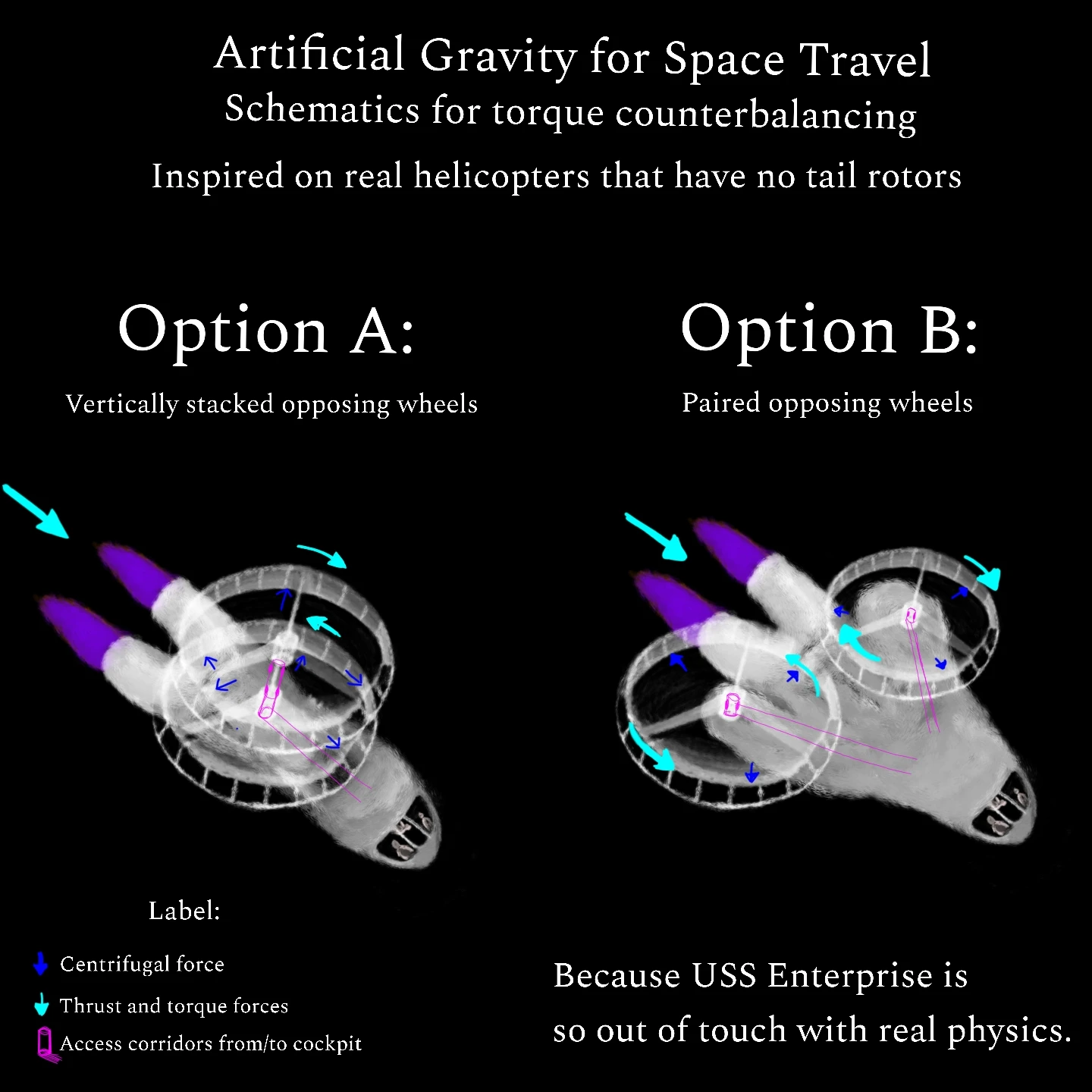
A schematics-like digital art entitled “Artificial gravity for space travel: schematics for torque counterbalancing inspired on real helicopters that have no tail rotors”, divided in two panels.
Both panels feature a isometric view of a faintly translucent spacecraft with a gray hull and front-facing cockpit (whose window shows 3 people inside, one of them upside-down weeee-ing in microgravity behind the other 2) very similar in shape to the NASA’s Space Shuttle (I actually thought of it as I drew), but with a pair of big ionic thrusters (emitting a strong purple glow) at the rear, as well as a pair of large rotating rings attached to the top of the hull, meant as a centrifuge for artificial gravity. The rings, rotating in opposite directions so to cancel out a torque that would otherwise inflict attitude onto the ship (as per Newton’s 3rd Law), are attached through 3 equidistant I-beams to a smaller cylinder (which doubles as a hallway from/to the rest of the ship) which, in turn, is attached to the husk, in different configurations across the panels.
The first panel, “option A: vertically stacked opposing wheels”, is self-descriptive: the rings are on top of each other, rotating in opposite directions in the same axis, much akin to coaxial-rotor helicopters (e.g. Sikorsky S-69).
The second, “option B: paired opposing wheels”, features a configuration akin to transverse-rotor helicopters (e.g. Landgraf H-2), but with a wingspan slightly angled backwards. Each ring is attached to opposite wings.
At the bottom, there’s a label box, describing the meaning of each arrow overlaying both diagrams: cyan arrows represent both the thrust for the ship and rotation for the rings, while blue arrows indicate the gravitational force from the centrifugal motion. A third overlay, painted in magenta, shows the locations for hatches and corridors connecting the inside of each centrifuge to the cockpit and the rest of the ship.
There’s also a jab at Star Trek: “Because USS Enterprise is so out of touch with real physics”, nodding at how Spock and his crew were “simply” able to stand inside the ship as if gravity was something taken for granted outside a planet.
@[email protected] @[email protected]
Lol
Indeed, the scale in which I depicted the idea isn’t accurate and, in reality, the whole thing should be way bigger, which means the astronauts would be barely visible from outside the cockpit’s windows.
At least in a mental model, if these models had larger dimensions than they’re currently implied to have, the spaceship’s body/hull would end up heavier than the rings, even when the rings are also scaled up, because the volume and the surface of the hull is implied/expected to exceed those of the rings, whose materials should be “truss-like” (i.e. hollow) for these to be lighter than the ship’s hull.
But, welp, it’s been a long while since I tinkered with Kerbal Space Program.
My desktop went to the big compost bin in the sky a couple of months ago and I’m just about at the point where I’ve saved enough for a replacement, and KSP is literally the first thing I’m itching to dive into when I do.
If you have the funds consider donating to KSA!