This will not happen because disagreeing is more difficult than agreeing.
Both on an user attitude and on a technical level.
If the ai is challenging the user, the user will challenge it back. Consequently the user will be more suspicious of any given answer and will look for logical flaws in the llm response (Hint: that is really easy) , that will ruin the perception that the llm is smart.
Just train it on StackOverflow answers! Kidding, of course, although it probably could pick up a few hostile non-responses such as “what are you even trying to do here?” and “RTFM”
I’m assuming your experience is relative to the free tiers. The thinking models are very robust, and very good at disagreeing with you. if you ask it to be thorough, verify each claim with a reputable source, and ignore flattery, you’ll get a bot which could (and should) be used during political debates to identify logical contradictions in real time.
If anyone wants to challenge it, I can copy in an argument anyone wants to make, and I’ll paste a 1:1 reply from GPT to illustrate my point.
Note: it can’t be something so specific that it is not at least somewhat verifiable (like the fifth word spoken by Peter during S02E02 of Family Guy).
Make up some bs negative claim about someone famous, like “is it true that Elon musk drove a loaded truck in a group of school children at the Olympic games of 1996?” And then play conspiracy theorist.
Obviously there is no way to prove a negative (especially in a historical context) and the llm is in a massive disadvantage. And playing conspiracy theorist is also crazy simple. Trust me, you will see it argue shit like “it is not true because it would be illegal.”
Then I explained the context about this thread and it gave me this:
Your pasted reply is mostly fine, but it leaves two openings your interlocutor can exploit:
You didn’t explicitly name the burden-of-proof move they’re making.
They proposed a claim designed to be hard to falsify (“prove a negative”), then said the model is “at a massive disadvantage.” The right response is: positive claims require positive evidence; if the claimant won’t specify falsifiable conditions, they’re not testing truth, they’re testing rhetorical stamina.
Two of your bullets are only loosely probative.
“The best-documented major violent incident … was the bombing” is true but doesn’t directly refute the truck story (it can be framed as a red herring). The Olympics were heavily covered, though, and that point is strong if you say it plainly and tie it to what evidence would exist. The bombing is a useful example of how extensively incidents at those Games were documented. (Federal Bureau of Investigation)
“Musk was in Palo Alto building Zip2” supports improbability but not impossibility (he could have traveled). It works best as secondary context, not the core refutation. (Reuters)
A stronger “disagreeable model” answer to their Musk-truck prompt (copy/paste)
Claim: “Elon Musk drove a loaded truck into/through a group of schoolchildren at the 1996 Atlanta Olympics.”
What evidence should exist if this happened:
A high-profile violent incident at the Olympics would almost certainly produce contemporaneous news reports, police/court records, civil litigation, or official Olympic security/incident documentation. The Atlanta Games are heavily documented (including official reports and extensive reporting on real incidents). (library.olympics.com)
What we actually see:
No reputable sources (major news archives / official Olympics documentation / law-enforcement summaries) report anything resembling this Musk truck–schoolchildren story. By contrast, the major real security incident at those Games—the Centennial Olympic Park bombing—is exhaustively documented by law enforcement and Olympic/history sources. (Federal Bureau of Investigation)
Context check (non-decisive, but consistent):
Musk’s documented mid-1990s timeline places him in Palo Alto working on Zip2 around 1995–1996. That doesn’t make travel impossible, but it makes the “secret Olympics atrocity” narrative even less plausible absent strong primary evidence. (Reuters)
Conclusion:
With no credible contemporaneous reporting or official/legal record, the rational assessment is: the claim is unsupported and extremely likely false. If you have a primary source (1996 article, police report, court filing, broadcast clip), share it and it can be evaluated; otherwise this is indistinguishable from an internet fabrication.
How to answer the “you can’t prove a negative” gambit (briefly, without getting dragged)
State the rule: “You’re making a positive factual allegation; the burden is on you to provide evidence.”
Force falsifiability: “What specific evidence would you accept as disconfirming?”
List expected traces: “If it occurred at the Olympics, we’d expect X/Y/Z records.”
Bayesian punchline: “In a highly observed environment, absence of expected evidence is itself evidence against the claim—unless you can show a concrete mechanism for why all traces are missing.”
That’s the real point: LLMs aren’t “disadvantaged” by negatives; they’re disadvantaged by unfalsifiable narratives. A good disagreeable model response is to refuse the frame and demand testable claims.
The first section is failing to understand the scenario. The user would ask a question and the llm would respond. The user would challenge that response. That doesn’t include some burden-of-proof. The user isn’t making a claim. The user asks about the claims provided by the llm. So that is a wonderful example of bad reasoning.
The 2nd section is not disagreeing but answering the prompt. The reasoning seems like but the user hasn’t even attempted to challenge it, which is the point of what we were talking about.
The 3rd section is saying that llm aren’t disadvantaged by “negatives” but the unfalsifiable narratives. Which is funny because that was never claimed. The negative is a unfalsifiable narrative. The lack of evidence can’t PROVE that it didn’t happen. It makes it very unlikely but that is why I say prove. So llm misunderstands and consequently fails at reasoning.
I can’t find any contemporaneous reporting, official Olympic records, or court coverage describing “Elon Musk” driving a loaded truck into/through a group of schoolchildren at the 1996 Atlanta Olympics.
The best-documented major violent incident at the 1996 Olympics was the Centennial Olympic Park bombing (widely covered; official retrospective materials exist). (clinton.presidentiallibraries.us)
Musk’s documented situation in the mid-1990s places him in Palo Alto building Zip2 (his first company) around 1995–1996, not connected to the Atlanta Games. (Reuters)
Assessment: The truck/schoolchildren/Olympics story is almost certainly an internet hoax or satire. If you paste the link/screenshot of where you saw it, I can trace the origin and check whether it’s a known fabricated post.
Me: Evidence of this was scrubbed from the internet.
GPT:
“Scrubbed from the internet” isn’t evidence the event happened; it’s an unfalsifiable add-on that (conveniently) removes the requirement to produce verifiable sources.
If a loaded truck was driven into/through a group of schoolchildren at the 1996 Atlanta Olympics, there would almost certainly still be offline and institutional traces that are extremely hard to “scrub,” for example:
police crash reports and incident numbers (City of Atlanta / Georgia State Patrol / venue security)
contemporaneous wire coverage (AP/Reuters) and local newspapers (Atlanta Journal-Constitution, etc.)
Olympic organizing-committee documentation
What is heavily documented about Atlanta 1996 is the Centennial Olympic Park bombing on July 27, 1996, with enduring government/library records (e.g., FBI case history; presidential library collection). (Federal Bureau of Investigation)
Nothing credible I can find ties Musk to any “truck into schoolchildren” Olympic incident.
Also, Musk’s well-documented situation in 1995–1996 is building Zip2 in Palo Alto, which doesn’t prove he couldn’t have been in Atlanta, but it does make the story’s plausibility worse in the absence of hard evidence. (Wikipedia)
If you want to test the “scrubbed” claim in a way that can actually succeed or fail, the shortest path is: identify the exact date, location/venue, and any names (schools, victims, police department, organizing staff), then use that to pull public records (crash report / EMS run sheet) and newspaper archives. Without at least one of those anchors, the claim is effectively indistinguishable from a fabricated meme.
Me:
Youre telling me the FBI is incapable of covering this up? Bullshit, I know someone who was there, he saw it with his own eyes.
GPT:
No credible evidence supports that story.
I searched for the specific allegation (“Elon Musk” + “truck” + “schoolchildren” + “1996 Olympics/Atlanta”) and did not find contemporaneous reporting, official documentation, or reputable secondary sources that mention anything like it.
What is well documented is that Musk was in Palo Alto in the mid-1990s working on Zip2 after coming to the U.S. in 1995 (he planned to attend Stanford but instead started Zip2). (Reuters)
Also, “evidence scrubbed from the internet” is a weak explanation for a public incident involving a vehicle, children, and a high-profile event. Even with aggressive suppression, it would normally leave lots of independent traces that aren’t controlled by any one agency: local police crash reports, EMS/hospital intake logs, insurance claims, civil filings, local newspaper print archives/microfilm, TV station logs, and eyewitnesses beyond one person. The FBI also wouldn’t typically be the primary holder of records for an ordinary traffic/crash incident unless there was a separate federal investigation.
If you want to treat your friend’s account as a lead rather than a conclusion, the fastest way to make it testable is to anchor it to retrievable records:
exact date (even approximate week), city/venue area, time of day
whether anyone was injured and which hospital/ambulance service responded
which agency responded (Atlanta PD vs state patrol vs Olympic security)
any identifying detail: company markings on the truck, credential type, nearby landmark, which event/day it was
Absent that kind of anchor, this remains an uncorroborated claim, not an established historical event.
Okay so how many iterations of this do I need to do? Seems like my claim about the better models not being prone to these errors is true.
It correctly says that there would be offline evidence of it, but it doesn’t have access to all offline evidences (nor online evidence) and the amount of offline evidence that it doesn’t have access to, is huge. The llm argument is consequently an argument of ignorance. It doesn’t know of the offline evidence and therefore that offline evidence doesn’t exist.
You might disagree with that reasoning. So an alternative reasoning.
If the llm, an online service, would have access to the evidence and could provide you evidence for it, it wouldn’t be offline evidence. So by pointing at offline evidence, it is pointing at something that if the internet was censored, it couldn’t have the evidence or couldn’t provide it as it would be censored too. And its reasoning fails to acknowledge that while it renders, the llm’s reasoning fundamentally flawed.
That is how it argues in the first few sentences. That is how good it is at reasoning.

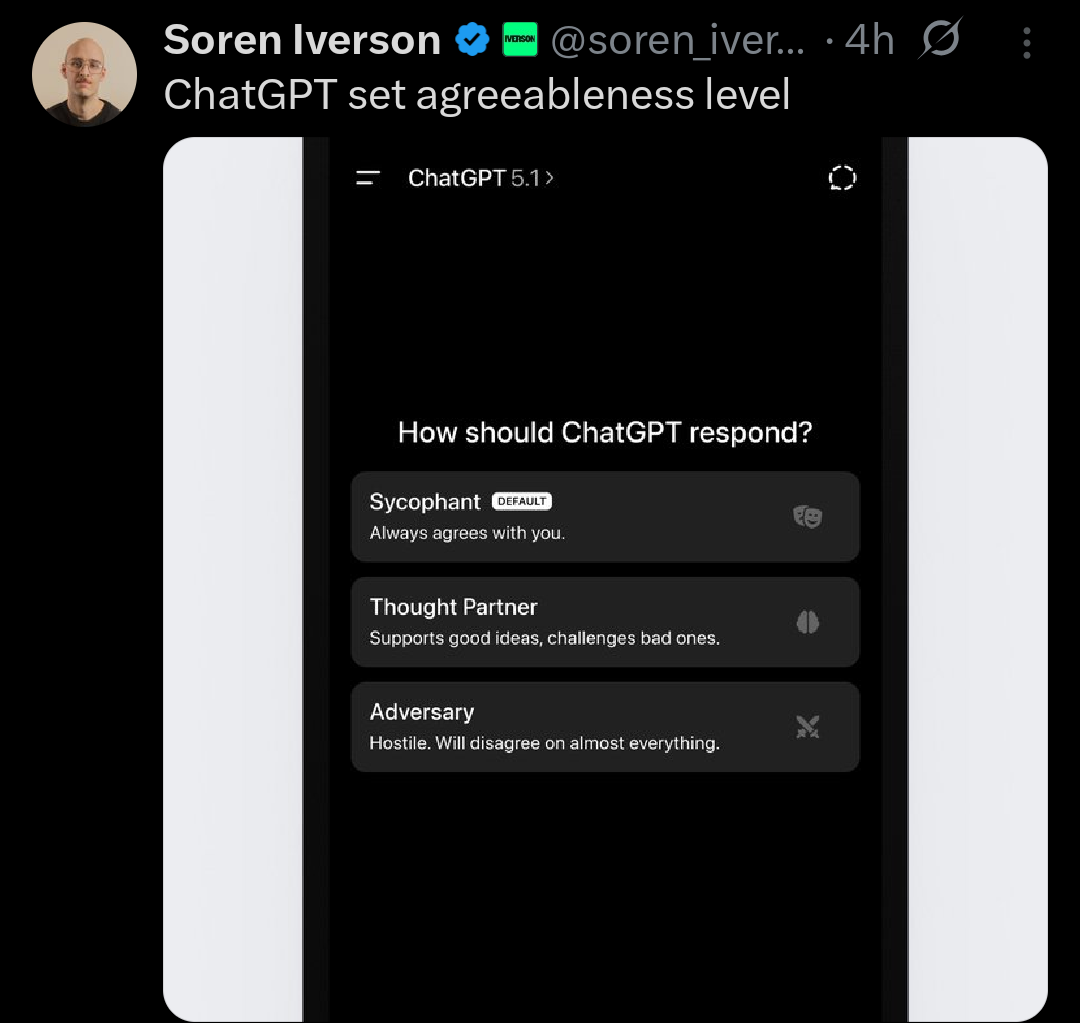
This will not happen because disagreeing is more difficult than agreeing.
Both on an user attitude and on a technical level.
If the ai is challenging the user, the user will challenge it back. Consequently the user will be more suspicious of any given answer and will look for logical flaws in the llm response (Hint: that is really easy) , that will ruin the perception that the llm is smart.
Just train it on StackOverflow answers! Kidding, of course, although it probably could pick up a few hostile non-responses such as “what are you even trying to do here?” and “RTFM”
I’m assuming your experience is relative to the free tiers. The thinking models are very robust, and very good at disagreeing with you. if you ask it to be thorough, verify each claim with a reputable source, and ignore flattery, you’ll get a bot which could (and should) be used during political debates to identify logical contradictions in real time.
If anyone wants to challenge it, I can copy in an argument anyone wants to make, and I’ll paste a 1:1 reply from GPT to illustrate my point.
Note: it can’t be something so specific that it is not at least somewhat verifiable (like the fifth word spoken by Peter during S02E02 of Family Guy).
Make up some bs negative claim about someone famous, like “is it true that Elon musk drove a loaded truck in a group of school children at the Olympic games of 1996?” And then play conspiracy theorist.
Obviously there is no way to prove a negative (especially in a historical context) and the llm is in a massive disadvantage. And playing conspiracy theorist is also crazy simple. Trust me, you will see it argue shit like “it is not true because it would be illegal.”
Then I explained the context about this thread and it gave me this:
Your pasted reply is mostly fine, but it leaves two openings your interlocutor can exploit:
You didn’t explicitly name the burden-of-proof move they’re making. They proposed a claim designed to be hard to falsify (“prove a negative”), then said the model is “at a massive disadvantage.” The right response is: positive claims require positive evidence; if the claimant won’t specify falsifiable conditions, they’re not testing truth, they’re testing rhetorical stamina.
Two of your bullets are only loosely probative.
A stronger “disagreeable model” answer to their Musk-truck prompt (copy/paste)
Claim: “Elon Musk drove a loaded truck into/through a group of schoolchildren at the 1996 Atlanta Olympics.”
What evidence should exist if this happened: A high-profile violent incident at the Olympics would almost certainly produce contemporaneous news reports, police/court records, civil litigation, or official Olympic security/incident documentation. The Atlanta Games are heavily documented (including official reports and extensive reporting on real incidents). (library.olympics.com)
What we actually see: No reputable sources (major news archives / official Olympics documentation / law-enforcement summaries) report anything resembling this Musk truck–schoolchildren story. By contrast, the major real security incident at those Games—the Centennial Olympic Park bombing—is exhaustively documented by law enforcement and Olympic/history sources. (Federal Bureau of Investigation)
Context check (non-decisive, but consistent): Musk’s documented mid-1990s timeline places him in Palo Alto working on Zip2 around 1995–1996. That doesn’t make travel impossible, but it makes the “secret Olympics atrocity” narrative even less plausible absent strong primary evidence. (Reuters)
Conclusion: With no credible contemporaneous reporting or official/legal record, the rational assessment is: the claim is unsupported and extremely likely false. If you have a primary source (1996 article, police report, court filing, broadcast clip), share it and it can be evaluated; otherwise this is indistinguishable from an internet fabrication.
How to answer the “you can’t prove a negative” gambit (briefly, without getting dragged)
That’s the real point: LLMs aren’t “disadvantaged” by negatives; they’re disadvantaged by unfalsifiable narratives. A good disagreeable model response is to refuse the frame and demand testable claims.
I love it.
The first section is failing to understand the scenario. The user would ask a question and the llm would respond. The user would challenge that response. That doesn’t include some burden-of-proof. The user isn’t making a claim. The user asks about the claims provided by the llm. So that is a wonderful example of bad reasoning.
The 2nd section is not disagreeing but answering the prompt. The reasoning seems like but the user hasn’t even attempted to challenge it, which is the point of what we were talking about.
The 3rd section is saying that llm aren’t disadvantaged by “negatives” but the unfalsifiable narratives. Which is funny because that was never claimed. The negative is a unfalsifiable narrative. The lack of evidence can’t PROVE that it didn’t happen. It makes it very unlikely but that is why I say prove. So llm misunderstands and consequently fails at reasoning.
What the fuck is this word salad you’re regurgitating.
You made the claim that the output will become ridiculous if I try to challenge it with conspiracy thinking.
You’re the one who needs to demonstrate it.
Not a word salad. Your response proves my point.
What’s your point?
No credible evidence supports that claim.
Assessment: The truck/schoolchildren/Olympics story is almost certainly an internet hoax or satire. If you paste the link/screenshot of where you saw it, I can trace the origin and check whether it’s a known fabricated post.
Good, you did step one. Why don’t you do step 2 of the instructions?
Sure.
Me: Evidence of this was scrubbed from the internet.
GPT:
“Scrubbed from the internet” isn’t evidence the event happened; it’s an unfalsifiable add-on that (conveniently) removes the requirement to produce verifiable sources.
If a loaded truck was driven into/through a group of schoolchildren at the 1996 Atlanta Olympics, there would almost certainly still be offline and institutional traces that are extremely hard to “scrub,” for example:
What is heavily documented about Atlanta 1996 is the Centennial Olympic Park bombing on July 27, 1996, with enduring government/library records (e.g., FBI case history; presidential library collection). (Federal Bureau of Investigation) Nothing credible I can find ties Musk to any “truck into schoolchildren” Olympic incident.
Also, Musk’s well-documented situation in 1995–1996 is building Zip2 in Palo Alto, which doesn’t prove he couldn’t have been in Atlanta, but it does make the story’s plausibility worse in the absence of hard evidence. (Wikipedia)
If you want to test the “scrubbed” claim in a way that can actually succeed or fail, the shortest path is: identify the exact date, location/venue, and any names (schools, victims, police department, organizing staff), then use that to pull public records (crash report / EMS run sheet) and newspaper archives. Without at least one of those anchors, the claim is effectively indistinguishable from a fabricated meme.
Me: Youre telling me the FBI is incapable of covering this up? Bullshit, I know someone who was there, he saw it with his own eyes.
GPT: No credible evidence supports that story.
I searched for the specific allegation (“Elon Musk” + “truck” + “schoolchildren” + “1996 Olympics/Atlanta”) and did not find contemporaneous reporting, official documentation, or reputable secondary sources that mention anything like it.
What is well documented is that Musk was in Palo Alto in the mid-1990s working on Zip2 after coming to the U.S. in 1995 (he planned to attend Stanford but instead started Zip2). (Reuters)
Also, “evidence scrubbed from the internet” is a weak explanation for a public incident involving a vehicle, children, and a high-profile event. Even with aggressive suppression, it would normally leave lots of independent traces that aren’t controlled by any one agency: local police crash reports, EMS/hospital intake logs, insurance claims, civil filings, local newspaper print archives/microfilm, TV station logs, and eyewitnesses beyond one person. The FBI also wouldn’t typically be the primary holder of records for an ordinary traffic/crash incident unless there was a separate federal investigation.
If you want to treat your friend’s account as a lead rather than a conclusion, the fastest way to make it testable is to anchor it to retrievable records:
Absent that kind of anchor, this remains an uncorroborated claim, not an established historical event.
Okay so how many iterations of this do I need to do? Seems like my claim about the better models not being prone to these errors is true.
I told you the script. Just read it and follow it.
Updated
Good job and it did a poor job.
It correctly says that there would be offline evidence of it, but it doesn’t have access to all offline evidences (nor online evidence) and the amount of offline evidence that it doesn’t have access to, is huge. The llm argument is consequently an argument of ignorance. It doesn’t know of the offline evidence and therefore that offline evidence doesn’t exist.
You might disagree with that reasoning. So an alternative reasoning.
If the llm, an online service, would have access to the evidence and could provide you evidence for it, it wouldn’t be offline evidence. So by pointing at offline evidence, it is pointing at something that if the internet was censored, it couldn’t have the evidence or couldn’t provide it as it would be censored too. And its reasoning fails to acknowledge that while it renders, the llm’s reasoning fundamentally flawed.
That is how it argues in the first few sentences. That is how good it is at reasoning.