They’re specifically soft when it comes using impulse vs warp for both subliminal and superliminal speeds. It’s whatever the writers needed at the time. It makes sense that they can use warp to go almost any speed, but it’s a whole lot of power to warp space just to cruise around a solar system. I think there was at least one episode of TNG where they went light speed or close to it with impulse, but I may be misremembering, I just remember thinking that’s not how their own science works.
They do and they don’t, again, depends on the writer, but relativity is a really hard concept for the average show watcher. Sci-fi doesn’t really exist without relativistic breaking tech of some sort. ST has warp and subspace communication. They have reasons those break relativity, and they kind of stick to them. Then they have beings like the Q that might as well be gods. And sometimes actual gods in TOS. As a whole, the series is nonsense. But they try to make it less so over time and that just makes it retconned nonsense.
For example, impulse engines can not accelerate a ship to anywhere near the speed of light. But they can accelerate it to enough of a fraction of C that things like time dilation become problematic. No breaking of physics but surprise surprise now your crew is 3 minutes younger than they should be, relative to Earth. Add that up over time and you’d potentially have to start swapping out crew members so that they don’t end up younger than their children when they retire. The Star Trek Voyager Technical Manual lists “full impulse” as 1/4C, or nearly 75,000 kilometers per second, which is probably why you hardly ever see it in use unless it’s a life or death situation.


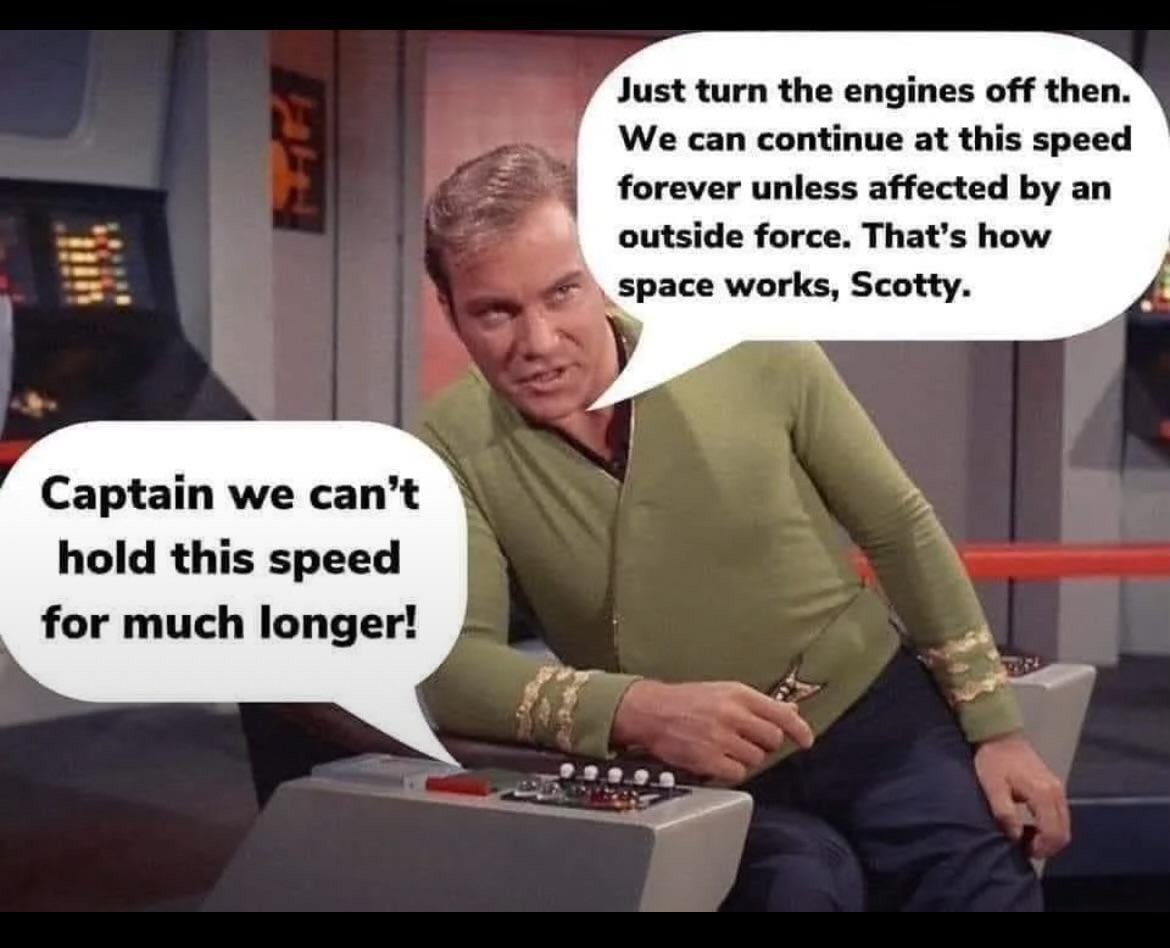
They’re specifically soft when it comes using impulse vs warp for both subliminal and superliminal speeds. It’s whatever the writers needed at the time. It makes sense that they can use warp to go almost any speed, but it’s a whole lot of power to warp space just to cruise around a solar system. I think there was at least one episode of TNG where they went light speed or close to it with impulse, but I may be misremembering, I just remember thinking that’s not how their own science works.
ST doesn’t seem to respect relatively anyway, so I guess it doesn’t matter, heh. The physics are different.
They do and they don’t, again, depends on the writer, but relativity is a really hard concept for the average show watcher. Sci-fi doesn’t really exist without relativistic breaking tech of some sort. ST has warp and subspace communication. They have reasons those break relativity, and they kind of stick to them. Then they have beings like the Q that might as well be gods. And sometimes actual gods in TOS. As a whole, the series is nonsense. But they try to make it less so over time and that just makes it retconned nonsense.
For example, impulse engines can not accelerate a ship to anywhere near the speed of light. But they can accelerate it to enough of a fraction of C that things like time dilation become problematic. No breaking of physics but surprise surprise now your crew is 3 minutes younger than they should be, relative to Earth. Add that up over time and you’d potentially have to start swapping out crew members so that they don’t end up younger than their children when they retire. The Star Trek Voyager Technical Manual lists “full impulse” as 1/4C, or nearly 75,000 kilometers per second, which is probably why you hardly ever see it in use unless it’s a life or death situation.