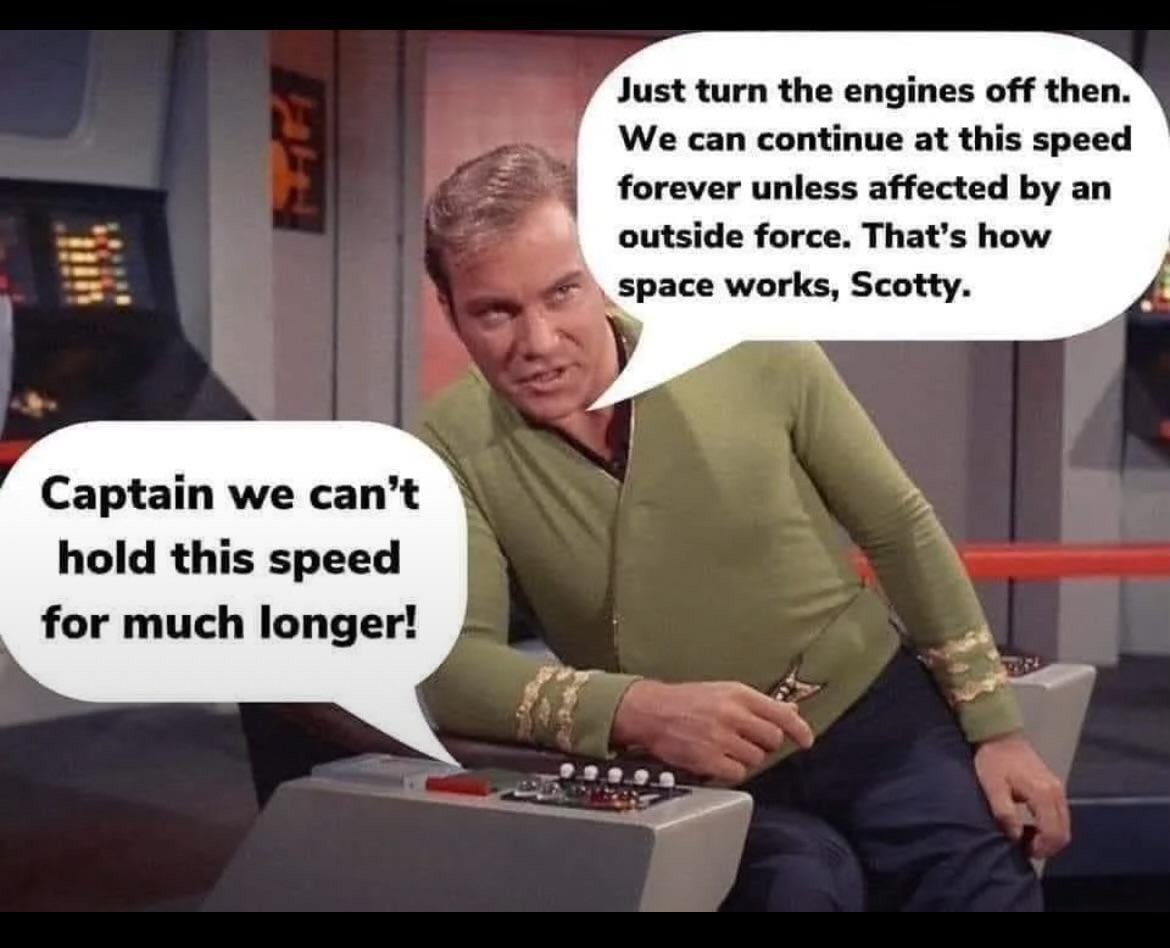

nah, thats movement relative to space time, warp suggests bending said space time in order to, relative to your destination, move faster than light, while essentially staying motionless in spacetime.
In this paradigm inertia is very much not a thing
This, the power is needed to maintain the subspace bubble, being thrown from said bubble from losing power has been shown to be dangerous. Maybe you just drop out of warp, maybe you drop out too close to something and have no control.
Thank you. I read this thinking “yeah this is not simple Newtonian motion”.
To suspend disbelief, when any non-hard sci-fi show says “speed” I subconsciously translate it to “acceleration.” If the ship they’re chasing (or being chased by) is pushing their engines to the max then the enterprise also needs to push its engines to the max to match the speed. If they just free-float at constant velocity then they’ll fall behind very quickly.
Not quite. The warp drive doesn’t actually provide any thrust, its purpose is to create the warp bubble and then “squish” the space in front of the starship.
Thus the “warp engines” do actually need to get constantly fed energy in order to work. Feed more energy equals get more squish equals go faster.
It doesn’t the ship through the universe, but the universe around it!
For the curious, OA has a pretty extensive, physically plausible theoretical writeups on warp bubbles:
https://www.orionsarm.com/eg-article/493f29cc472f0
They’re the STL kind, but still, they do seem to require power.
AFIAIK the impulse drives are sub relativistic in Star Trek, right? Or maybe they aren’t, but that seems.
They’re specifically soft when it comes using impulse vs warp for both subliminal and superliminal speeds. It’s whatever the writers needed at the time. It makes sense that they can use warp to go almost any speed, but it’s a whole lot of power to warp space just to cruise around a solar system. I think there was at least one episode of TNG where they went light speed or close to it with impulse, but I may be misremembering, I just remember thinking that’s not how their own science works.
ST doesn’t seem to respect relatively anyway, so I guess it doesn’t matter, heh. The physics are different.
They do and they don’t, again, depends on the writer, but relativity is a really hard concept for the average show watcher. Sci-fi doesn’t really exist without relativistic breaking tech of some sort. ST has warp and subspace communication. They have reasons those break relativity, and they kind of stick to them. Then they have beings like the Q that might as well be gods. And sometimes actual gods in TOS. As a whole, the series is nonsense. But they try to make it less so over time and that just makes it retconned nonsense.
It depends. Impulse engine? Sure. Warp? Nope. Also, you need shielding.
What about hyperdrive?
When moving at a high speed through the galaxy you potential may change. This must be paid and paid quickly too.
Pretty sure the warp drives need continuous power to contract space in front of the ship and expand it behind the ship to allow faster than light travel
The ship isn’t actually moving during faster than light travel, it just bends space around it
They can only move at impulse speed without engine output due to their being no friction and gravity in space
Even when the impulse drives are down, the ship always just stops 🤷♂️
My favorite bit is how when life support goes offline, it’s like they’re running out of oxygen within seconds. I once saw the math referencing the actual canon dimensions of the Enterprise D and its canon crew complement. It’s comically large for the number of people in it. You could shut off all the CO2 scrubbers in a space that cavernous, and it would be months before the crew began noticing any ill effects. The Enterprises are god-damn ginormous.
The Enterprises are god-damn ginormous.
It’s all those bowling alleys and home theatres they installed in the lower decks.
I recently saw a DS9 episode where O’Brien said life support is down and it’s going to be a problem in a day or sth, was pleasantly surprised at that.
Might still not be accurate, but at least it was not a “oh shit we’ll die now” kind of thing.
It depends. Lack of air circulation can cause problems in minutes as people can end up breathing stagnant air. Less of a problem if you have artificial gravity as then you have convection and/or the coriolis effect to help keep the air moving. As for actually running out: less of an issue.
It’s the Vulcans. They actually respirate at 1000x the rate of humans. It’s how they remain emotionless. They are too focused on breathing to get angry. The massive compression necessary to breathe that much is actually how they are constantly so full of hot air. They don’t actually need to breathe that much to survive, but they are just too proud to give it up even in an emergency situation. It’s all a weird power play. 🖖
Did you steal this from Dr mccoy’s Facebook?
Oh I’m sorry, is a ship’s head medical officer with decades of experience treating a dozen or more species of crewmen and guests not a good enough source for you? Don’t let those pointy eared bastards fool you. They’re devious.
Ok season 1 archer
For one time in their cold-hearted miserable lives couldn’t they just give a damn?
I think they might actually be in fluidic space and just really unobservant.
I mean, technically all space is fluidic space. The interstellar Medium is a fluid. It transfers pressure waves, has a temperature, has a density, even a viscosity.
https://en.wikipedia.org/wiki/Interstellar_medium
Normally you can ignore the drag from the Interplanetary or Interstellar media, but if you had a ship that could travel at high relativistic speed, pushing past 0.9c, 0.99c, 0.999c, etc., you actually would have to consider the drag from it. Ships going that fast would have to be designed with aerodynamic principles in mind, just like atmospheric craft.
Like the ships (lighthughers) in Revelation Space and other works from Alastair Reynolds :D
Normally you can ignore the drag from the Interplanetary or Interstellar media, but if you had a ship that could travel at high relativistic speed, pushing past 0.9c, 0.99c, 0.999c, etc., you actually would have to consider the drag from it. Ships going that fast would have to be designed with aerodynamic principles in mind, just like atmospheric craft.
This is new and surprising to me. Do you have a source? It seems to me that if it gets to a point where you need to design your ship using aerodynamic principle, you should also be able to drive your ship using aerodynamic principle (i.e., push on stuff around the ship, instead of expelling propellant from the ship as usual spacecrafts do).
I suppose if you could develop some type of sci-fi magnet ram-air funnel thingy you could make something work with the hydrogen atoms drifting around, but you’d still have to jet something out the back to keep going. Less like a rocket, more like an airplane.
“It’s like flying through soup, sir!”
“Mmm… Soup… 🤤”
Except when they go into orbit and then things work as expected.
There is definitely gravity in space! It just doesn’t feel that way because there’s no ground so you’re mostly in free fall which to you is indistinguishable from being in no gravity. (fun fact: this indistinguishability is actually the crux of General Relativity!)
Yep, everything is in freefall orbit of something bigger.
What if you are in the gravity center of the universe?
i think that would actually be the case most of the time.
you don’t care about anything outside the observable universe and inside that bubble, the cosmological principal would apply, stating that on a large enough scale, the universe and distribution of matter in it is considered homogeneous
so unless you are in close proximity to some local gravitational source, i think you would be generally affected by roughly the same gravity from all directions.
Let me know if you ever go.
have they reverse the polarity of the shields?
they can’t do that without decoupling heisenberg compensators, duh.
Yeah, at impulse they would still want the deflector shields, but at warp they can only remain faster than light due to power creating the warp bubble/field. Like a rubber band, you need to constantly exert force to repell the elastic forces.
Like a rubber band
A true Trekkie
So what you’re saying is, we need more rubber bands

There’s never a time when you don’t.
To argue in the spirit of OP’s meme:
You can’t create warp bubble/field as you go faster than light. Under relativity (to say nothing about other physical theories) “faster than light” travel is possible only if the “warp field”/“bent spcetime”/“wormhole”/etc. is already there and you’re just using it to travel.
Faster warp is probally akin to “better bubble/space time folding.” Cant maintain this warp speed is akin to saying “we dont have the power right now to maintain this complex of a space time fold.”
My point is you can’t be the one making the “fold” that you’re traveling in, no matter how much energy or whatever you have. If you do that your travel would either be slower than light or it would severely violate relativity (in ways that Alcubierre drive or wormhole or whatever don’t).
It’s a different kind of space. They’re going faster than light.
This is something that always bothered me when watching some sci-fi space shows. A space walk occurs, but there is only so much thrust that can be used. Once the thrust stops, the person stops.
Thats…not how vacuums work.
What bothers me more is the crappy placement of these dialog bubbles. The order of them makes you read Kirk’s dialog first.
These are Laverne and Shirley speech bubbles, designed to ensure that neither speech bubble can complain about not getting top billing.
This sort of thing is really common in video games where you’re able to move in zero G.
In the few games that have accurate zero G movement people get really confused. They’ll hold a movement key the entire way to a destination then smack into it because they didn’t realize they’d have to hold the opposite key for an equal amount of time to stop. Or they’ll fly a certain distance like that, then want to make a 90° turn, only to keep careening off in the direction of their initial travel with a slight bend to it.
Play hardspace shipbreaker, it’s qn entire game about manipulating objects and yourself in a zero g environment
It’s not how atmospheres work either
I don’t recall ever seeing that with space walks in shows before. But depending on the show, in many there’s typically some form of inertial dampener and/or artificial gravity generator tech (or the equivalent) in the canon that allows for the crew to remain more or less stationary/move around normal and attached to the ground even while accelerating/decelerating and in stable orbit. Given such tech is always kind of handwave-y because such tech isn’t actually feasible with our current understanding of physics, it could be argued that they are the cause of what you describe.
Like if the role of the inertial dampener is to keep your position absolutely stable relative to the ship absent forces acting on you, if the radius of its influence extends outside of the ship to some degree, you might expect them to slow and stop relative to the ship once their thrusters stop. And same with the artificial gravity, if it extends out of the ship some and “downward” is directed towards the ship, you would expect them to be able to walk on the hull and even “fall” towards it.
Unrelated but in the expanse they really nailed those aspects. When there’s a pursuit, it’s always an acceleration pursuit, which is limited by how much G the characters can tolerate, and for how long.
The only magic tech they introduce is a super efficient fusion core engine, but they use it to improve realism rather than destroy it. It’s great.
And they accelerate through the first 50% of a journey, flip, and decelerate the remaining 50%. I can’t name another sci-fi tackle space journeys in a realistic way like that. Everything else just treats it like air travel - pushing your way through something with drag.
My favorite touch is how the rooms are stacked vertically in the ships so the gravity is provided by the acceleration. Also how pouring drinks always happens differently depending on the gravity and spin off the body they’re on. Man I love this show!
Man I love this show!
WHERE SEASON 7? 😭
I think the rest of the books happens after a hiatus of a thousand years, doesn’t it ? I doubt it’s even the same cast of characters, not sure i’m interested in that.
When I saw the engines in front of the ships… I got so confused lol… like: wtf, why is it moving forward when the engines should be pushing it backwards? I had to google it and then I was like: aaaahhhhhh that makes so much sense now
Alastair Reynolds is good about this in his work.
Yep. Did it way before the expanse. I think that was my first introduction to the concept of accelerate flip accelerate the other way.
I would like to see more settings with beam-powered propulsion. That’s honestly the most realistic way of actually achieving interstellar travel. You set up large beaming arrays powered by fusion reactors or huge solar arrays. Or you build a laser system right out of the Sun’s upper atmosphere. Then you accelerate to significant fractions of c, riding on a beam of laser light.
Slowing down is a problem, but even that can be done with beam power. As it approaches a destination system, a ship can unfurl a secondary mirror array. If the system back at Sol can maintain focus over that distance, you use the secondary array to bounce light back onto the incoming craft, slowing it down. And if you can’t maintain focus over that distance, you can use chained pushing lasers powered by the destination Sun to send a slow down array ahead of your incoming crewed starship. Then you just have pushing lasers installed in both systems, and you can easily send ships back and forth.
If we end up ever actually doing interstellar travel for real, it’s likely to be through this method. Laser light sails are the cheat code for practical interstellar travel, but they almost never show up in fiction. Which is a shame, as there’s a lot of interesting settings and themes that could be explored. If you’re riding on a beam ship, you don’t actually have engines onboard capable of speeding up or braking your ship. You surely have some engines - to avoid space debris and for navigating before/after being accelerated/decelerated by the laser arrays. But you are ultimately completely at the mercy of the people operating those beaming arrays. If you’re relying on a braking array to slow your ship down at its destination, what happens if the destination system decides you’re no longer welcome there? By simply not turning on the laser, you will be doomed to scream off into the void. And speeding up/slowing down is just such an intricate dance of light and momentum. Lasers have to be aimed at not where your ship is, but where it’s going to be. And a chain of many stations may need to work together, each in their turn, for the journey to succeed. And who is paying for all this infrastructure? Who controls it? Is it nation states, unified world government, is it private corporations? Is travel on them free, or do you have to pay a lifetimes of wages to afford a ride on a beam ship? Lots of possibilities. Oh, and since ships travel along known paths, space piracy is a real possibility in the right setting.
The Mote in God’s Eye covers this light sail.
It starts with humans detecting coherent light (a laser) and realizing it’s propelling a light sail. It loops around the sun and now heading the opposite way the light impulse is now decelerating.
The Heechee series by Fred Pohl uses a reasonable system, including relativity. A major plot point is that you can get into one of their magic ships, press the button, and pray your food halfway point holds out until the ship flips to brake.
I’m on the second Expanse book and I am fucking loving it. I absolutely love hard Sci-Fi. I think The Expanse is taking the cake for my favorite Sci-Fi book series. Before this is was The Three Body Problem series. I specifically love Death’s End
Haven’t gotten around to the 3 body problem yet, but it seems reaaaaally nice !
It’s an amazing series. I highly recommend it. I like the third one the best.
Well, and the acceleration drugs they take to withstand the high G. Kinda unobtainium drugs.
Shit you’re right that’s also magic tech
In every ST series, they only ever say that in warp. And nobody has no idea how warp works.
less so in nutrek, old trek usually has some techno-babble included. i wonder if they think the viewers will get bored to death from a pseudo-explanation of how warp works, eventhough they sorta explained it over the franchise as (contracting and expanding space using a subspace field).
transwarp, vortex, slipstream kinda sidesteps the speed of light in our own universe, by interdimensional travel, hence why its faster than warp.
I just know if you go faster than Warp 9 you’re fucked
Warp 10. The Enterprise C regularly surpassed 9.5.
The D. We only saw The C once. That was the ship Tasha went to with Shooter McGavin.
IIRC the in universe reason for the E’s long ass nacelles was to allow it to achieve 9.95. I am pretty sure I remember part of the expanded universe going into experimental refits of the USS Sovereign that allowed it to hit 9.995.
Didn’t rikers enterprise go to warp 13?
Rikers enterprise went to Warp 69
It did, but it also attacked the klingons from below rather than the standard head on so we know they writers were all high when they wrote that!
Writers are not physicists, and the TOS Enterprise also had a few minutes above warp 10 at some point. It’s whatever a set of 2-4 writers and 3-5 producers decided that week, and retconning the awkward bits later.
It’s whatever a set of 2-4 writers and 3-5 producers decided that week, and retconning the awkward bits later.
it is actually not, they had detailed manual for that. star trek was inconsistent or vague about lot of stuff (for example how their economic utopia works), but they usually tried to have their technobabble consistent.
they changed how the warp speed works between TOS and TNG.
https://memory-alpha.fandom.com/wiki/Warp_factor#Star_Trek:_The_Original_Series
(not saying there weren’t exceptions, for example there were some really random numbers flying in the equinox double episode.)
Then tell me what Tom Paris did in the Cochrane shuttlecraft ;)
That’s my point. It’s a standard until it’s not for a convenient plot reason.
I never was making that claim, just that the person I replied to say going above 10 was dangerous
Sure, but I’m saying that any thought or concern about a canon transwarp limit is at risk of being dashed by the whims of people looking for a plot device.
Oh for sure, warp factors and the limits thereof can be bent to fit a particular story
At some point in the cannon they decided warp 10 is the transwarp limit. They ignored it a couple of times.
they changed that between TOS and TNG.
https://memory-alpha.fandom.com/wiki/Warp_factor#Star_Trek:_The_Original_Series
Well, at minimum, fucking seems to be involved.
The Delta Flyer went above Warp 10.
But that was Voyager, and Voyager frequently is not considered cannon.
Yeah, but you get to have sex with the captain, uncaffeinated.
Warp 10 was how they got back, wasn’t it?
But it’s also at the end of the Star Trek timeline, so they’re allowed to advance the tech curve a little bit
Warp 10 was how they got back, wasn’t it?
no, warp 10 is how paris and janeway made their lizard babies, left them stranded somewhere and then never talked about them again. worf is parent of the year compared to these two.
Voyager took a Borg transwarp corridor to get back to Earth. Future Admiral Janeway facilitated it.
But for some reason they keep dropping out of orbit around planets.
What else were they orbiting?
Stars, crystaline entities,…
Lady streamers at twitchcon
I can only remember occasions where they had atmospheric drag, dropping out of orbit is much more of a Star Wars thing.
But I can believe one of the new shows fucked the entire thing up.
Another consideration outside of the warp field maintenance is how incredibly destructive a collision with even nanograms of mass can be at relativistic velocities and shielding against those takes a lot of power itself
I always thought that’s exactly what the deflector dish was for. is this not the case?
i believe they’re saying that the deflector shield requires constant power, so that’s part of why the engine is required while moving rather than just while accelerating
ah, makes sense.
Scotty knows that conservation of momentum actually doesn’t happen over long distances in an expanding universe. Eventually you’ll stop.
https://www.youtube.com/watch?v=lcjdwSY2AzM
But also you need a warp drive to maintain warp. As soon as you turn it off or damage the nacelles you’re kicked out of the warp bubble. This happened in Into Darkness.