This is something that always bothered me when watching some sci-fi space shows. A space walk occurs, but there is only so much thrust that can be used. Once the thrust stops, the person stops.
This sort of thing is really common in video games where you’re able to move in zero G.
In the few games that have accurate zero G movement people get really confused. They’ll hold a movement key the entire way to a destination then smack into it because they didn’t realize they’d have to hold the opposite key for an equal amount of time to stop. Or they’ll fly a certain distance like that, then want to make a 90° turn, only to keep careening off in the direction of their initial travel with a slight bend to it.
I don’t recall ever seeing that with space walks in shows before. But depending on the show, in many there’s typically some form of inertial dampener and/or artificial gravity generator tech (or the equivalent) in the canon that allows for the crew to remain more or less stationary/move around normal and attached to the ground even while accelerating/decelerating and in stable orbit. Given such tech is always kind of handwave-y because such tech isn’t actually feasible with our current understanding of physics, it could be argued that they are the cause of what you describe.
Like if the role of the inertial dampener is to keep your position absolutely stable relative to the ship absent forces acting on you, if the radius of its influence extends outside of the ship to some degree, you might expect them to slow and stop relative to the ship once their thrusters stop. And same with the artificial gravity, if it extends out of the ship some and “downward” is directed towards the ship, you would expect them to be able to walk on the hull and even “fall” towards it.

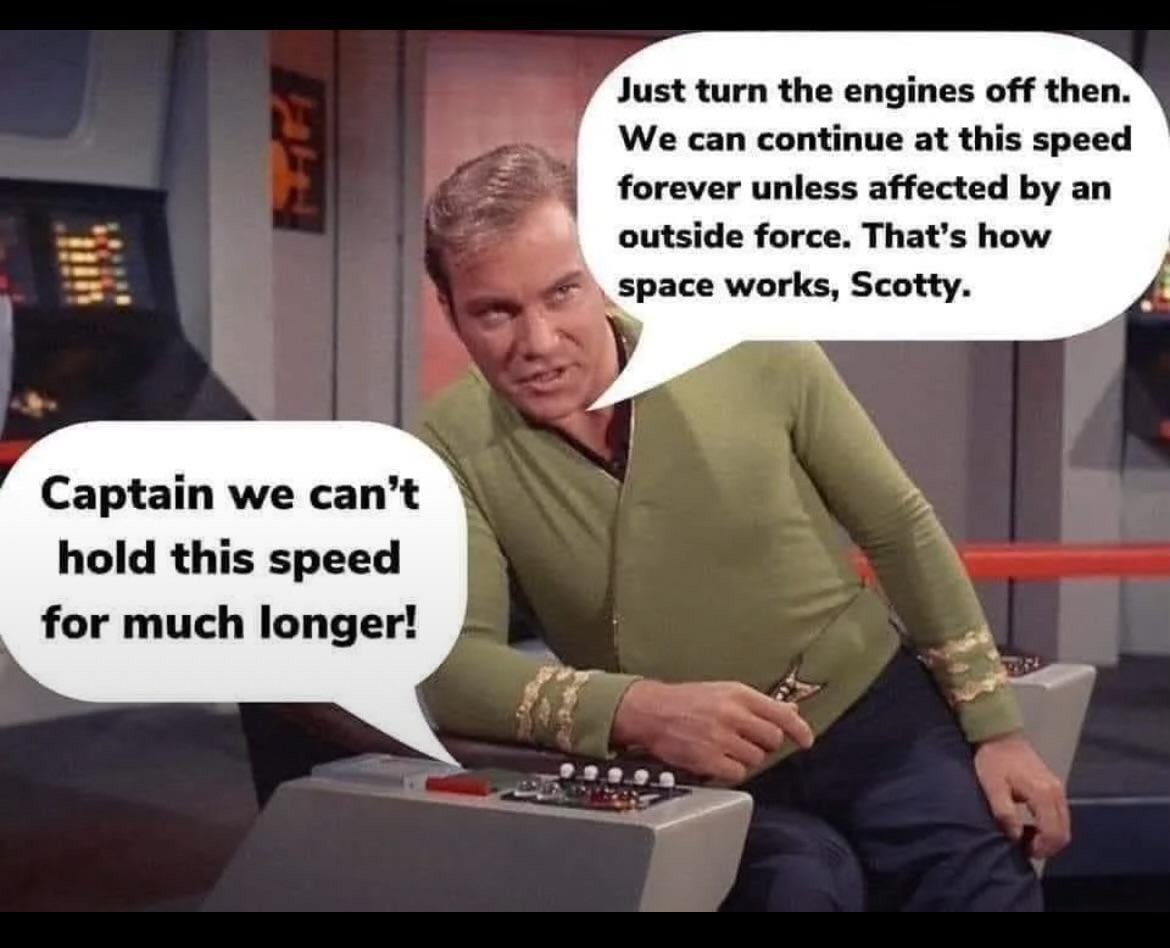
This is something that always bothered me when watching some sci-fi space shows. A space walk occurs, but there is only so much thrust that can be used. Once the thrust stops, the person stops.
Thats…not how vacuums work.
What bothers me more is the crappy placement of these dialog bubbles. The order of them makes you read Kirk’s dialog first.
These are Laverne and Shirley speech bubbles, designed to ensure that neither speech bubble can complain about not getting top billing.
This sort of thing is really common in video games where you’re able to move in zero G.
In the few games that have accurate zero G movement people get really confused. They’ll hold a movement key the entire way to a destination then smack into it because they didn’t realize they’d have to hold the opposite key for an equal amount of time to stop. Or they’ll fly a certain distance like that, then want to make a 90° turn, only to keep careening off in the direction of their initial travel with a slight bend to it.
Play hardspace shipbreaker, it’s qn entire game about manipulating objects and yourself in a zero g environment
It’s not how atmospheres work either
I don’t recall ever seeing that with space walks in shows before. But depending on the show, in many there’s typically some form of inertial dampener and/or artificial gravity generator tech (or the equivalent) in the canon that allows for the crew to remain more or less stationary/move around normal and attached to the ground even while accelerating/decelerating and in stable orbit. Given such tech is always kind of handwave-y because such tech isn’t actually feasible with our current understanding of physics, it could be argued that they are the cause of what you describe.
Like if the role of the inertial dampener is to keep your position absolutely stable relative to the ship absent forces acting on you, if the radius of its influence extends outside of the ship to some degree, you might expect them to slow and stop relative to the ship once their thrusters stop. And same with the artificial gravity, if it extends out of the ship some and “downward” is directed towards the ship, you would expect them to be able to walk on the hull and even “fall” towards it.