And they accelerate through the first 50% of a journey, flip, and decelerate the remaining 50%. I can’t name another sci-fi tackle space journeys in a realistic way like that. Everything else just treats it like air travel - pushing your way through something with drag.
My favorite touch is how the rooms are stacked vertically in the ships so the gravity is provided by the acceleration. Also how pouring drinks always happens differently depending on the gravity and spin off the body they’re on. Man I love this show!
I think the rest of the books happens after a hiatus of a thousand years, doesn’t it ? I doubt it’s even the same cast of characters, not sure i’m interested in that.
There are nine books and they all (give or take a few) follow the same main cast. Extremely minor time-skips excluding the following. Spoilers:
Tap for spoiler
There aren’t any time skips besides for minor ones, except at the end of the series, after the destruction of the ring network and the death of holden, where there is a massive time-skip to the point one of the ring colonies develops sufficiently advanced interstellar travel, to the point they are able to visit earth and be greeted by the now-immortal Amos.
When I saw the engines in front of the ships… I got so confused lol… like: wtf, why is it moving forward when the engines should be pushing it backwards? I had to google it and then I was like: aaaahhhhhh that makes so much sense now
I would like to see more settings with beam-powered propulsion. That’s honestly the most realistic way of actually achieving interstellar travel. You set up large beaming arrays powered by fusion reactors or huge solar arrays. Or you build a laser system right out of the Sun’s upper atmosphere. Then you accelerate to significant fractions of c, riding on a beam of laser light.
Slowing down is a problem, but even that can be done with beam power. As it approaches a destination system, a ship can unfurl a secondary mirror array. If the system back at Sol can maintain focus over that distance, you use the secondary array to bounce light back onto the incoming craft, slowing it down. And if you can’t maintain focus over that distance, you can use chained pushing lasers powered by the destination Sun to send a slow down array ahead of your incoming crewed starship. Then you just have pushing lasers installed in both systems, and you can easily send ships back and forth.
If we end up ever actually doing interstellar travel for real, it’s likely to be through this method. Laser light sails are the cheat code for practical interstellar travel, but they almost never show up in fiction. Which is a shame, as there’s a lot of interesting settings and themes that could be explored. If you’re riding on a beam ship, you don’t actually have engines onboard capable of speeding up or braking your ship. You surely have some engines - to avoid space debris and for navigating before/after being accelerated/decelerated by the laser arrays. But you are ultimately completely at the mercy of the people operating those beaming arrays. If you’re relying on a braking array to slow your ship down at its destination, what happens if the destination system decides you’re no longer welcome there? By simply not turning on the laser, you will be doomed to scream off into the void. And speeding up/slowing down is just such an intricate dance of light and momentum. Lasers have to be aimed at not where your ship is, but where it’s going to be. And a chain of many stations may need to work together, each in their turn, for the journey to succeed. And who is paying for all this infrastructure? Who controls it? Is it nation states, unified world government, is it private corporations? Is travel on them free, or do you have to pay a lifetimes of wages to afford a ride on a beam ship? Lots of possibilities. Oh, and since ships travel along known paths, space piracy is a real possibility in the right setting.
Not to mention a beam that powerful is naturally a highly potent weapon with potentially interstellar ranges, that’s a lot of power even for a government.
It starts with humans detecting coherent light (a laser) and realizing it’s propelling a light sail. It loops around the sun and now heading the opposite way the light impulse is now decelerating.
The Heechee series by Fred Pohl uses a reasonable system, including relativity. A major plot point is that you can get into one of their magic ships, press the button, and pray your food halfway point holds out until the ship flips to brake.


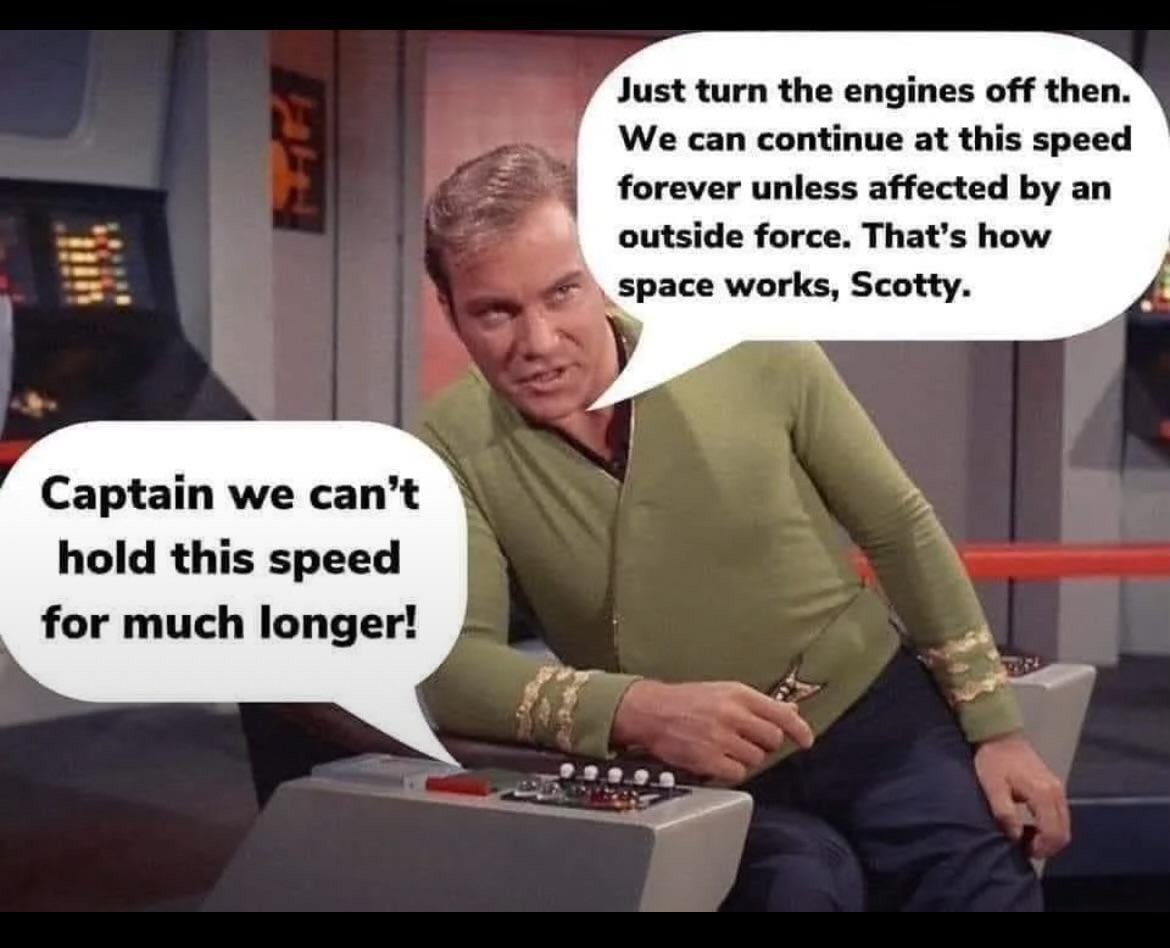
And they accelerate through the first 50% of a journey, flip, and decelerate the remaining 50%. I can’t name another sci-fi tackle space journeys in a realistic way like that. Everything else just treats it like air travel - pushing your way through something with drag.
My favorite touch is how the rooms are stacked vertically in the ships so the gravity is provided by the acceleration. Also how pouring drinks always happens differently depending on the gravity and spin off the body they’re on. Man I love this show!
WHERE SEASON 7? 😭
I think the rest of the books happens after a hiatus of a thousand years, doesn’t it ? I doubt it’s even the same cast of characters, not sure i’m interested in that.
There are nine books and they all (give or take a few) follow the same main cast. Extremely minor time-skips excluding the following. Spoilers:
Tap for spoiler
There aren’t any time skips besides for minor ones, except at the end of the series, after the destruction of the ring network and the death of holden, where there is a massive time-skip to the point one of the ring colonies develops sufficiently advanced interstellar travel, to the point they are able to visit earth and be greeted by the now-immortal Amos.
When I saw the engines in front of the ships… I got so confused lol… like: wtf, why is it moving forward when the engines should be pushing it backwards? I had to google it and then I was like: aaaahhhhhh that makes so much sense now
Alastair Reynolds is good about this in his work.
Yep. Did it way before the expanse. I think that was my first introduction to the concept of accelerate flip accelerate the other way.
I would like to see more settings with beam-powered propulsion. That’s honestly the most realistic way of actually achieving interstellar travel. You set up large beaming arrays powered by fusion reactors or huge solar arrays. Or you build a laser system right out of the Sun’s upper atmosphere. Then you accelerate to significant fractions of c, riding on a beam of laser light.
Slowing down is a problem, but even that can be done with beam power. As it approaches a destination system, a ship can unfurl a secondary mirror array. If the system back at Sol can maintain focus over that distance, you use the secondary array to bounce light back onto the incoming craft, slowing it down. And if you can’t maintain focus over that distance, you can use chained pushing lasers powered by the destination Sun to send a slow down array ahead of your incoming crewed starship. Then you just have pushing lasers installed in both systems, and you can easily send ships back and forth.
If we end up ever actually doing interstellar travel for real, it’s likely to be through this method. Laser light sails are the cheat code for practical interstellar travel, but they almost never show up in fiction. Which is a shame, as there’s a lot of interesting settings and themes that could be explored. If you’re riding on a beam ship, you don’t actually have engines onboard capable of speeding up or braking your ship. You surely have some engines - to avoid space debris and for navigating before/after being accelerated/decelerated by the laser arrays. But you are ultimately completely at the mercy of the people operating those beaming arrays. If you’re relying on a braking array to slow your ship down at its destination, what happens if the destination system decides you’re no longer welcome there? By simply not turning on the laser, you will be doomed to scream off into the void. And speeding up/slowing down is just such an intricate dance of light and momentum. Lasers have to be aimed at not where your ship is, but where it’s going to be. And a chain of many stations may need to work together, each in their turn, for the journey to succeed. And who is paying for all this infrastructure? Who controls it? Is it nation states, unified world government, is it private corporations? Is travel on them free, or do you have to pay a lifetimes of wages to afford a ride on a beam ship? Lots of possibilities. Oh, and since ships travel along known paths, space piracy is a real possibility in the right setting.
This is how they do interstellar travel in James Cameron’s Avatar
Not to mention a beam that powerful is naturally a highly potent weapon with potentially interstellar ranges, that’s a lot of power even for a government.
The Mote in God’s Eye covers this light sail.
It starts with humans detecting coherent light (a laser) and realizing it’s propelling a light sail. It loops around the sun and now heading the opposite way the light impulse is now decelerating.
The Heechee series by Fred Pohl uses a reasonable system, including relativity. A major plot point is that you can get into one of their magic ships, press the button, and pray your food halfway point holds out until the ship flips to brake.