Okay cool, I didn’t put that together while reading the first post. Although my understanding is that Trek warp drives would fall into the Void Drive category based on these descriptions. The bubble completely encases the ship while at warp and effectively shortens the world line they’re following, at least from the ship’s perspective. In the famous “Neelix almost kills the ship with cheese episode” they create a “static” warp bubble and invert it towards the ship in order to heat up all of the biogel packs on Voyager. Also I looked up the impulse engine thing and they arent relativistic but they are capable of accelerating a ship to 1/4C which is surely enough to cause some time dilation issues.
The void drives in OA are a bit crazy in that they’re almost like little pocket dimensions: sub microscopic, maneuverable, “bigger on the inside” like a Tardis, and requiring further nested void bubbles to enter/exit them without destabilizing. They’re more like something Q would use in their civil war. The description may sound closest to ST’s “ship inside warp bubbles,” but mechanically the displacment/halo drives are closer and their attempt at “more physically consistent” ST warp drives, while void ships are at the absolute edge of what’s possibly plausible in physics, assuming all engineering issues go away.
A giant ship at 1/4c is still quite high, yes… it’s also at the point where, under normal physics, you’d have to worry about things like the exhaust plume vaporizing whatever’s behind it.
Also Q help you if the navigational deflectors wink out for even a microsecond lol. I’m not a physicist but I’m fairly certain that hitting a mote of dust at 1/4C would cause a large enough explosion to wipe out an entire planet, if not an entire solar system.
I found a fun calculator trying to research this. An object weighing 1 microgram, travelling at 0.25c, would contain nearly 3 megajoules of kinetic energy. So yeah I guess dust wouldn’t be apocalyptic but that still wouldn’t be fun to bounce into/through.


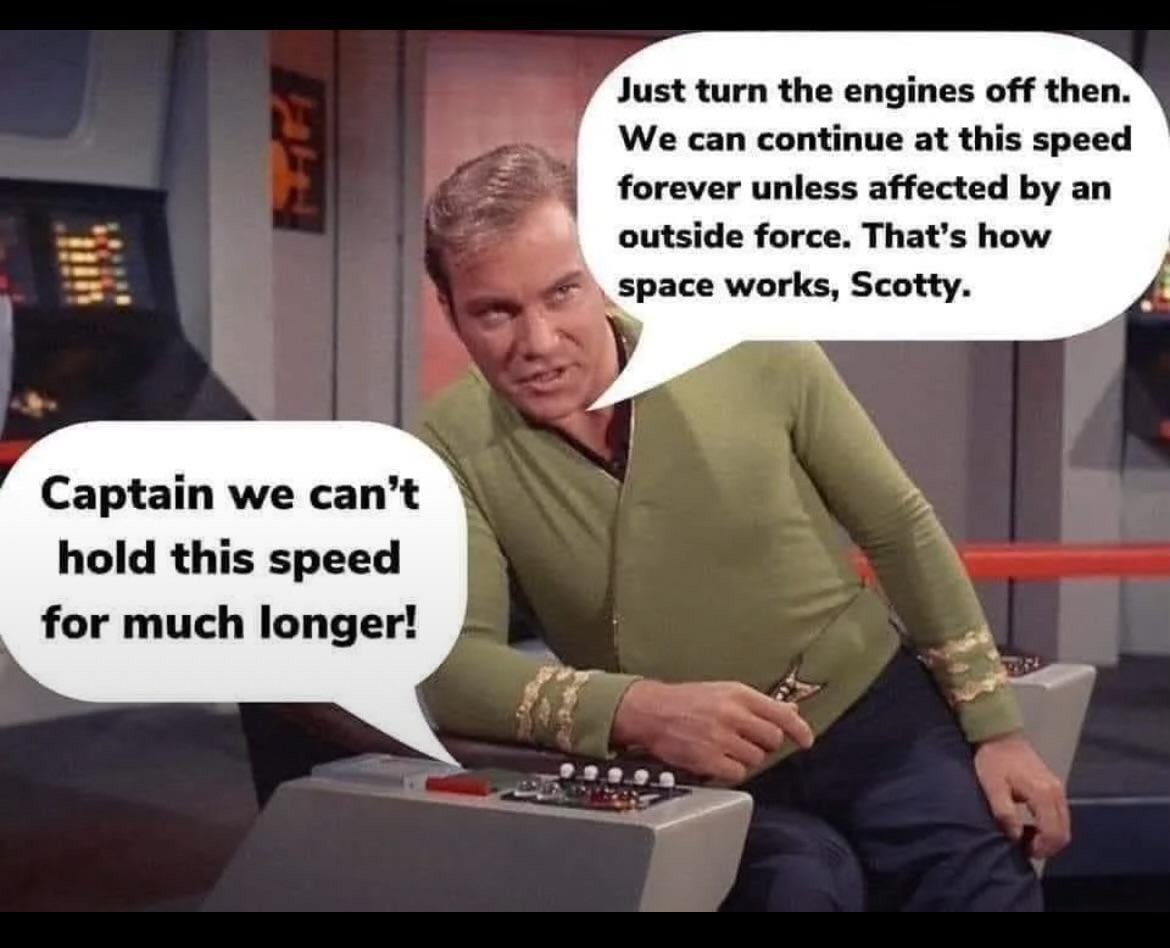
Okay cool, I didn’t put that together while reading the first post. Although my understanding is that Trek warp drives would fall into the Void Drive category based on these descriptions. The bubble completely encases the ship while at warp and effectively shortens the world line they’re following, at least from the ship’s perspective. In the famous “Neelix almost kills the ship with cheese episode” they create a “static” warp bubble and invert it towards the ship in order to heat up all of the biogel packs on Voyager. Also I looked up the impulse engine thing and they arent relativistic but they are capable of accelerating a ship to 1/4C which is surely enough to cause some time dilation issues.
The void drives in OA are a bit crazy in that they’re almost like little pocket dimensions: sub microscopic, maneuverable, “bigger on the inside” like a Tardis, and requiring further nested void bubbles to enter/exit them without destabilizing. They’re more like something Q would use in their civil war. The description may sound closest to ST’s “ship inside warp bubbles,” but mechanically the displacment/halo drives are closer and their attempt at “more physically consistent” ST warp drives, while void ships are at the absolute edge of what’s possibly plausible in physics, assuming all engineering issues go away.
A giant ship at 1/4c is still quite high, yes… it’s also at the point where, under normal physics, you’d have to worry about things like the exhaust plume vaporizing whatever’s behind it.
Also Q help you if the navigational deflectors wink out for even a microsecond lol. I’m not a physicist but I’m fairly certain that hitting a mote of dust at 1/4C would cause a large enough explosion to wipe out an entire planet, if not an entire solar system.
A 1 gram rock would be “almost nuclear,” yeah, but not planet killing, and most micrometeoroids/cosmic dust is fortunately much smaller than that.
I found a fun calculator trying to research this. An object weighing 1 microgram, travelling at 0.25c, would contain nearly 3 megajoules of kinetic energy. So yeah I guess dust wouldn’t be apocalyptic but that still wouldn’t be fun to bounce into/through.