
So after months of dealing with problems trying to get the stuff I want to host working on my Raspberry Pi and Synology, I’ve given up and decided I need a real server with an x86_64 processor and a standard Linux distro. So I don’t continue to run into problems after spending a bunch more, I want to seriously consider what I need hardware-wise. What considerations do I need to think about in this?
Initially, the main things I want to host are Nextcloud, Immich (or similar), and my own Node bot @[email protected] (which uses Puppeteer to take screenshots—the big issue that prevents it from running on a Pi or Synology). I’ll definitely want to expand to more things eventually, though I don’t know what. Probably all/most in Docker.
For now I’m likely to keep using Synology’s reverse proxy and built-in Let’s Encrypt certificate support, unless there are good reasons to avoid that. And as much as it’s possible, I’ll want the actual files (used by Nextcloud, Immich, etc.) to be stored on the Synology to take advantage of its large capacity and RAID 5 redundancy.
Is a second-hand Intel-based mini PC likely suitable? I read one thing saying that they can have serious thermal throttling issues because they don’t have great airflow. Is that a problem that matters for a home server, or is it more of an issue with desktops where people try to run games? Is there a particular reason to look at Intel vs AMD? Any particular things I should consider when looking at RAM, CPU power, or internal storage, etc. which might not be immediately obvious?
Bonus question: what’s a good distro to use? My experience so far has mostly been with desktop distros, primarily Kubuntu/Ubuntu, or with niche distros like Raspbian. But all Debian-based. Any reason to consider something else?
You must log in or register to comment.
Anything can be a “server” in your use-case. Something low power at idle will not cost an arm and a leg to run, and you can always upgrade later if you need more.
Check the Minisforum refurb store and see what you can get for under $150.
Under $150 might be tricky in Australia, but I had a quick look for “mini PC” from a refurb shop near me and came up with one, two, three for options under $230.
Something low idle
I’m guessing that this might be a typo, but I’m not quite sure what it’s meant to read. Or what it means if it’s not a typo.
All of those would be perfectly cromulent nodes for small containers. The first issue you’ll run into is the low ram. Some homelab projects would cause you to exceed 8gb, but the good news is if you’re using an external backend via NFS, you can always scale out (more nodes) or up(more compute per node,) later with minimal headache.
If you’re going to be memory constrained, don’t waste 1-2gb on a gui, install Ubuntu/Debian/whatever headless
Hmmm, it does seem they’ve finally raised prices. Well that’s a huge bummer.
I can’t say the 3 options you posted are really good deals, but maybe that’s just the market in Australia. I’d check to see what the max RAM in those are and upgrade to at least 16GB though. It should still be cheap for non DDR5.
What considerations do I need to think about in this?
Mostly just making sure it suits your power needs while also being efficient.
For now I’m likely to keep using Synology’s reverse proxy and built-in Let’s Encrypt certificate support, unless there are good reasons to avoid that.
I mean I don’t know much about those, but I don’t see any reason to continue doing that. Yunohost automates this stuff, if that’s what you’re looking for.
Is a second-hand Intel-based mini PC likely suitable?
Yes. Or AMD.
I read one thing saying that they can have serious thermal throttling issues because they don’t have great airflow
That’s entirely dependent on the specific Mini PC, processor, cooling solution, cooling profile, etc. Most of them are fine and if you have problems you can just crank up the fan speed. Unless you absolutely need to keep it in a living space.
Is there a particular reason to look at Intel vs AMD?
The one thing Intel is better at is hardware transcoding. So if you want to run Plex, Jellyfin, etc. it might be worth getting one of those.
Bonus question: what’s a good distro to use?
Pretty much everyone uses plain old Debian.
The piece of hardware I recommend to everyone who doesn’t have crazy massive storage needs is the CWWK pocket NAS.
N100 is a very good choice. Used can be top or flop. Up to you if you want to take the risk/chance.
ubuntu is a solid distro, especially since you have knowledge with it.
When I bought a N100 I installed fedora and love it much more than ubuntu because of auto updates without problems, cockpit, podman and selinux.
If your proxy works, then let it work. If you have to maintain it, or set up a new system, I recommend switching to caddy because it’s just so easy.
I would switch ubuntu for debian, but that is more personal preference. As they are mostly the same architecture, there is not much of a learning curve.
What does debian have what ubuntu hasn’t?
Out of curiosity. I’ve got a debian bookworm running but I couldn’t tell a noticable difference between the two
Ubuntu is based on Debian, by the nature of that it will have more things than Debian.
Ubuntu generally has more cutting Edge features and tools by the nature of what it is, but the company supporting it also is pushing snap files for compatability containers which may or may not be your cup of tea.
Debians official packages can sometimes be a tad older since their ideology is stability over everything else.
A popular hypervisor distro proxmox uses Debian as the base for it’s great stability.
I second this.
Bought a $150 NGKTech from Aliexpress with 16 GB of RAM a couple of years ago, and it’s been such a beast with Proxmox.
Extremely low power consumption, no fan noise, barely any heat and chugs through Jellyfin transcoding, Minecraft/Valheim servers, HA OS and so many more small containers.
Just remember to set the C-state in BIOS and re-paste the CPU before you fire it up. The stock stuff is crap.I was expecting to outgrow it quite quickly, but it just powers through it all.
I can’t see any reason to get anything more powerful at all.
I had good results with SFF (Small Form Factor) machines, mostly Dell Optiplexes. More space inside while manageably small. Usually a lot of them around as former leasing machines.
Oh really interesting. So SFF is a little larger than Mini PC but smaller than standard desktops? Just quickly looking at refurb prices Optiplexes seem to be available a little cheaper than Mini PCs, too.
I have nothing to compare to, but I recently bought a Dell OptiPlex 9020 for $15/£13. It works wonders. I run a handful docker containers and a VM and haven’t experienced any issue since I bought it. It’s my first time experimenting with a home lab setup.
So after months of dealing with problems trying to get the stuff I want to host working on my Raspberry Pi and Synology
I take it ARM still not there package wise? Sucks to hear, I was really hoping we’d be further along by now
i just use a second hand laptop I got from “hock and go” down on gold coast, it has an ethernet port :O AMD stuff, I always generally stick with AMD for graphics as a lot of people complain about nvidia on linux, when I was in the store looking at them all did some pretty extensive searching on network driver compatibility, it has been a complete bitch in the past to deal with (ESPECIALLY wifi drivers), it seems to be a bit better these days
got it home, stuck a 2tb sata ssd in it, installed just regular ubuntu 24.04 lts, works well, i have the desktop version installed but 99% of the time I’m just sshing in
use it for immich and qbittorrent and a few other things
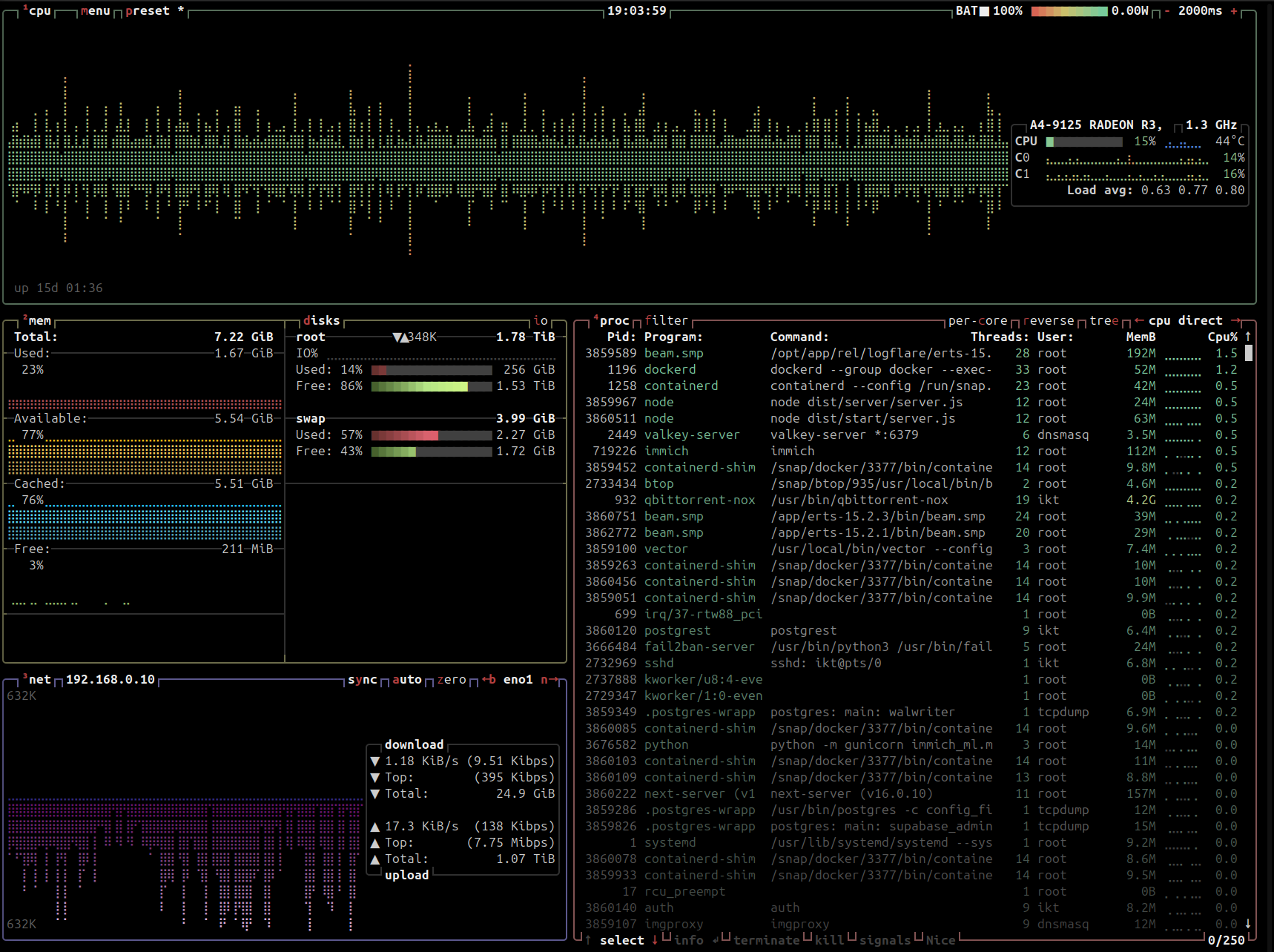
Works well enough for me, even though this might be the highest idle cpu usage I’ve ever seen (it’s not a fast cpu):
Btop: https://files.ikt.id.au/6c8kwp.png
My other servers are idling at like 0.1:
Htop: https://files.ikt.id.au/4uvrht.png
But I haven’t noticed any issues outside of immich taking longer if I go like, recheck all photos or starting up services, not a problem for me
was interested in this as well: https://www.ozbargain.com.au/node/934940
Seagate Expansion External Hard Drive HDD 24TB US$309.02 (~A$478.61) / 28TB US$353.02 (~A$546.76) Delivered @ B&H Photo Video
But haven’t dealt with USB attached storage before, I assume it would be fine but I’ll wait till I’m a bit closer running out of space
$ df -h Filesystem Size Used Avail Use% Mounted on /dev/sda2 1.8T 164G 1.6T 10% / /dev/sda1 1.1G 6.2M 1.1G 1% /boot/efiI take it ARM still not there package wise
I think for a lot of use cases it might be there. Unfortunately for me specifically, I think ARM might be the cause of part of my problems with Puppeteer, which is why I’m ruling it out.
You’re based in Brissy or further north in Qld, right? What kind of thermals does your system have, and what’s the room it lives in like?
haven’t dealt with USB attached storage before
I actually have, and if you’re interested I’d say go for it, with a couple of caveats. It worked great for me for years with my MediaWiki, torrents, and a couple of other minor web services hosted on my Raspberry Pi, with data stored on the USB external drive. I think it may have been a Seagate, even. Unfortunately I made the mistake of not backing it up, and when the external drive died I lost my data. That would be the biggest thing I’d consider if you’re looking into a USB external HDD. It’s extra important since the drive is probably not designed to be always on in the way a WD Red or equivalent is.
In the same vein, used thinkcentres are dead cheap and good, easy to tinker with physically, and for what I know no problems when it comes to linux (nvidia drivers are probably as on any other platform). Got a ussf m920q IIRC, added som ram, changed the CPU and swappyd out the SSD for a big one and it became my main driver (also have some 710 and a tower for more inside space, GPU, …) low power draw and “it just works”.
100%, thinkcentres are the most well supported of the major brands iirc
the battery is a nice little in built UPS feature, bit underrated if you get a second hand laptop with a working battery
I personally use my previous desktop PC with an i7-4790T CPU and 32GB Ram for selfhosting.
@jwildeboer shows his homelab in his blog using some Mini-PCs.
https://jan.wildeboer.net/2025/05/Cute-Homelab/
I would suggest, when you don’t need HDDs for storage reasons, to go with a refurbished Mini-PC with as much RAM as possible.
While I like his setup, I’m not a big fan of 3D printed components being added to the whole setup primarily because not everyone has a 3D printer lying at home …
The cost though it’s actually quite good I have to say.
@androidul I would say, selfhosting is doing the best out of available possibilities.
For me it is just an 11 years old PC, which was much to good to put to waste.My intention with the example from @jwildeboer was more about the usage of Mini-PCs than about their rack mounting.
But it also shows, what could be possible with more ressources.
@androidul Agreed. The 3d printed mounts are optional. But nice ;) My main point is that with these refurbished little machines you have redundancy and avoid the single point of failure. @db_geek
HP Microserver
Only if you have free / cheap electricity