I’ve seen this posted before. Important points to consider: Imperial Russia had a housing shortage in the cities due to industrialization occurring and the existing housing was often of poor quality. According to one source: “In major cities, a significant portion of housing consisted of barracks, basements, semi-basements, dormitory-style rooms, dugouts, and semi-dugouts.”
Then WW1 hit followed by the civil war and housing construction essentially stopped with some housing destroyed in the war. Then in the interwar period, priority was given to industrial construction in the USSR, resulting in low housing construction volumes, with a significant share consisting of temporary housing. Rapid industrialization and increasing population shifts to cities increasing demand. Then WW2 hit and huge amounts of existing housing were destroyed in the fighting.
So the USSR was in tight spot and did the best they could with limited time and resources which for most Russians ended up being a huge improvement.
Most of the issues with this era of housing projects stem from the fact that the plans for upkeep were abandoned. Most of the buildings themselves were solid and very modern and with the right maintenance they would’ve been in much better condition than they are now.
The buildings that have received that care and attention still look great. Not all the areas were well planned but most of the time they’re fine.
And that’s without constraining that judgement to Russia specifically. Many of the countries that built like this were very ambitious but the ambition faltered with time as the resources allocated to maintenance were used for other things.
My mom still lives in one of the “socialist cubes” that were built in Finland in the late 70’s (and they’re literally the same kind of design; we actually exported concrete elements to eg. the DDR and others for building more socialist cubes).
The building was kinda bleak back in the 80’s and 90’s, although at least it was painted and not just grey like some of the more egregious ones, but the exterior has been renovated over the years, the windows were redone, plumbing got upgraded, the balconies were all torn down and rebuilt, it’s been painted, etc etc. It’s still affordable to live in even after all that, and it looks nice too. And the floor plan is actually meant for humans to live in unlike 99% of modern developments in Finland which are meant to produce the maximum amount of income for some giant construction conglomerate, so the apartments end up eg. being shaped like long tubes with one window at the end, or with the entry being in the kitchen, which is the same space as the living room.


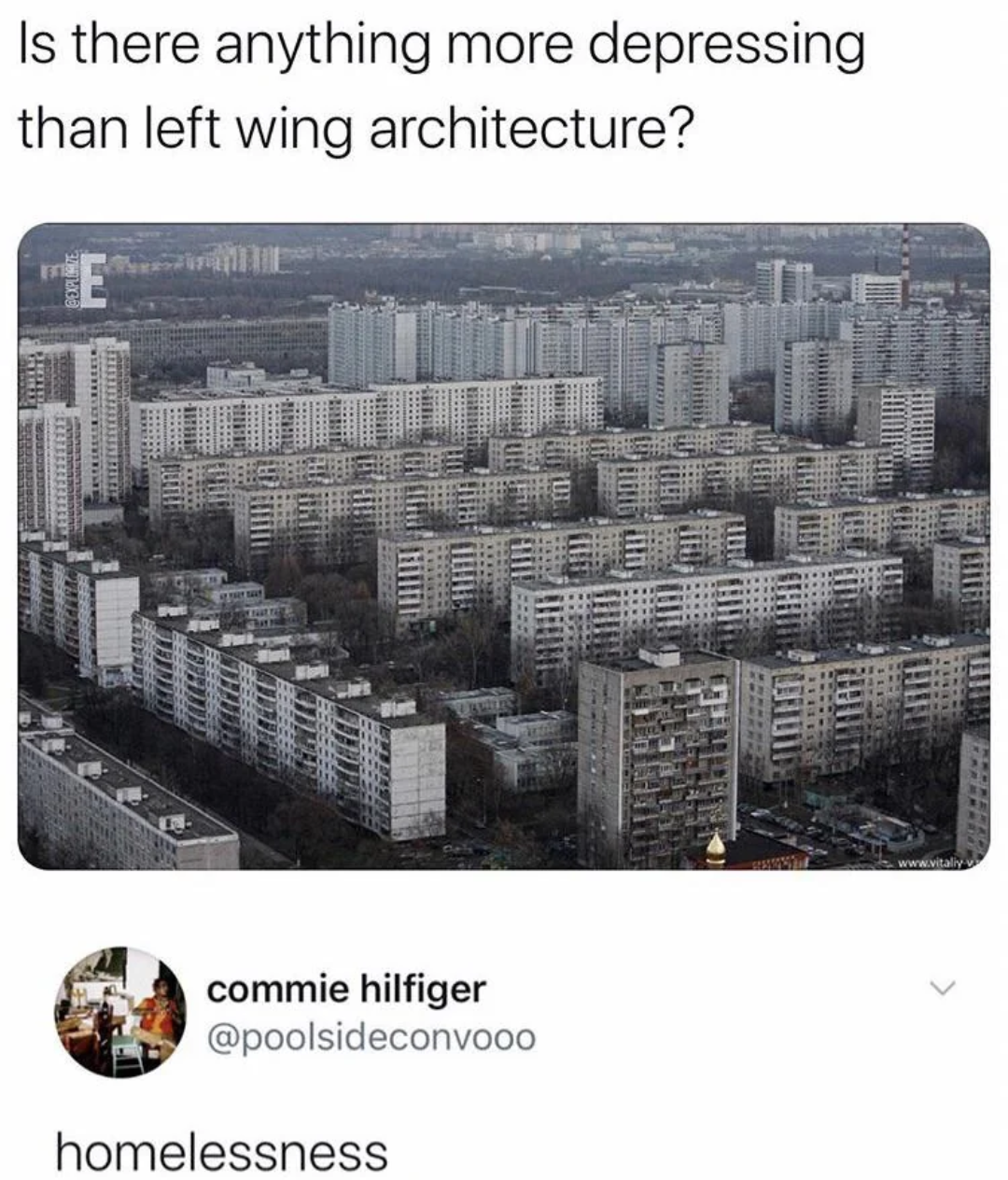
I’ve seen this posted before. Important points to consider: Imperial Russia had a housing shortage in the cities due to industrialization occurring and the existing housing was often of poor quality. According to one source: “In major cities, a significant portion of housing consisted of barracks, basements, semi-basements, dormitory-style rooms, dugouts, and semi-dugouts.”
Then WW1 hit followed by the civil war and housing construction essentially stopped with some housing destroyed in the war. Then in the interwar period, priority was given to industrial construction in the USSR, resulting in low housing construction volumes, with a significant share consisting of temporary housing. Rapid industrialization and increasing population shifts to cities increasing demand. Then WW2 hit and huge amounts of existing housing were destroyed in the fighting.
So the USSR was in tight spot and did the best they could with limited time and resources which for most Russians ended up being a huge improvement.
https://en.wikipedia.org/wiki/Housing_construction_in_the_Soviet_Union
Most of the issues with this era of housing projects stem from the fact that the plans for upkeep were abandoned. Most of the buildings themselves were solid and very modern and with the right maintenance they would’ve been in much better condition than they are now.
The buildings that have received that care and attention still look great. Not all the areas were well planned but most of the time they’re fine.
And that’s without constraining that judgement to Russia specifically. Many of the countries that built like this were very ambitious but the ambition faltered with time as the resources allocated to maintenance were used for other things.
My mom still lives in one of the “socialist cubes” that were built in Finland in the late 70’s (and they’re literally the same kind of design; we actually exported concrete elements to eg. the DDR and others for building more socialist cubes).
The building was kinda bleak back in the 80’s and 90’s, although at least it was painted and not just grey like some of the more egregious ones, but the exterior has been renovated over the years, the windows were redone, plumbing got upgraded, the balconies were all torn down and rebuilt, it’s been painted, etc etc. It’s still affordable to live in even after all that, and it looks nice too. And the floor plan is actually meant for humans to live in unlike 99% of modern developments in Finland which are meant to produce the maximum amount of income for some giant construction conglomerate, so the apartments end up eg. being shaped like long tubes with one window at the end, or with the entry being in the kitchen, which is the same space as the living room.