To be fair, usually when a language adopts a new word from other languages, they start spelling it in there own fashion. English is unusual in that they use the original spelling.
Not always, the word skosh(meaning just a little bit or a tiny amount) comes from the Japanese word sukoshi(少し), but that can probably be attributed to the language not generally using romanized letters.
It’s a very interesting word to me since its one of the very few words that migrated from Japanese to English and isn’t a name of something. The way it came over is also rather interesting, as it was through collaboration between US and Japanese soldiers during the Korean war.
My favorite are British English, who can’t stand the French to the point that they say things like filet with a hard T.
This also reminds me of a recent trip to Colorado, where they do the same thing with Spanish words, anglicizing all of them. Salida (sa-LIE-da) is the first one that’s coming to mind, but I know there are other cities in Colorado that are clearly Spanish words that they’ve just abused.


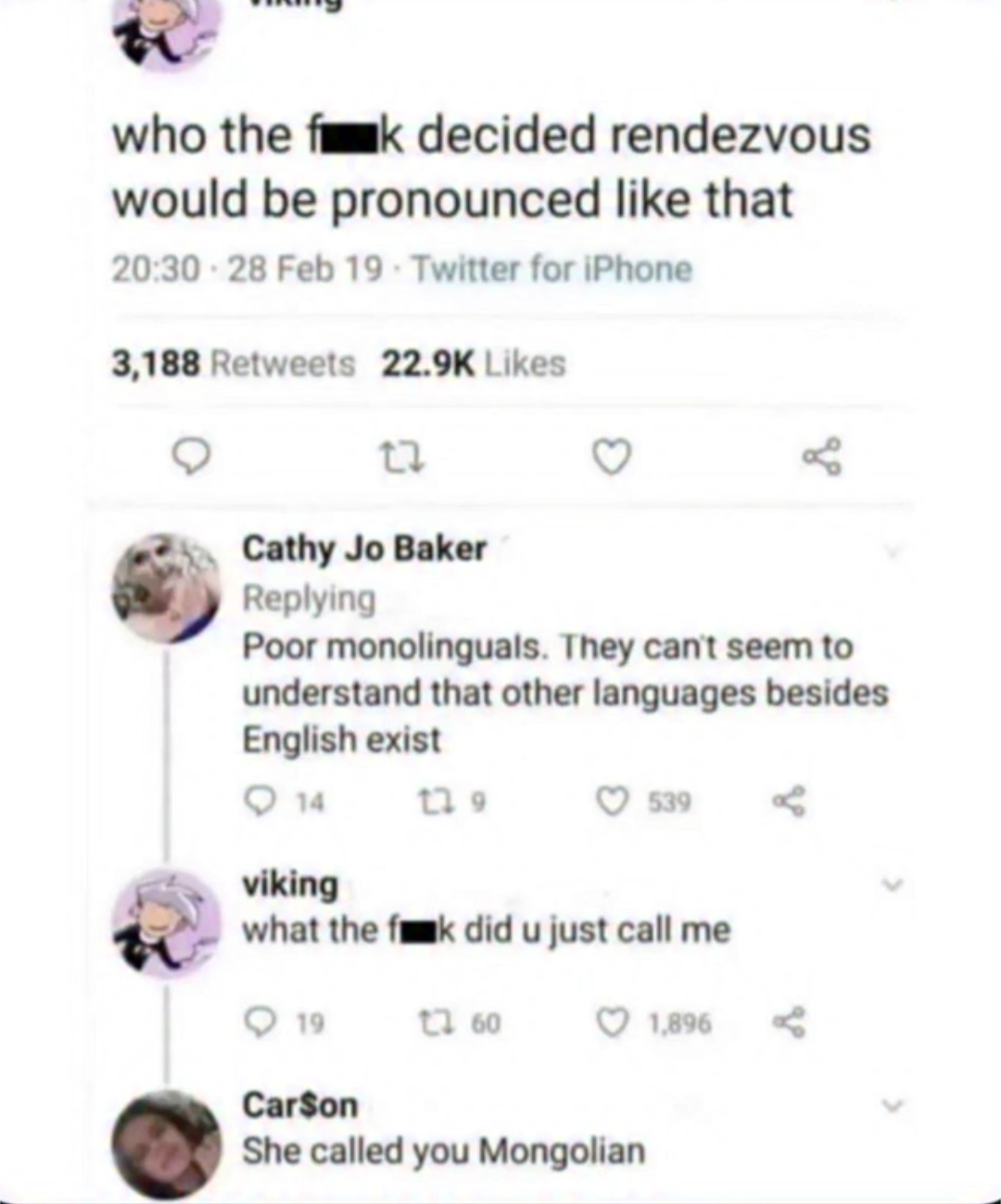
To be fair, usually when a language adopts a new word from other languages, they start spelling it in there own fashion. English is unusual in that they use the original spelling.
French in particular gets a lot of words with original spellings because it used to be the language of the courts in England.
And you also have words like Wednesday…
Worcestershire sauce
WAR-shǝ-stir
Woden’s day
Not always, the word skosh(meaning just a little bit or a tiny amount) comes from the Japanese word sukoshi(少し), but that can probably be attributed to the language not generally using romanized letters.
It’s a very interesting word to me since its one of the very few words that migrated from Japanese to English and isn’t a name of something. The way it came over is also rather interesting, as it was through collaboration between US and Japanese soldiers during the Korean war.
Hancho (via head honcho) also comes to mind.
I think kawaii is in the process of being absorbed, though I’ve mostly seen it in more weeby areas of the internet, so hard to say for sure.
I wouldn’t consider it anywhere near mainstream at this point.
My favorite are British English, who can’t stand the French to the point that they say things like filet with a hard T.
This also reminds me of a recent trip to Colorado, where they do the same thing with Spanish words, anglicizing all of them. Salida (sa-LIE-da) is the first one that’s coming to mind, but I know there are other cities in Colorado that are clearly Spanish words that they’ve just abused.
People from Nevada make a point of pronouncing their state different than the Spanish word
In “there” own fashion huh ?