I’m wondering if they got France and Germany mixed up. I don’t remember all the French I was taught growing up, but it didn’t sound right. So I googled it and got “droigts” and “orteils” for “fingers” and “toes”.
Not really. We are talking about how numbers are called in different languages. Other languages have actual names for twenty that aren’t a combination of digit+ten.
Basque is hogei, ten is hamar, two is bi, there is no phonetic similarity. The way language is created then informs how counting and numbers work.
Spanish has a proper distinct name for 20, but then is like english for 30 and above.
No need to be so passive aggressive while not understanding what I was trying to explain.
It’s fucking far off. I can’t stress how bonkers your number naming is. I speak two romance languages and two Germanic ones, and I’ll not try French because this and many other bullshittery.
French took it’s number system from Basque, which is at least more consistent since iirc in French 70 is 60+10 while the consistent logic should be 3*20+10.
Anyway, you say that twenty is far from twenty ->twen ten->second ten. 70 in Basque is hirurogeitahamar->hirur hogei ta hamar->hirugarren (third) hogei(twenty) eta(and) hamar(ten). It’s the same logic.
The only reason you say it’s bonkers is because you don’t understand. Different = wrong. Lmao.
Also, don’t fucking say that french is my language, I’m Basque Spaniard.
Also, as the other commenter said, we are speaking English, do you understand how insane of a language it is? It’s a Frankenstein of several languages where words were imported while keeping the pronunciation, so there’s no fucking logic as to how you are to say things.
How do you said “read”? No that’s wrong, I meant the past tense. Oh, it needs context?
How do you say entrepreneur? Why are you saying it in French? Fuck logic.
In Spanish you are able to pronounce correctly any word you read for the first time because the rules it has define strict pronunciation. Same for Basque, the only thing you might do wrong is intonation but most of the time it’s the second syllable. It’s fucking crazy that you both need to learn a word and how it’s pronounced in english, for every word.
Oh, extra edit. If the Basque/French counting system makes the language too hard don’t touch spoken Chinese lmao, intonation changes completely words way more frequently than Papa/papá.
I think you’re allowing this to make you angrier than you should.
You clearly speak English, which I think of as the mongrel child of two or three Germanic languages and a Romance one, and not in a good way, so I also think it’s the most fucked up and inconsistent one of the lot. The only thing it’s got going for it as a language is genderless nouns.

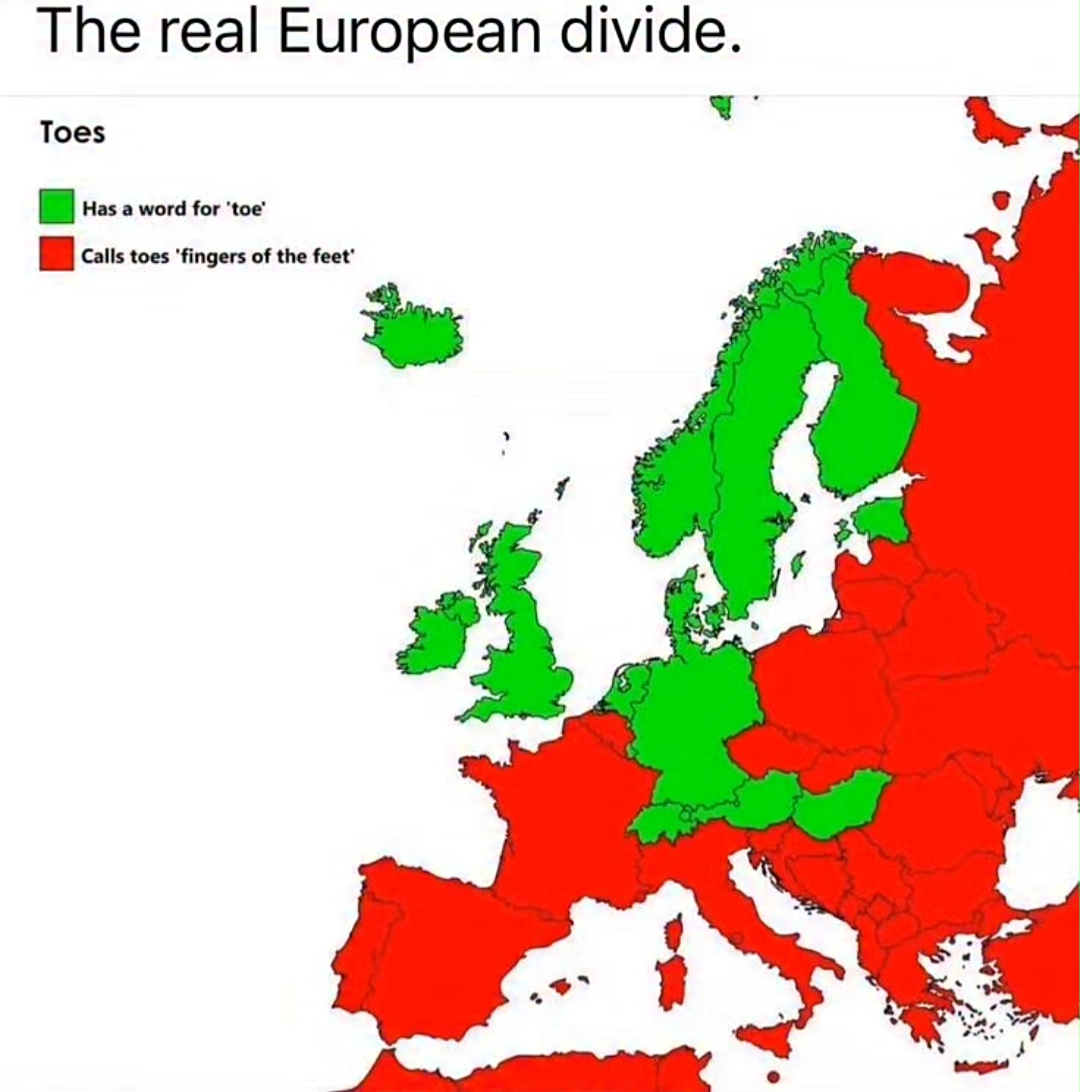
I’m wondering if they got France and Germany mixed up. I don’t remember all the French I was taught growing up, but it didn’t sound right. So I googled it and got “droigts” and “orteils” for “fingers” and “toes”.
German has “Finger” and “Zehen”
Yes, but why do we say “Fußzeh” there aren’t any other “Zehen” on the body, right?
I don’t think I have ever heared anyone say “Fußzeh”. Maybe it’s regional?
Yeah I’ve heard it before and I usually brought up that exact same argument, the fuck kinda other toes do we have lol
But I wouldn’t say it’s common or widespread, at least from my experience
Never heard or said “Fußzeh” before.
Heard it first after moving to the South, it’s absolutely regional.
Like saying dreiviertel Elf for 10:45 or Teppich for Decke or Fuß for the entire leg.
Both “orteils” and “doigts de pied” are used in French, the former sounding less childish than the latter.
The same language where ninety-two is “four twenties and a twelve”?
Just four twenty twelve, that’s enough. We’re not savages.
Ninety two is nine ten two anyway, it’s not that far off. In fact french and Basque at least do have a word for twenty, english doesn’t.
Twenty is rebranded two ten.
Thirty is third ten.
And so on.
Congratulations. You’ve just discovered how base 10 counting works.
Not really. We are talking about how numbers are called in different languages. Other languages have actual names for twenty that aren’t a combination of digit+ten.
Basque is hogei, ten is hamar, two is bi, there is no phonetic similarity. The way language is created then informs how counting and numbers work.
Spanish has a proper distinct name for 20, but then is like english for 30 and above.
No need to be so passive aggressive while not understanding what I was trying to explain.
The other word for twenty in English is score. Pretty rarely used, however.
It’s fucking far off. I can’t stress how bonkers your number naming is. I speak two romance languages and two Germanic ones, and I’ll not try French because this and many other bullshittery.
French took it’s number system from Basque, which is at least more consistent since iirc in French 70 is 60+10 while the consistent logic should be 3*20+10.
Anyway, you say that twenty is far from twenty ->twen ten->second ten. 70 in Basque is hirurogeitahamar->hirur hogei ta hamar->hirugarren (third) hogei(twenty) eta(and) hamar(ten). It’s the same logic.
The only reason you say it’s bonkers is because you don’t understand. Different = wrong. Lmao.
Also, don’t fucking say that french is my language, I’m Basque Spaniard.
Also, as the other commenter said, we are speaking English, do you understand how insane of a language it is? It’s a Frankenstein of several languages where words were imported while keeping the pronunciation, so there’s no fucking logic as to how you are to say things.
How do you said “read”? No that’s wrong, I meant the past tense. Oh, it needs context?
How do you say entrepreneur? Why are you saying it in French? Fuck logic.
In Spanish you are able to pronounce correctly any word you read for the first time because the rules it has define strict pronunciation. Same for Basque, the only thing you might do wrong is intonation but most of the time it’s the second syllable. It’s fucking crazy that you both need to learn a word and how it’s pronounced in english, for every word.
Oh, extra edit. If the Basque/French counting system makes the language too hard don’t touch spoken Chinese lmao, intonation changes completely words way more frequently than Papa/papá.
I think you’re allowing this to make you angrier than you should.
You clearly speak English, which I think of as the mongrel child of two or three Germanic languages and a Romance one, and not in a good way, so I also think it’s the most fucked up and inconsistent one of the lot. The only thing it’s got going for it as a language is genderless nouns.