
You must log in or register to comment.
In Polish, “ręka” can mean both arm and hand and which one it is is context dependent
Kinda same in Slovenian. You don’t shake hands, you shake arms. Anything you do with your hands is done with your arms. The word for hand is not used that often.
Are there jerk off jokes about someone’s arm being their lover instead of their hand?
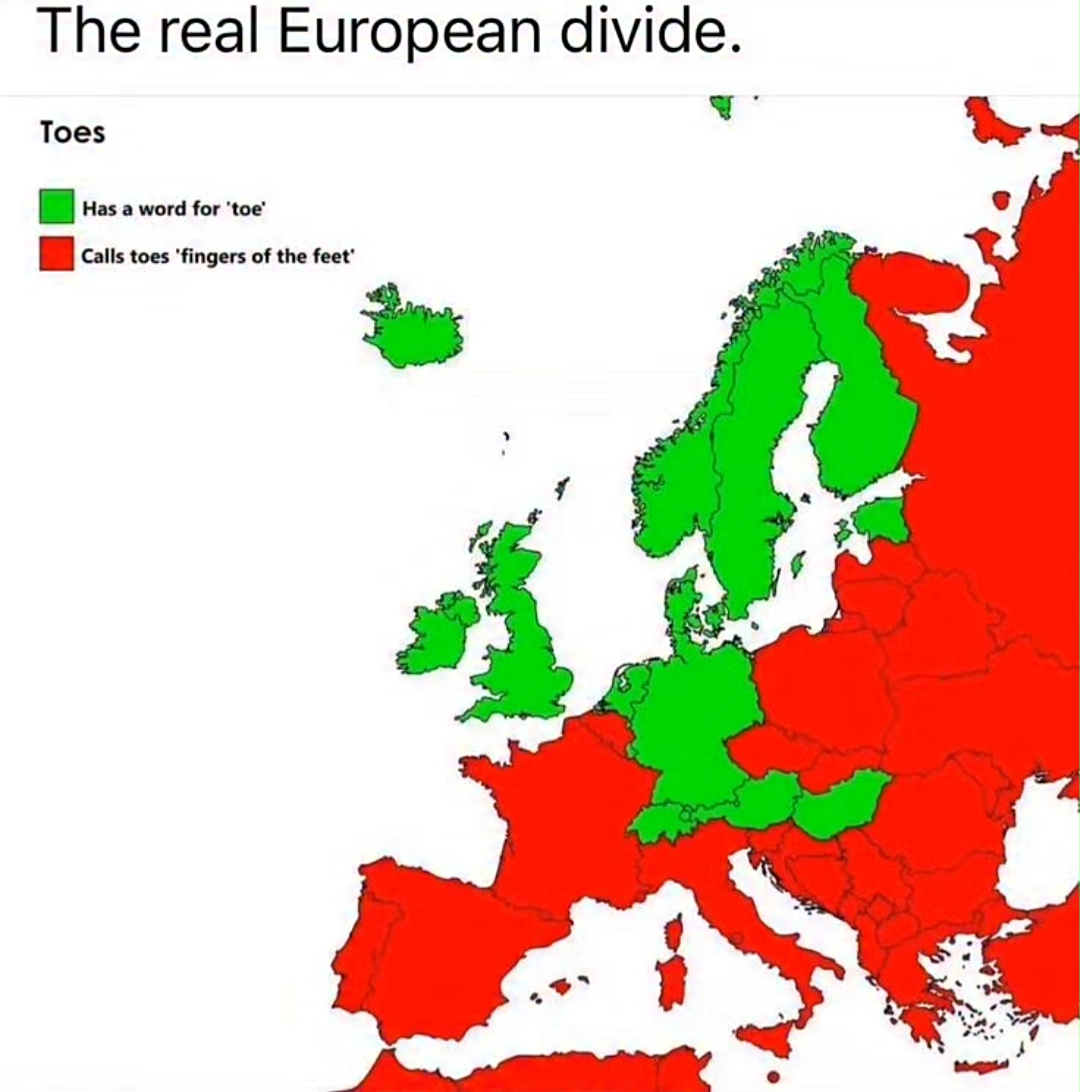
This unites the Germanic and Uralic languages in by far the most important cultural way.
deleted by creator
in French, les orteils but also plenty of slang: les nougats, les arpions, les radis, les haricots…
Well we definitely have both, we do also say “doigts de pied”.
We have a word for toe, and we don’t use it very much.
I don’t know much about it, but I suspect this is not far off from being just a map of the 'Germanic" language family.
Not quite. Green countries are germanic or uralic (finnish, estonian, hungarian). I assume each country is only represented by a single language on the map, and Ireland is probably assumed to be speaking English according to this map.
In certain Austroasiatic languages, your wrists and ankles are your hand-necks and foot-necks.
In hungarian we have a similar thing but for your foot and hand, its leg-head and arm-head respectively.
I have a theory: If you need 3 or 4 words in some language to specify “Fingers of the feet”, they will make their own word for it, because it is troublesome to say. In Polish it’s just “palce u nóg” (which means something like fingers (toes ofc) next to legs, which don’t make much sense, but we don’t think about it).
In that case wouldn’t German have to use something like Fußfinger instead of Zeh?
Yeah, as if we ever had trouble making something one word.
Wait. “Palce u nóg” would translate rather to “fingers at legs” not “next to legs” which has a lot more sense. Still sounds weird but yeah.
So the Flemish part of Belgium has “tenen”, which is not toefinger. The french have “orteils”, which is also not fingers of the foot( finger is doigt ).
So the map is at least wrong for those two countries.
Are you really telling me that cookie clicker was made by a french toe?
You can also use “doigts de pied” in French, so you can be whichever colour you like.
Real funny they coloured it differently, because Flanders literally shares a language with The Netherlands.
To be fair half the world seems to forget Belgium is not all french sometimes, or puts french as the default even though Flanders’ population is almost twice as large as Wallonie. Even adding the population of Brussels and Wallonie, Flanders still has the larger population. (Numbers for stats come from statbel)
Either way if you ignore regional languages you’re not doing linguistics. And the author could not even get it right for national languages, if we even accept that arbitrarily picking one makes any sense.
This map is a masterclass in what not to do and it almost feels like intentional engagement farming.
Now do one for who has a word for “glove” vs “hand shoe”.
German Word for mittens is Fäustlinge, literally fistlings.
Okay but that’s kinda adorable
Byt then you also have Handschuhe (I bet I typed that wrong)
Germany not calling them “feet fingers” was unexpected.
I’m wondering if they got France and Germany mixed up. I don’t remember all the French I was taught growing up, but it didn’t sound right. So I googled it and got “droigts” and “orteils” for “fingers” and “toes”.
German has “Finger” and “Zehen”
Yes, but why do we say “Fußzeh” there aren’t any other “Zehen” on the body, right?
I don’t think I have ever heared anyone say “Fußzeh”. Maybe it’s regional?
Yeah I’ve heard it before and I usually brought up that exact same argument, the fuck kinda other toes do we have lol
But I wouldn’t say it’s common or widespread, at least from my experience
Never heard or said “Fußzeh” before.
Heard it first after moving to the South, it’s absolutely regional.
Like saying dreiviertel Elf for 10:45 or Teppich for Decke or Fuß for the entire leg.
Wait until you go even further south and every receptacle that can hold liquids is “kübel”.
Both “orteils” and “doigts de pied” are used in French, the former sounding less childish than the latter.
The same language where ninety-two is “four twenties and a twelve”?
Just four twenty twelve, that’s enough. We’re not savages.
Ninety two is nine ten two anyway, it’s not that far off. In fact french and Basque at least do have a word for twenty, english doesn’t.
Twenty is rebranded two ten.
Thirty is third ten.
And so on.
The other word for twenty in English is score. Pretty rarely used, however.
It’s fucking far off. I can’t stress how bonkers your number naming is. I speak two romance languages and two Germanic ones, and I’ll not try French because this and many other bullshittery.
French took it’s number system from Basque, which is at least more consistent since iirc in French 70 is 60+10 while the consistent logic should be 3*20+10.
Anyway, you say that twenty is far from twenty ->twen ten->second ten. 70 in Basque is hirurogeitahamar->hirur hogei ta hamar->hirugarren (third) hogei(twenty) eta(and) hamar(ten). It’s the same logic.
The only reason you say it’s bonkers is because you don’t understand. Different = wrong. Lmao.
Also, don’t fucking say that french is my language, I’m Basque Spaniard.
Also, as the other commenter said, we are speaking English, do you understand how insane of a language it is? It’s a Frankenstein of several languages where words were imported while keeping the pronunciation, so there’s no fucking logic as to how you are to say things.
How do you said “read”? No that’s wrong, I meant the past tense. Oh, it needs context?
How do you say entrepreneur? Why are you saying it in French? Fuck logic.
In Spanish you are able to pronounce correctly any word you read for the first time because the rules it has define strict pronunciation. Same for Basque, the only thing you might do wrong is intonation but most of the time it’s the second syllable. It’s fucking crazy that you both need to learn a word and how it’s pronounced in english, for every word.
Oh, extra edit. If the Basque/French counting system makes the language too hard don’t touch spoken Chinese lmao, intonation changes completely words way more frequently than Papa/papá.
I think you’re allowing this to make you angrier than you should.
You clearly speak English, which I think of as the mongrel child of two or three Germanic languages and a Romance one, and not in a good way, so I also think it’s the most fucked up and inconsistent one of the lot. The only thing it’s got going for it as a language is genderless nouns.
Congratulations. You’ve just discovered how base 10 counting works.
Not really. We are talking about how numbers are called in different languages. Other languages have actual names for twenty that aren’t a combination of digit+ten.
Basque is hogei, ten is hamar, two is bi, there is no phonetic similarity. The way language is created then informs how counting and numbers work.
Spanish has a proper distinct name for 20, but then is like english for 30 and above.
No need to be so passive aggressive while not understanding what I was trying to explain.
Hungary calls them foot fingers, should be red
Nope. In portuguese we do not call the toes “fingers of the feet”. In fact we do not have a word for fingers. Or toes.
What we have instead is a word for those little appendages that one can find at the end of one’s arms or legs. We call them “dedos”. Most of the time we do not feel the need to specify if we are talking about fingers or toes. Context is usually enough to distinguish between the two. But when do have to be specific, we call the fingers “dedos of the hands” and the toes “dedos of the feet”.
Now, that may seem weird to some, but to me what is really surprising is that some languages found it necessary to use two words to describe what is essentially the same fucking shit.
Huh what? Dedos are fingers. And we say “dedos dos pés”.
You said “nope” then wrote a paragraph of text to confirm what you just tried to deny.
what is essentially the same fucking shit.
?
You stubbed your finger?
As someone who only speaks English, the cognitive map made by that language is kind of disgusted to think of toes and fingers interchangably.
Fingers are (or should be) clean, and are allowed to touch many things. I am perfectly comfortable touching many things with my fingers that other people’s fingers have touched.
But toes? Toes are gross. They are not interchangeable with fingers. Unless I’m in the shower cleaning my toes, if my fingers touch my toes I probably need to wash my hands after. And other people’s toes?..
No - toes and fingers are not the same thing. My toes are great, I’m glad to have them for balance while walking or running. But they are not fingers, or vis versa
“Digits” would be the English equivalent of “dedos”, and the words are indeed related.
Now, that may seem weird to some, but to me what is really surprising is that some languages found it necessary to use two words to describe what is essentially the same fucking shit.
Sucking on fingers is an entirely different kink from sucking on toes. So somewhat different I suppose.
to me what is really surprising is that some languages found it necessary to use two words to describe what is essentially the same fucking shit.
I mean, you can start calling all sorts of body parts the same shit, and some of them even have words already. Like we say arms and legs, but we could also say upper and lower limbs. We’ve got knees and elbows and shoulders, but they’re all just joints.
Now I’m wondering what languages have the fewest words that could describe the entire body, as in once you break down the word “body” into any number of parts (without using the word “body”, like upper and lower body), how many other words are needed? I think in English you couldn’t get away with anything less than head, neck, torso, and extremities (although one might argue that the latter refers only to hands and feet so you’d have to put limbs back in as well).
Torso and appendages
Head/neck being an appendage is arguable. But basically because there are better words to describe it, not because it isn’t one.
Axial and appendicular
Sooo… “nubbins”?
(German “Nubsis” comes to mind as well)
It’s the same in spanish
Language maps shouldn’t be country maps, as language boundaries rarely overlap country borders. And it’s also wrong, in Hungarian toe is “lábujj” literally means “footfinger”
By that logic, it should be both green and red, because it looks like “lábujj” is both a word, and like you said it means “footfinger”.
Sociocultural boundaries are almost entirely grounded in language. Nation states are almost entirely grounded in imagination.
Reminds of a great lyric from the song “…Meltdown” by Enter Shikari:
Countries are just lines drawn in the sand with a stick
Where’s the “toes of the hand” section?
Belgium is in wrong color
No trolling of Wallonia please.
wallifornia
dirty south from belgium, wah wah wah
I am the pope of dope!