also, the planet has to have less than a maximum mass, sothat a spaceship can still lift off from that planet. that’s because fuel consumption scales exponentially with planet’s mass, and if the planet’s mass is too big, basically you “hit a wall” in the fuel-over-planet-mass diagram where it simply becomes practically impossible to lift off from that planet ever again. that maximum mass is around 10^26 kg.
it is remarkable that earth is in this narrow mass range. there’s only a handful of objects in the solar system who are in this mass range: earth, mars, venus, the 4 biggest moons of jupyter, and the biggest moon of saturn (i hope i didn’t forget anyone). that’s why i think that these objects are especially interesting for long-term human settlement.


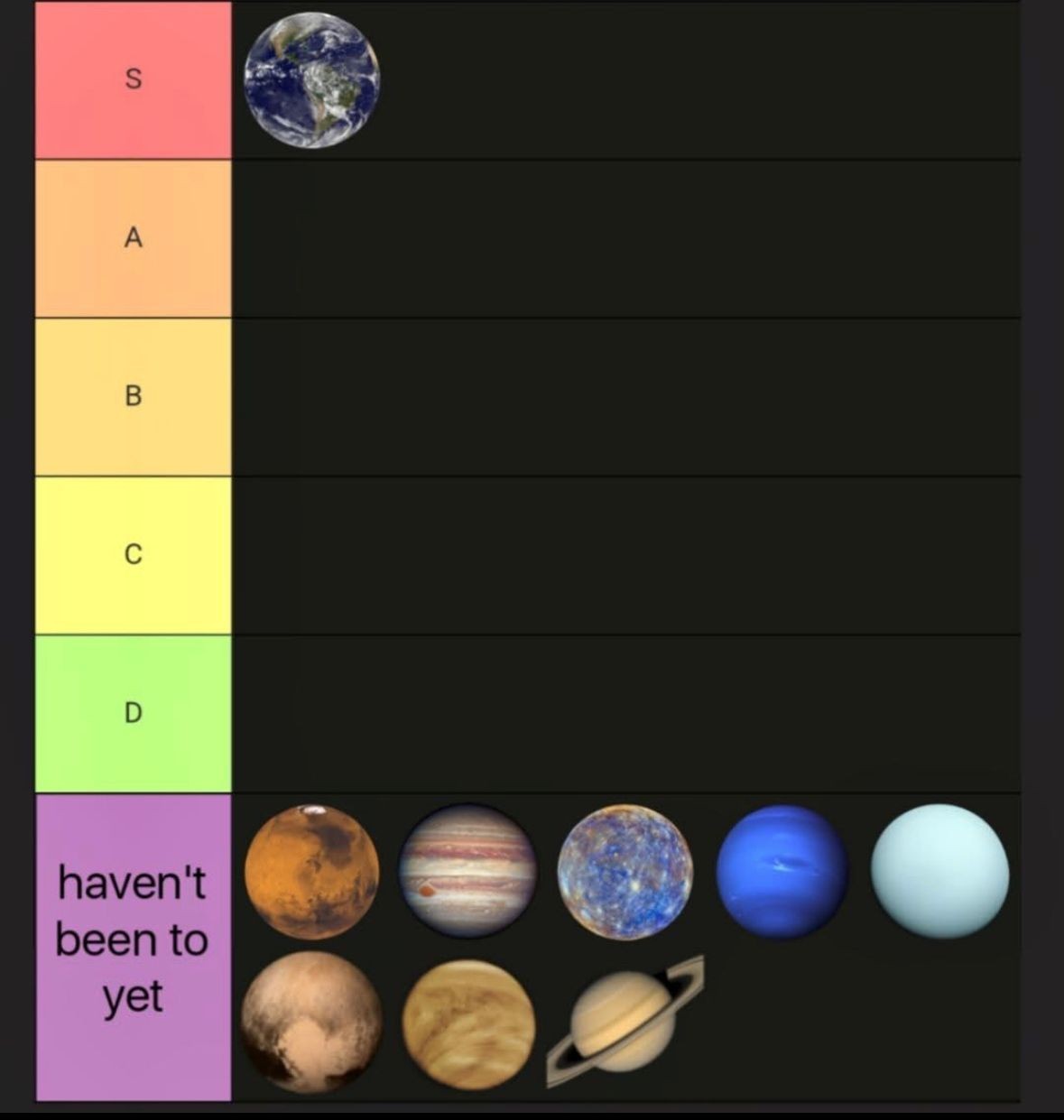
What about all the moons? They’re part of the solar system too!
like, i remember doing the maths a while ago and figuring out the following:
a planet needs to be in a certain mass range (from minimum mass to maximum mass) to be attractive to long-term human setttlement.
it is remarkable that earth is in this narrow mass range. there’s only a handful of objects in the solar system who are in this mass range: earth, mars, venus, the 4 biggest moons of jupyter, and the biggest moon of saturn (i hope i didn’t forget anyone). that’s why i think that these objects are especially interesting for long-term human settlement.
Ganymede and Titan are an easy shoe-in for A tier.