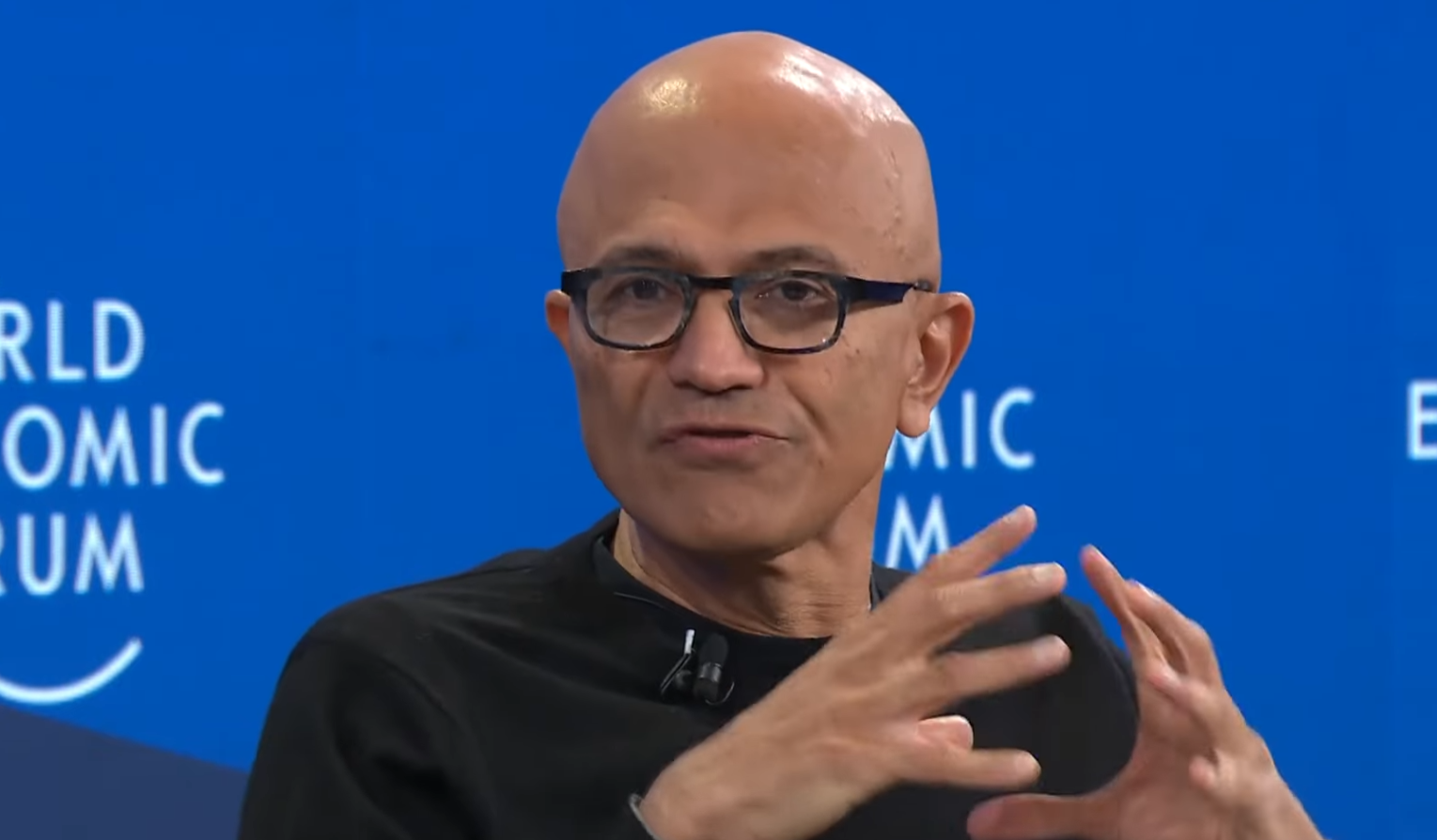
In a conversation at this year’s rich person convention—aka the World Economic Forum—Microsoft CEO Satya Nadella warned that AI will lose public support unless it’s used to “do something useful that changes the outcomes of people and communities and countries and industries.”
He did at least provide one real example of what he means by all this: “When a doctor can … spend more time with the patient, because the AI is doing the transcription and entering the records in the EMR system, entering the right billing code so that the healthcare industry is better served across the payer, the provider, and the patient, ultimately—that’s an outcome that I think all of us can benefit from.”
These people really live in a different reality than the rest of us.
MS never had social permission. They just jumped in on the racist asshole government agenda to destroy science and technology entities that worked to protect us from climate change and asshole companies like MS.
I’m just spitballing here, but maybe you should find out what people want first, and then build that.
The only useful that comes to mind is abolishing it.
They already don’t have “social permission” to do what they’re doing, so what are they worried about losing?
Also, an american tech oligarch speaking to a forum in Europe about billing healthcare insurance companies is fucking hilarious.
Everyone else was probably thinking “Does he realize we’re not all american?”
It’s a forum in Europe but many businessmen there were certainly from the US. It’s the World Economic Forum, after all.
Yes, but not exclusively from the US. It’s the World Economic Forum, after all.
Maybe the other american oligarchs were all “Ta-ta,” but that doesn’t make it any less ignorant to resort to american defaultism before a worldwide forum…
They never had mine.
Starting to get nervous that people aren’t gonna bite, huh?
That they’re still trying to figure out what to do is just further proof that AI is a solution in search of a problem.
I mean, sure, that’s a great use case for AI. How about you actually build a machine that can do that instead of pretending LLMs can do it?
But then they can’t take that machine and claim it’s the precursor to actual Artificial Inteligence
They never had “social permission”.
The Internet calling it MicroSlop is probably getting to him.
From tech bloggers calling them out in adding AI to everything including Notepad, to journalists raising eyebrows to their confusion why other companies aren’t shoving AI into everything, to this:
I was a die hard windows user that recently installed Linux and suffered through the learning curve because windows was getting that frustrating
How are you liking it? Was the transition as hard as you thought?
This is amazing… hundreds of billions poured i to this shitshow whereas if they just dumped hundreds of billions into housing, healthcare, schools, that would have infinitely better outcomes for the public
So, that is impossible. Just stop already.
I do not want AI involved in my patient-doctor communication at all. If transcription software is needed, though I’m not convinced it is, then they can use transcription software, but at the end of the day I think a human being should be the one responsible and making decisions regarding what is and is not officially listed in a medical record. AI is not sufficiently advanced enough for me to trust that it will not make mistakes that could endanger lives.
If we wanted to save time with billing codes, we could just do away with them and have a system that just lets people get the healthcare they need. If a test is ordered, that test should be entered as is by the doctor and not need any additional interpretation or overhead. I don’t do medical billing, but I can’t imagine a reason it needs to be more complicated than that.
Specialized AI double checking radiology may have a use, but I still don’t see it as a replacement as much as a second check.
Specialized AI double checking radiology may have a use, but I still don’t see it as a replacement as much as a second check.
Exactly. An automatic second opinion that flags scans that should be looked at again? Excellent. Something that’s wrong 10% of the time being the sole decision maker? No thank you.
Remember a few years ago when articles about neural networks scanning for cancer found stuff before human doctors did? That’s a form of AI I’m afraid will get defunded too when that hammer comes down on all this “LLM in everything” bullshit.
Even the transcription software that is not purely transcription, but actually an LLM that “takes notes” and “summarizes” can hallucinate and add in stuff that was never mentioned. And then AI trained on biased data (i.e., like all of them) tend to give shittier notes for any patients who are of color.
Oh definitely. That’s exactly why I specified that it needs to be explicitly transcription software. Even speech to text on my phone gets it wrong with enough regularity that I check it every time. I can’t imagine what it would be like if I was using less common words In a medical setting. I don’t love the idea of every word said in a doctor’s office being recorded and that recording being on record forever, but to a certain extent I can understand doctors who might think that would be helpful. What I don’t think would be helpful is having anyone except the doctor or another trained medical professional summarize that information. I do understand that doctors are human and mess up and miss things and might even take worse notes than AI would, but at least it is a Doctor who is doing that. It is a human being who met the other human being and sat in a room with them who is making these decisions.
I expect that doctors agree. Unfortunately, in the U.S. at least, doctors are not in charge of these decisions. Money is. And, money is convinced this will get them more money, so AI is being forced down their throats. Just like everywhere else.
Money is greedy, money is fast, but money isn’t smart. We just remember the shit that worked, and forget all the failures along the way.
Codes need to be complicated. Insurance is taking advantage of that (and adding more complexity), but the complexity is in the system in ways that cannot be removed. The common cholesterol test is a lot cheaper to run than a vitamin D test (20 years ago I found online the price list from a lab, IIRC costs ranged from $0.80 to $15,000 - I can’t find anything current and my memory might be off a bit, but close enough for discussion), so there needs to be a different code for each test just to ensure the right bill is made. Insurance just uses those codes to decide which they will pay for.
I do not want my insurance to pay for homeopathy or other scams. That just raises my rates and ensures a worse outcome for everyone. So the system of different codes for everything is overall good. There are a lot of debate on how much money we should spend on someone who will die “soon”, some would call giving them a quick poison the most humane thing to do - there is plenty of room to disagree on what should or should not be allowed and insurance is just taking a position that not everyone agrees with.
The real problem in my opinion is nobody has a choice about what insurance they have, and so we are all yelling we want something “better” without needing to care about the trade offs.
I understand different things need different codes, otherwise the labs or other doctors don’t know what they need to do, but the fact a doctor can order a test and then a random person with no medical background, or even just a machine, can tell the doctor “no, that’s not needed” is a waste in the system and a waste of people’s, often sick people’s, time. There is no code for homeopathy tests or procedures, so there’s no way for them to be prescribed. A doctor can’t order 10 ccs of water danced on by fairies, so I don’t see that being an issue. My point is that whatever a doctor orders shouldn’t need that much oversight. If at the end of the year the government wants to run a “how many MRIs per patient” check on providers they can still do so, but that doesn’t require every MRI to be justified in the moment. Then you can investigate the practice for potential fraud if they’re not actually doing the MRIs and just charging for them, or if they’re being ordered unnecessarily. Doctors should be trusted to do right by their patients. If the government had a going rate for procedures and there was one place where people can see everything that was billed as part of their care things might not need as much oversight.
I admittedly don’t work in the field, and I’m aware Medicare/medicaid fraud does happen, but considering the waste (on all sides including patients) created by all the overhead I think we’d come out ahead by just trusting doctors and checking end of year stats.
Also, through the ACA people do technically get quite a lot of choice in their healthcare benefits. I don’t think it’s a good system because in my opinion your income shouldn’t dictate your quality of care or coverage, but if you’re looking for more choice in the US and have not looked at the marketplace I recommend doing so. I personally think single payer is better, but definitely look there if you’re looking for HSA or deductible differences.
Insurance… that is the issue.
Insurance itself is a great idea. However the implementation is all wrong.
The government could mandate that all insurance companies use the same codes Medicare does, standardized coding would cut out a lot of actual waste in the healthcare system.
Again, implementation is wrong, not the idea
Since fucking when has the corporate class needed (or even cared about) “permission” to do anything?
Y’all have been raping the environment, eroding our privacy, flaunting regulations and fucking with our elections for basically my entire lifetime.
Wow. No direction just a general plea to “do something useful”.
I still think they’re all competing for the sake of competing. They have all the money and all the credit, what do they care?
Microslop: “Why don’t you do something useful with AI, you idiots?! And when you can, use CoPilot 365 Series XL Pro 11 edition, powered by AI!”
Don’t mistake people not being aware of the cost as consent.