
I first saw “epoch” in Chrono Trigger and I thought it was pronounced like “E-Pock.” Years later, I found out it’s the same as “epic.” So I had probably actually heard it spoken before ever reading it, but thought they were saying “epic” and not “epoch” because, in the context, both words would absolutely work.
…
goddamnit
TIL
Nah, this is wrong. In british english, it’s pronounced EE-pock. American it’s generally pronounced eh-pock. In no way is it ever pronounced ‘epic’.
whew thank fuck, I didn’t catch the dropdown for american vs British when searched it
Mine was queue. I assumed it was pronounced like kway. I thought queue as in a line, was cue, like the stick.
That’s how I thought “quay” was pronounced. Stupid me!
My left eye twitches when niche rhymes with itch.
Why would you pronounce it “eesh”?
English is nothing if not a bastard child of way too many different languages and has inherited and then changed their pronunciation rules. English pronunciation will never make sense.
Or it was the name of a character in a JRPG you played as a child.
JRPGs are like 50% book so I say we still count it.
I’ve always had a bad opinion of people who try to chide little kids who use words like runned instead of ran. I’d always argued the kid successfully extrapolated past tense words end with a hard d sound and haven’t gotten to deeper English classes to learn the special scenarios for words like run or drink.
If you track how kids perform at this, you actually find a bathtub curve. When they are really young and just learning words, they are actually quite good at irregular conjunctions (for the few words they know). Then, as they get older and learn a bunch of other words, they start messing up the irregular ones they used to get right. Then, of course, they eventually learn the exceptions as exceptions.
You are correct; the “correct” way to correct speech issues like this is to repeat their story back to them using the correct wording.
For my 4yo, currently he is saying hims rather than his. Rather than saying in a corrective way “his, is how you say that, not hims”; you repeat the story, “oh, that is his tractor!”.
Mine was “facade”.
Fuck Aid
I said “Sortie” out loud for the first time the other day, and even though it was pronounced correctly I still interrupted my own story to repeat it with a look of disgust, thinking “Surely not!”
What did you think was the correct pronunciation in that moment? Soar tee ay?
Albeit was al-bite
Segue was si-you
That just sounds like German arbeit then
Fuschia is pronounced Fuck-tosia
Hell, it oughta be!
Archipelago
Still don’t know the correct way.
The H is silent, accent the first and third syllables.
In NZ we (mostly) pronounce it arc-ah-pela-go some however are weird and say arc-ee-pelE-go
some however are weird and say arc-ee-pelE-go
We hunt those people down and sacrifice them during the yearly Ritual.
I’ve heard both ark uh pella go and ark i pelli go. Probably just dialect difference.
I’m a fan of Archie pella-go but I’m almost positive that nobody anywhere considers it correct 🤷
I could get behind that.
As a Canadian … no doot aboot it
Elegant
For some reason I said “eglant”
Harsh lesson to learn in a 8th grade class speech.
“Epitome”
Epy tome!
Hubris
Never thought of that one but yeah that would be tough.
I learned epitome is not pronounced ep-e-tome but rather e-pit-toe-me
Me the first time I heard a guitarist pronounce the brand Epiphone as “Epiphany”.
Why word look like ep-e-tome if word no sound like ep-e-tome?
Mine:
- adolescence = “a-doller-sanse”
- awry = “aww-reeee”
- banal = “banal”
Awry is particularly relatable.
Aw-ry, aw-ry, aw-ry.
I just really like banal. It feels right. Freeing
Just don’t forget your blubricant!
Awry was something I pronounced like you did forever until I heard it spoken. Sadly that was in some medieval show, so I wasn’t sure if it was supposed to be an accent or if you actually pronounce it like that :D
I often start talking about a book I’m reading only to realise I have zero idea how to pronouce the names of half of the characters.
My sister recently blew my mind when she straight up pronounced “the Teixcalaanli Empire”, presumably correctly and without any hesitation. I haven’t heard it out loud before then. Hell, I didn’t even know it was possible to pronounce it in the first place.
I listen to a lot of audiobooks, so consequently I can tell you all about my favorite characters and alien races but fucked if I know how the author chose to spell it.
That usually works, but not always. The Wheel of Time audiobooks have two narrators. Michael Kramer reads when the POV is from a male character and Kate Reading reads female POVs. They apparently don’t to each other, because they pronounce many names differently. For instance, is the character Moghedien pronounced MOH-gah-deen or moh-GED-ee-in?
The problem with audiobooks is you can miss a key word or phrase when something is introduced and then go through the whole book wrong.
This is true. I dont try to consume “dense” material via audiobook. Usually LitRpg stuff or more pulpy scifi. I straight up dont have the time to read, but my job involves a lot of driving.
The thing that bugs me about people who hate on audiobooks (Not saying you were) is that yeah, someones reading it to me but I’m still supporting authors. Sadly books are a declining market.
And now I was like - What? Isn’t it supposed to be Tleilax? But yeah, Teixcalaanli Empire, I miss the Memory Called Empire world, I need a third book now!
None of the Dune audio works can agree on how “Tleilaxu” is pronounced. I’ve heard everything from “telly-axe-uh” to “t’lay-lax-you”
We were actually talking about A Memory Called Empire by Arkady Martine. Can’t recommend it enough. It’s narrowly my favourite lesbian science fiction debut novel-turned-series about a galactic empire of 2019.
~Halfway through atm and enjoying it, reminds me a bit of Ancillary Justice. Didn’t know it was a series. What’s your runner up?
Gideon the Ninth. Very different, very fun.
I didn’t like Ancillary Justice that much. I loved some of the themes and how the world works, but narratively it felt like it was always pushing too hard to be dramatic. I think I’ll finish the rest of the series at some point, but it’s not quite for me.
Ah, fair enough. Though I’d probably swap Gideon and Ancillary.
Ancilliary is not 2019 though, and I don’t know if it’s lesbian enough. The rest of it fits though, I have to admit.
I LOVED Ancillary Justice, but all the set up just falls kinda flat in the next books. Or at least, the rest is just… Not really in the same vibe? It’s hard to explain…
I still really liked the follow up two, but definitely a different vibe
I read the trilogy recently and agree. She very much embraced the “shared universe, but different stories” author arc, instead of falling into the tropey “everything in this universe revolves around these 6 charectors you love forever” style that is way more common.
How can you read like that?! I have to make up a pronunciation in my head or I can’t go on.
I sort of do. It’s half mangled version of the name, half an abstract identifier of the character, and there’s a bit of “shape” of the name as a whole too, I suppose. But when I want to say the name aloud, I realise it’s pretty far from what the actual name sounds like.
English is just mispronounced French
Interesting history provided by Rob Words - https://youtu.be/TUL29y0vJ8Q
Poppycock. It’s mispronounced German and Latin and Greek and French and… well… English, all with a delightful seasoning of mispronounced Dutch and Spanish.
Poppycock.
From the Germanic “Puppenschafft” /s
“The History of English Podcast” is really fun and gets into the weeds of why English is such a mess.
Not be be confused with “The History of England Podcast”, which is also really good.
I love that podcast, and particularly when I’m driving, because while Kevin tends to repeat himself and speak slowly, it’s generally pedagogically sound, somehow in the service of his point and ensuring I don’t miss much if I get distracted. He’s also an attorney (probate, IIRC), so when he occasionally drifts into legal stuff, it’s doubly insightful.
Or indeed “The History of English Podcasts” which tragically doesn’t seem to exist.
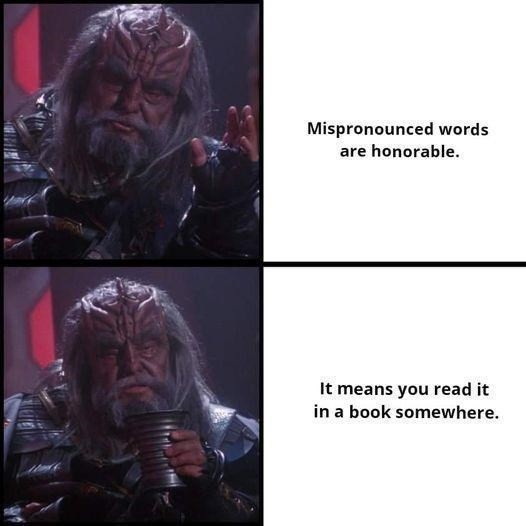
Well, not necessarily a book nowadays. But this was a long time ago in a galaxy far, far away.
Ah. The Minellium falcon.
Solo and Greedo at the table
Solo, his arms wide
Hisss!
This joke doesn’t work for a normal language like spanish that has regular orthography, only languages like english or french that have broken spelling.
Klingonese is read the way it’s spoken so it also wouldn’t suffer from this problem.
Spanish is one of the best languages for having the spelling match the pronunciation, but it’s not perfect. First of all, you can’t spell something just based on hearing it because a /k/ sound can be a ‘c’ or a ‘k’, and a /s/ can be an ‘s’ or a ‘c’. It also has silent letters like ‘h’. Going the other way, seeing the spelling of Mexico, Xalapa, Oaxaca, etc. would lead someone who didn’t know to try to pronounce them with a /ks/ sound, but they’re really pronounced as if they were spelled Mejico, Jalapa and Oajaca. Then, there are loan words like “psicologia” where the “p” is retained from the original language, but not pronounced in Spanish.
First of all, you can’t spell something just based on hearing it because a /k/ sound can be a ‘c’ or a ‘k’, and a /s/ can be an ‘s’ or a ‘c’.
Yes you can. K isn’t often used in spanish except for loan words. C and S aren’t interchangeable in spelling they just sound the same when pronounced in certain phonemes. There are very specific rules about which letter is used in each phoneme. If you know spanish then you’d know this since they are some of the first lessons you learn about spelling.
Every other example you gave was a loan word.
they just sound the same when pronounced
Proving my point that you can’t tell which one to use based on sound alone.
There are very specific rules about which letter is used in each phoneme
Yes, English has rules about which letter to use in which situation too.
Oh, and I forgot the biggest one for Spanish: the /k/ sound can be “qu” or “c”.
Tell me you don’t speak spanish without saying it.
Tell me how confidently wrong you can be without saying it.
a normal language like spanish that has regular orthography
que necesitas para entender que esto es algo falso? Un Casco?
Every letter in spanish is always pronounced with regular rules. You don’t have to guess. Things like “pingüino” and the u having the diaresis makes it obvious that you have to pronounce the u in the word vs “quitar” where you don’t pronounce the u.
Just because you can pronounce s and c the same and c and k the same doesn’t make it bad orthography.
Just because you can pronounce s and c the same and c and k the same doesn’t make it bad orthography.
yes it does
Source : Turkish speaker.
EDIT : It’s not just s c and k, q also gets involved. LL and Y and some variations having J and G enter into it, the constant H letters that don’t get pronounced, etc etc.
No romance language can say anything about being “regular” from an orthographic sense.
Redundant can still be regular. It may not be easy to write, but it’s easy to pronounce.
No it really doesn’t. The joke is about not knowing how to pronounce a word when you read it. That isn’t a problem in spanish because the rules are exact on how the words are pronounced. You can read any word in spanish no matter how complicated or new and as long as you know the spanish pronunciation rules and it isn’t a foreign word you will know how to pronounce it. Foreign words, like foreign words in most languages, don’t usually follow spanish orthography so those are a crap shoot.
Edit:
It’s not just s c and k, q also gets involved. LL and Y and some variations having J and G enter into it, the constant H letters that don’t get pronounced, etc etc.
All those things are completely regular. They vary in pronunciation by dialect but every person with the same dialect will pronounce the word the same when they read it.
That isn’t a problem in spanish because the rules are exact on how the words are pronounced.
and is there any data loss that happens when pronounced words are written using these rules?
Why would there be? If you know how to read then you know how to write because again, spanish is completely regular in that aspect.
so you never have had to double check how to spell something in english or in spanish?
Eh, French isn’t that bad, although there is some general fuckery.
If you didn’t know how to pronounce something in English before the internet, you were basically shit out of luck.
A1 is coming for our jobs. It’s an evil cable of people.
Audiobooks do the reverse.
“Wait, that’s how you spell that??”
I guess it’s usually with names, though.
*pronounce rather than spell, but yeah.
Particularly, many stresses turned out to be not where I imagined them.
No, I think they had it the way they meant to.
They hear the name while listening to audiobooks and then see the name written later.
I still don’t know the actual pronunciation of macabre.
Macaw-bruh
Macabre moment
deleted by creator
There are three accepted ways of saying it:
Ma-cah-bruh
Ma-cahb
Ma-cahb-err
Well if you can read IPA, it’s something like /məˈkɑːbrə/
Although I’d argue the ə can be silent.
M’cabr 🤠

An oldy but a goody
It’s a word like “cuisine” that doesn’t just come from French, it’s literally a French word and properly still pronounced the French way, so silent “r” and silent “e” on the end.
Yeah I’d agree with that, but unfortunately most people aren’t linguistic purists, so absolute prescription doesn’t really work.
It does if we refuse to give up.
You can try, but even if you have a majority of people using the correct version, still the other one can proliferate.
Kinda how people still say “could of” instead of “could have” even when there’s always someone noting the mistake.
Unfortunately languages go where they want. ¯\_(ツ)_/¯
That’s when we deploy vicious mockery and downvotes. Languages may try to go where they want, but that doesn’t mean that I can’t yank on the steering wheel.
Or read it in a shitpost somewhere
I’m not sure. This seems to imply there are no memes in the 33rd century.
K-Pop!
puh·ta·see·uhm sow·duh. Nailed it!
adaguy!